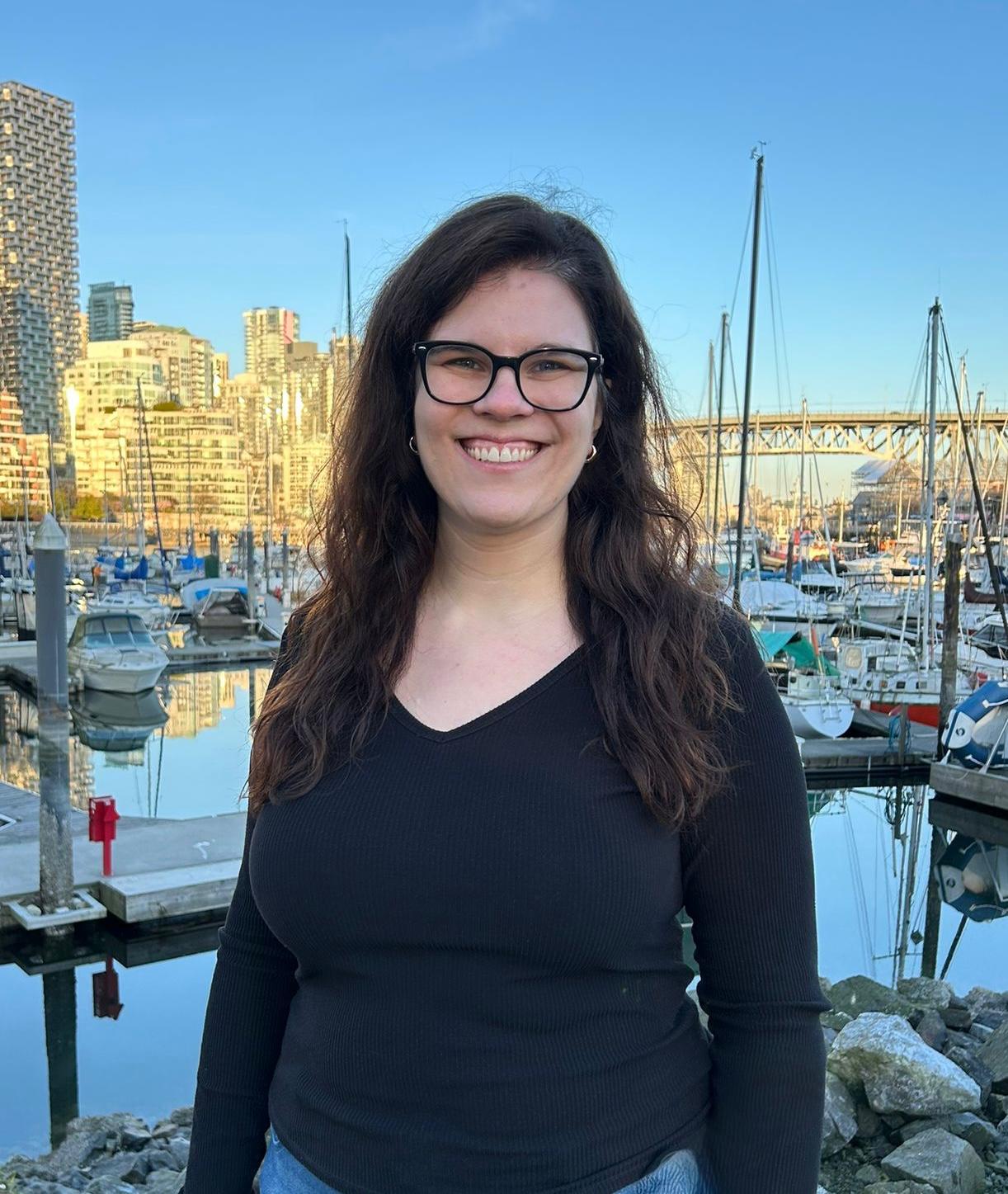
Congratulations to Dr. Melissa Stadt, recipient of the 2026 Cecil Graham Doctoral Dissertation Award. The annual award is given by the Canadian Applied and Industrial Mathematics Society (CAIMS) to an outstanding PhD thesis in applied mathematics at a Canadian university. Stadt graduated last year with her PhD in Applied Mathematics; she now works as a research scientist at AbCellera in Vancouver, British Columbia.
“This is a huge honour,” Stadt says. “For my work to be recognized at a high level – it’s super exciting.”
Stadt’s dissertation, “Mathematical Modelling of Whole-Body Electrolyte Homeostasis,” builds on work she began during her MMath at Waterloo. Both her master’s and PhD were supervised by Dr. Anita Layton, professor of Applied Mathematics.
“Melissa is a rare combination of brilliance, creativity, and independence,” Layton says. “She approaches complex problems with deep insight and remarkable drive, and her productivity as a doctoral student was truly outstanding. I feel fortunate to have worked with her, and I could not be more pleased to see her recognized with this award.”
The dissertation is based on a series of papers that Stadt co-authored with Layton. The first portion of the project establishes a whole-body potassium regulation model with a detailed kidney component. “The novelty of that model,” Stadt explains, “is that we included detailed hormone regulation and a detailed kidney.” During Stadt’s PhD, new research emerged providing surprising insight into how the kidneys regulate potassium, and she adjusted her model accordingly. “That’s something I like about mathematical modelling,” she says. “You can do so many experiments and test hypotheses with your models relatively quickly.”
The second portion of Stadt’s thesis focuses on calcium homeostasis, particularly differences in the body’s calcium regulation during pregnancy and lactation. “It’s interesting,” she says, “we don’t know why this is, but during pregnancy the kidney and gut adjust to supply excess calcium, and during lactation it’s mostly supplied by the bones.”
Now that Stadt has graduated, she uses the skills she learned at Waterloo to do modelling and simulation work with a focus on drug development. “The underlying math is the same, and a lot of the principles are highly translatable. The communication skills that I learned from Anita and the rest of my committee helps me to collaborate across teams and is an essential skill for any scientist.”
In addition to Layton, Stadt is particularly grateful to the professors in the applied mathematics department and especially other members of her committee: Dr. Sue Ann Campbell and Dr. Brian Ingalls. “They showed me how to be a good scientist, and they all taught me how to communicate science well, which is a vital part of the dissertation process.”