“In every stage of the life of the building – planning, construction, and occupation – there are optimization problems to solve,” says Dr. Levent Tunçel, professor in the Department of Combinatorics & Optimization. “That’s true of every major building project, and it’s true of M4.”
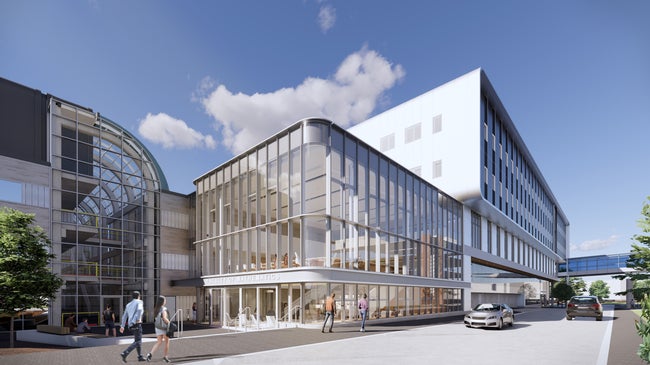
Mathematics 4 (M4), the cutting-edge research and teaching facility currently being built on the University of Waterloo’s campus, was designed by Moriyama Teshima Architects and is being built by Gillam construction. Though the building’s designers aren’t math professors, they are constantly thinking about optimization – making the best decisions with limited resources to achieve their goals.
“Before you even start building, there are problem areas called critical path methods, which are research areas involving optimization,” Tunçel says. “You create a graph that tells you which tasks must come before other tasks, how long they’ll take, and what kind of resources they’ll require. For example, you can’t build the second floor before you build the foundation – that’s obvious! – but you also have to consider more complicated questions around water pipes, sewage, electricity, and so on. Based on those conditions you can lay out the whole project problem, and figure out how to optimize it.”
During construction, he explains, optimization also appears at every level: individual components for a building such as beams and wires have already been optimized by engineers and manufacturers for effectiveness, cost, and other factors. Crews must be scheduled to most efficiently use their time and skills. And changes or delays lead to constant recalculations, or re-optimization.
“To make things more complicated, in a project like M4, you’re never just optimizing for one thing, such as cost or speed,” Tunçel says. “You have many values, which are often in conflict with each other, and decision makers have to decide how to prioritize them. That’s called multi criteria, or multi objective optimization.”
Optimization in Practice
“The overall strategic plan of the university and its ongoing initiatives lay the framework of how we plan and design our projects,” says Tyler MacIntyre, the M4 project manager at Waterloo. “UWaterloo pursues design excellence with better-than-code minimum requirements for enhanced accessibility, sustainability, mental health and wellness, and Indigenous-inspired design.”
When designing M4, architects were particularly concerned with the building’s environmental impact, both during construction and during the building’s life cycle. “Waterloo’s Net Neutral Building Design Guideline sets the framework for decision-making to ensure that major additions and renovations meet the highest standards of energy efficiency and carbon emission reduction goals, while optimizing the life cycle cost and management of infrastructure,” MacIntyre explains. The building’s designers chose strategic features like natural ventilation, a “green” server room, and rooftop solar panels that would be good for the environment as well as financially responsible.
In another innovative decision, M4 will integrate the William G. Davis Computer Research Centre’s office wing into the new building. “By reusing that wing,” he says, “we saved nearly 1,000 tons of CO2 (embodied carbon), offsetting nearly twelve years of operational carbon.”
At the same time, the building’s designers also looked at how M4 could help increase student happiness and well-being, make research more efficient, and integrate important values like Indigenization, all while reducing interruptions to campus life during construction.
“The building demonstrates a holistic approach to optimization,” MacIntyre says. “Not only in the mathematical sense, but also as a commitment to efficiency, sustainability, resilience, and the best possible use of spatial, material, and environmental resources throughout both the design process and the final built form.”
Earth Movers
Practical optimization in building predates mathematical optimization by thousands of years. “Mathematical optimization is just creating mathematical models to understanding that decision making, using mathematics and computation to solve it, and then translating it back into recommendations,” Tunçel says.
In fact, one of the earliest examples of formal mathematical optimization is a construction problem: the “earth mover’s problem.” Eighteenth century mathematician Gaspard Monge imagined a situation in which piles of dirt needed for a construction problem were scattered across various sources, and needed to be transported to a construction site. “This gives rise to an optimization problem for the construction manager,” explains Dr. Stephen Vavasis, professor in the Department of Combinatorics & Optimization. “Find a schedule for wagons that specifies the source, destination, and cargo amounts for each trip, minimizing the total cost of transportation.”
Monge’s solution to the problem was considered so clever that the French government classified it as a military secret for decades. In the 20th century the problem was rediscovered independently by Soviet mathematician Leonid Kantorovich, and was also classified by the government. Today, however, the earth mover’s problem – also called the “optimal transport problem” – has led to multiple mathematical discoveries and serves as a central tool for modern machine learning.
Learn more about Mathematics 4 on the M4 website.