Congratulations to Pulkit Sinha, Ruikun Zhou, and Xiao Zhong, who have all received Graduate Research Excellence Awards. The awards, which are funded through alumni and community support, recognize and celebrate excellent research by emerging scholars in the Faculty of Mathematics.
Pulkit Sinha ($5000)
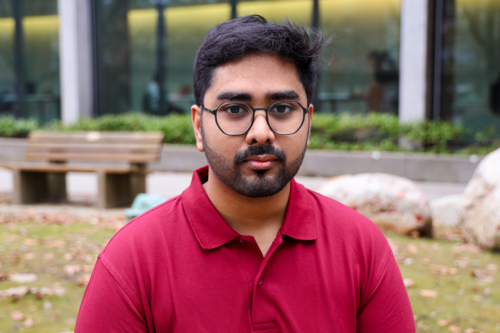
Pulkit Sinha is a PhD student in computer science, specializing in quantum information. “Receiving the Graduate Research Excellence Award is an incredible honour,” he says. “Having my work recognized in this way really boosts my confidence in the broader impact of my thesis.”
The award recognizes Sinha’s research paper, “Dimension Independent and Computationally Efficient Shadow Tomography.” The work introduces a novel learning algorithm for shadow tomography, the problem of estimating the expected values of quantum observables using independent and identically distributed (I.I.D.) copies of an unknown quantum state.
“A defining feature of the new algorithm is that the required number of I.I.D. copies does not scale with the dimension of the quantum system, yielding a quadratic improvement over the trivial approach,” he says. “Furthermore, the algorithm guarantees both quantum and classical computational efficiency, provided the targeted observables are themselves efficiently measurable.”
Sinha is grateful to his advisor, Dr. Ashwin Nayak, for his guidance. “He was the first to see the potential in this result and pushed me to develop it,” he says.
Ruikun Zhou ($2500)
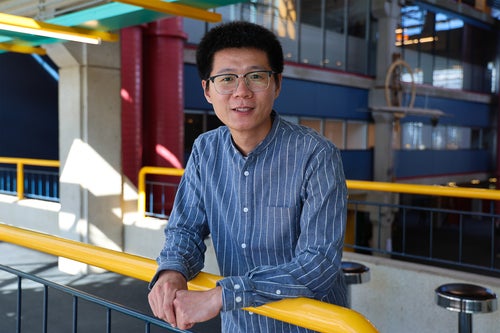
Dr. Ruikun Zhou graduated with his PhD in applied mathematics in 2025, and will begin a postdoc in the Department of Aeronautics and Astronautics at the Massachusetts Institute of Technology next month. “I am thrilled and deeply honoured to receive this reward for my research,” he says. “It is a wonderful recognition of the hard work that went into this project and a great encouragement as I move forward in my academic career.”
Zhou’s awarded research uses classical mathematical methods to gain insight into the “black box” of AI deep learning. The project presents an operator-theoretic learning-based method inspired by traditional operator theory for identifying unknown dynamical systems with high precision and data efficiency, alongside explainability and reliable traceability, which are vital for safety-critical systems such as autonomous vehicles and robots.
“In the real world, we often only collect data in discrete-time snapshots, even though these systems are operating continuously,” he explains. “We used a mathematical concept called an ‘infinitesimal generator of operators’ to bridge this gap for modelling. By leveraging the generator, we showed that the time derivative of the states can be accurately approximated using the integrals of the discrete-time observations through a resolve-type Koopman-operator approach.” This allowed the researchers to learn the continuous behaviour of a system while simultaneously proving its stability mathematically via Lyapunov functions, even when data was sampled at relatively low observation frequency.
Zhou is grateful to his supervisor, Dr. Jun Liu, and his coworker Yiming Meng, for their help, guidance and encouragement. “Because of them, I learned how to do research and, just as importantly, how to keep my passion for it,” he says. “Without them, this award and my PhD would not have been possible. I am also genuinely grateful for the Applied Math department’s supportive and friendly environment throughout my PhD.”
Xiao Zhong ($2500)
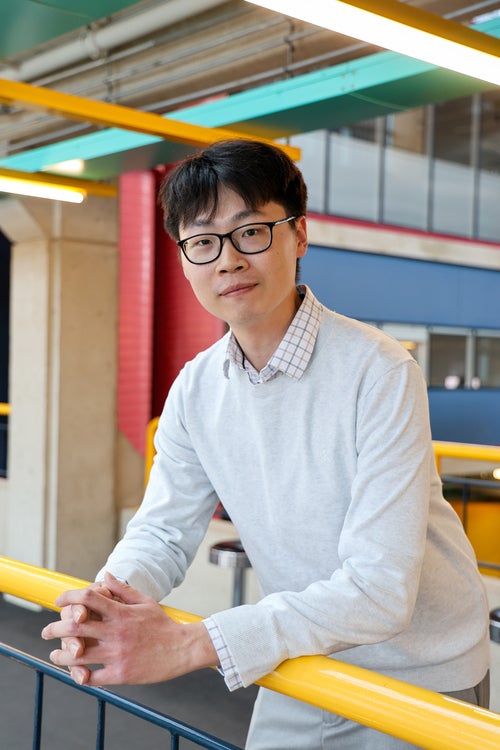
Xiao Zhong is a PhD candidate in the Department of Pure Mathematics. “I am very glad and honoured that our work has received this recognition,” he says. “It is a strong affirmation at this early stage of my academic career.”
The award recognizes the first in a series of three research papers that “completely resolves a dynamical analogue of a classical number theory question about greatest common divisors.” Zhong explains that in recent decades mathematicians have reinterpreted traditional number-theoretic problems within a broader framework that studies what happens when a mathematical process is repeatedly applied: a perspective known as arithmetic dynamics.
Their studied problem reinterprets a well-known question in number theory asking for an upper bound on the size of the greatest common divisor of two integer sequences. The paper series introduces a new approach that resolves the problem and “reveals a surprising connection to one of the central conjectures in the field, the Dynamical Mordell-Lang Conjecture.”
Zhong is grateful to his supervisor, Dr. Jason Bell, for “his continuous guidance and support throughout my PhD journey.” He also thanks his collaborators, Dr. Chatchai Noytaptim and She Yang, as well as the Pure Math department.