PhD Candidate, Combinatorics and Optimization
Math, Mentorship & Meaning
Meet Cicely “Cece” Henderson, a fourth-year PhD student in Combinatorics & Optimization whose love of graph theory, teaching, mentorship and science communication has shaped her graduate experience at Waterloo.
Cece’s path to graduate school began with two passions: teaching and mathematics. As an undergraduate calculus tutor at Wellesley College, she discovered how much she enjoyed finding the explanation that could make a difficult concept “click” for each student. Then, during a study-abroad program with Budapest Semesters in Mathematics, she took a graph theory course that challenged her in a completely different way.
“It was the hardest class I had ever taken,” Cece recalls. Rather than being discouraged by the difficulty, she found herself motivated to work harder and solve the problems. A summer research project at Grand Valley State University further cemented her love of graph theory and showed her that academia could bring together both teaching and research.
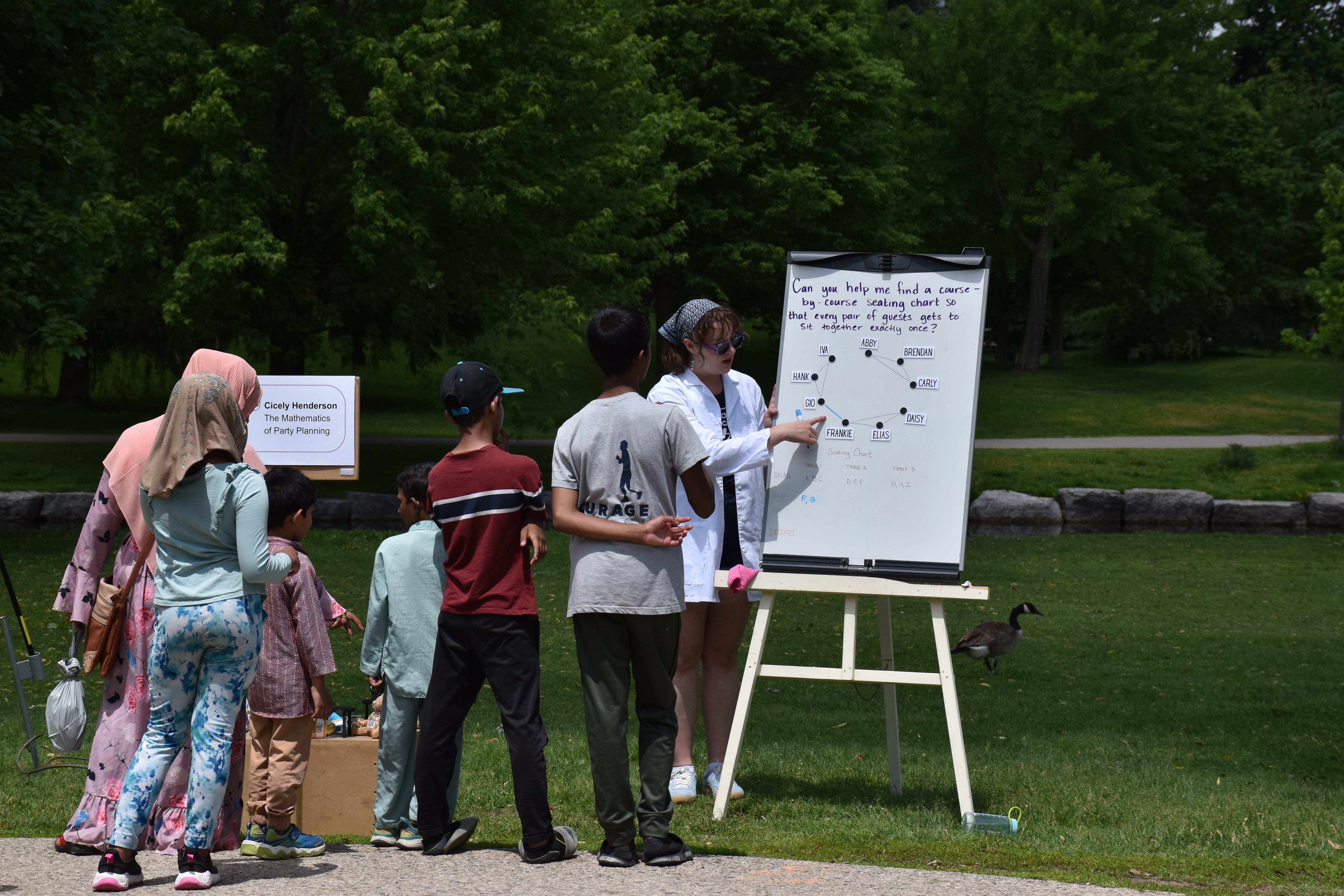
Today, Cece’s research focuses primarily on design theory, a field closely related to graph theory. Her work explores abstract questions about how mathematical structures can be arranged and connected. One way to picture the kinds of problems she studies is to imagine a teacher trying to schedule weekly homework groups so that every pair of students works together exactly once.
“I like that the questions I’m thinking about are grounded enough in the real world that I can still explain the broad strokes of what I’m doing to my (non-mathy) parents.”
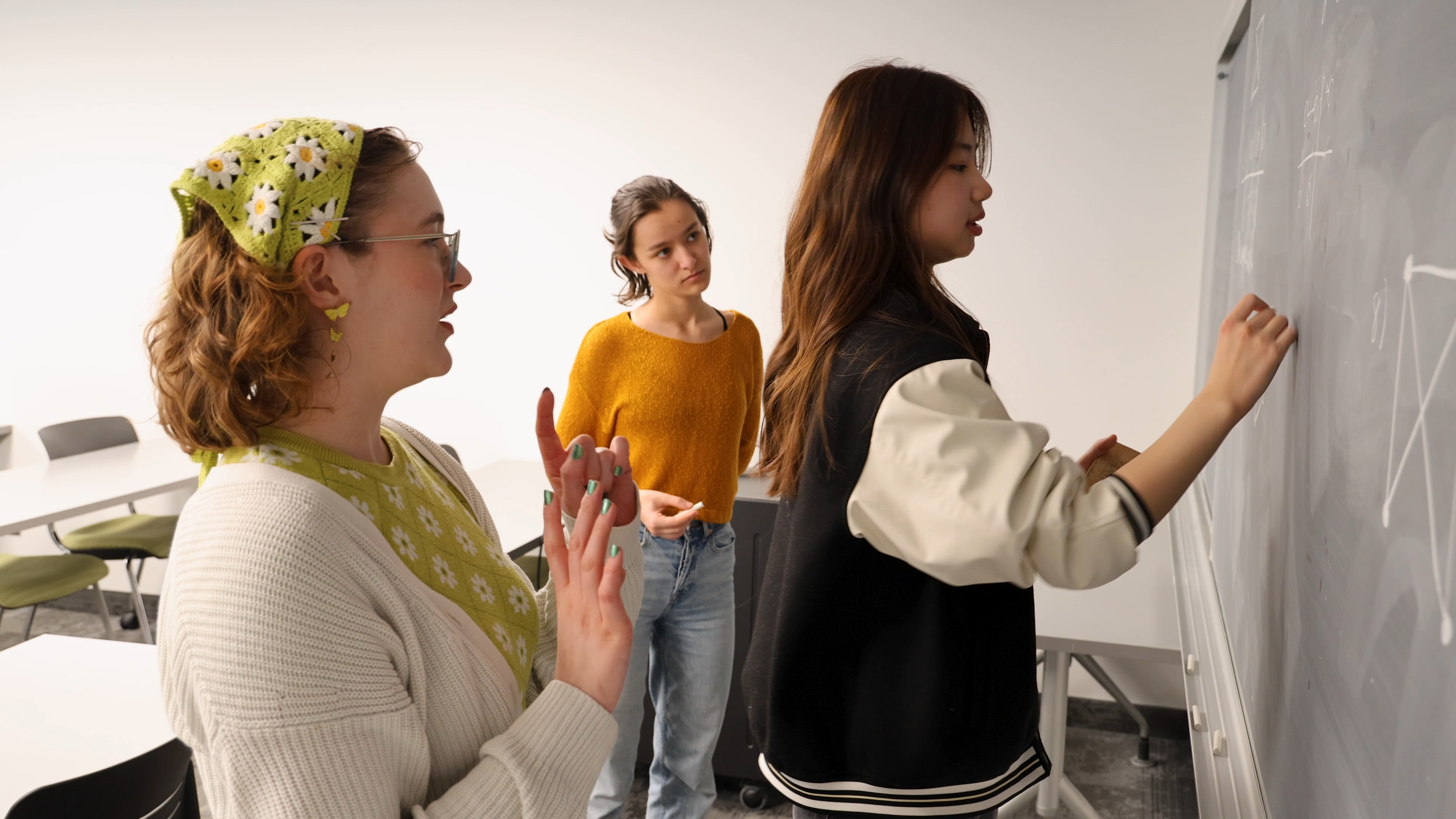
For Cece, the people around her are just as important as the mathematics. She describes the Waterloo Math community as incredibly supportive, remembering how students rallied around those preparing for comprehensive exams during her first year. Friends studying alongside her, older students sharing notes, and others offering help with research topics all helped make a challenging period feel more manageable.That spirit of community has also shaped Cece’s involvement with Women in Mathematics (WiM).
Through WiM’s Directed Reading Program, she has mentored groups of talented undergraduate students who identify as an underrepresented gender in mathematics. The experience has strengthened her confidence as a teacher and reinforced her desire to become a professor.
“Their great questions, dedication to the project, and creative ideas remind me why I want to be a professor one day.”
As a WiM TA, Cece also helps organize events and is currently part of the organizing team for the upcoming Navigating Your Careers Conference, taking place at Waterloo this November. The conference aims to help students explore opportunities in both academia and industry while highlighting the accomplishments of women in STEM through its speakers.
Her own journey has also shaped her desire to encourage others to pursue mathematics. When she started university, Cece enjoyed mathematics but believed she was not “smart enough” to study it seriously. Mentors helped change that perspective by showing her what she was capable of and encouraging her to pursue graduate studies.
Now, she hopes to offer that same encouragement to others, particularly students who are underrepresented in STEM.
“I am so grateful for the mentors who taught me that ‘smart enough’ is a subjective threshold.”
Cece’s interest in supporting others extends beyond mentorship. As she has developed as a researcher, she has also become passionate about communicating mathematics to broader audiences. She has written explanatory articles for publications including Math Horizons and MAA Focus and participated in outreach programs such as Soapbox Science and Ask a Mathematician.She also attended ComSciConCAN in 2025, a science communication workshop for STEM graduate students in Canada. This year, she helped bring the 2026 workshop together as a member of the organizing committee, making the experience a particularly meaningful full-circle moment.
And there’s another side to Cece that might surprise her fellow mathematicians: she attended an arts-based high school, where she auditioned into the theatre department. Her afternoons were spent in three hours of drama classes, an experience that helped her overcome her public-speaking nerves and continues to influence her appreciation for reading, writing and dancing. Although acting ultimately wasn’t the career for her, the combination of mathematics, teaching and communication seems to have found its own stage. Looking ahead, Cece hopes to build a career in academia that combines research with teaching and mentorship, while continuing to explore how science communication can be part of her work.
From graph theory and design theory to mentorship, outreach and science communication, Cece is building a career that reflects her belief that mathematics is not only about solving difficult problems, but also about helping others discover that they are capable of tackling them.