A team of computer scientists at the University of Waterloo has developed a new method to create more “natural” virtual assistants to help people living with a mental illness.
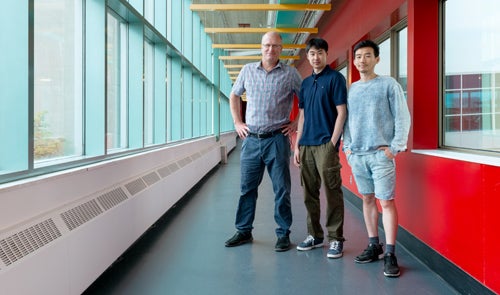
From left to right: Jesse Hoey, Steven Feng, Aaron Li
The new method, called SMERTI (pronounced “smarty”), enables virtual assistants to use natural language and emotional cues that change depending on the context they are used in. This allows virtual assistants to better connect with the people that they are helping.
“Certain personalities or emotions within a virtual assistant appeal more to certain individuals,” said Steven Feng, an undergraduate student in Waterloo’s David R. Cheriton School of Computer Science.
SMERTI consists of several artificial intelligence software tools working together, including similarity masking (SM), entity replacement (ER) and text infilling (TI). SMERTI’s job is to take a text response from a virtual assistant and adjust it to fit different situations.
For example, it would take the advice of “It is sunny outside; I know you hate to, but you must wear sunscreen” to “It is rainy outside; I know you hate to, but you must bring an umbrella.”
To evaluate SMERTI, the team presented eight researchers with original pieces of text that were written by humans, along with various modifications from multiple tools, including SMERTI. The researchers were then asked to review the sentences and rate them on a scale of one to five based on fluency, sentiment preservation, and content exchange (how well the new text substitutes the text replaced).
“Based on the respondents’ ratings of the various systems it was found that SMERTI outperformed all the baseline models especially in terms of fluency and overall replacement of the text to fit the new semantics,” said Jesse Hoey, an associate professor in the Waterloo’s Cheriton School of Computer Science.
Hoey pointed out that fluency and content exchange were both successful when it came to preserving emotion, and that preserving personality would be the next step in the research. The researchers are now working on a system that will allow virtual assistants to generate and retain a consistent personality, something that is considered key for mental health support.
The study, titled “Keep Calm and Switch On! Preserving Sentiment and Fluency in Semantic Text Exchange”, was authored by Waterloo’s Faculty of Mathematics researchers Feng and Hoey, and research assistant Aaron Li.