
Natural Sciences and Engineering Research Council of Canada (NSERC) Alliance Society awarded a $5 million grant to WxAlliance, a Concordia-led initiative that brings together universities, government partners such as Environment and Climate Change Canada (ECCC) and societal partners to improve weather forecasting in Canada. Dr. Francis Poulin, Professor of Applied Mathematics, leads the project from the University of Waterloo, one of the partners in this nationwide project.
Classical weather forecasting systems are based on complex mathematics equations that study the interactions between current atmospheric conditions to predict the weather. However, these systems produce approximate results due to which smaller events such as thunderstorms are not always predicted accurately.
Modern approaches use machine learning to predict the weather based on historical data. In remote areas adjoining the Arctic Ocean like Northern Canada, these models may not have enough localised data to predict the weather correctly.
Both approaches have benefits and drawbacks. The NSERC Alliance Society grant will fund research that combines mathematical modeling and modern computing power to conceptualize a new model that can bring together the strengths of both these models to forecast weather more accurately.
“At Waterloo, we bring expertise in mathematical modelling and are interested in developing these methods to better understand the atmosphere and ocean,” says Poulin.
Poulin’s research focuses on physical and biological oceanography. He is actively investigating the dynamics of the Arctic Ocean and will further develop this research through this grant. The Beaufort Gyre, a massive whirlpool north of Alaska and Canada, stores the Arctic’s largest supply of fresh water. Its behaviour influences sea ice and heat movement across the region.
The image below shows two computer simulations of a simplified version of this gyre. Both begin as smooth, steadily turning whirlpools, but over time become unstable, forming smaller whirlpools called eddies and stretching into long, thin filaments. The colours show the direction of spin: red for one direction, blue for the other.
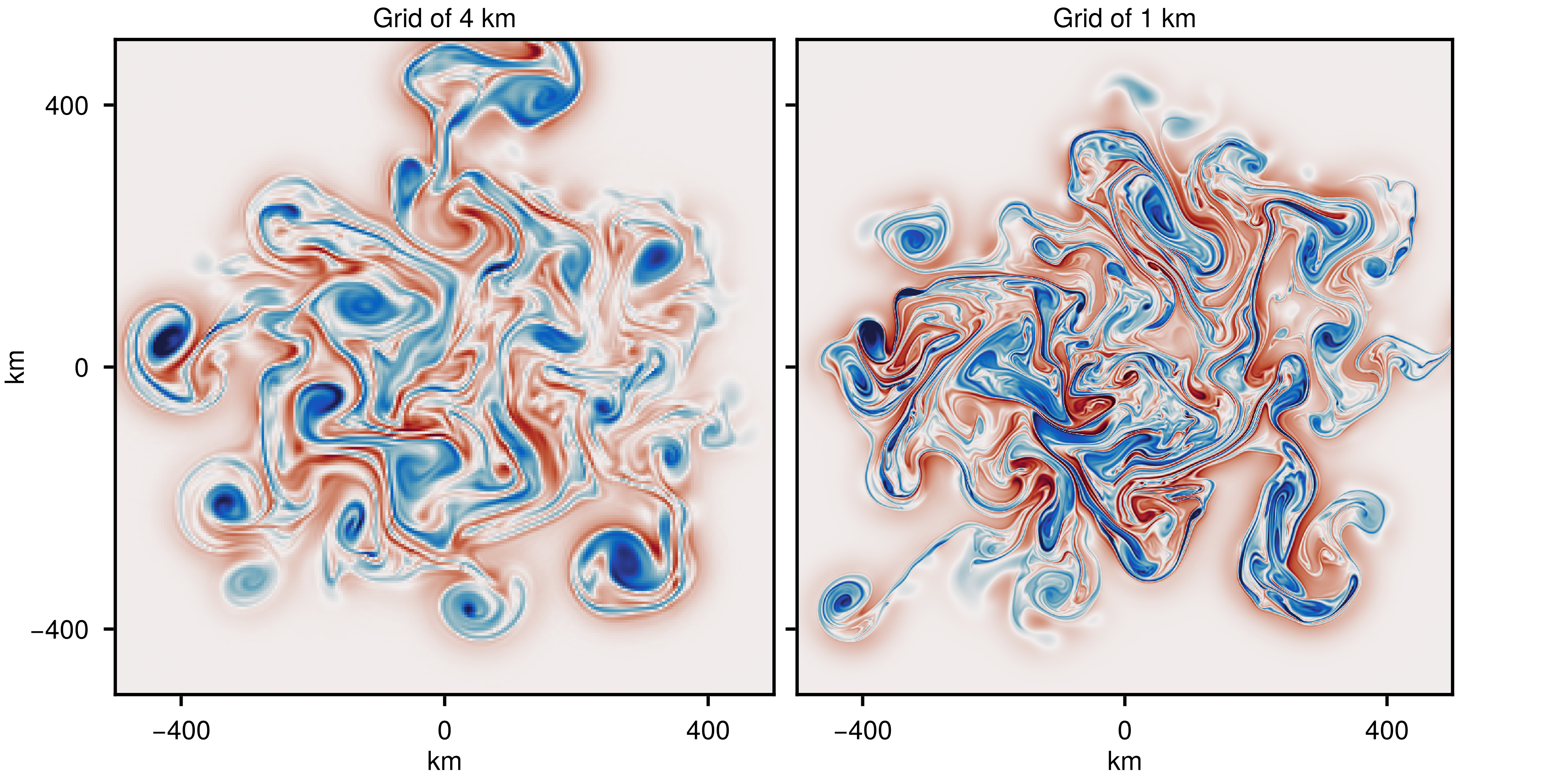
The simulations use grid points spaced four km apart on the left and one km apart on the right. The large swirls appear in both, but only the finer grid captures the sharp edges, thread-like filaments and small whirlpools. In the Arctic, these small features carry heat and fresh water and can affect the sea ice above them, so seeing them matters. The finer grid needs 64 times more calculations than the coarser one, so Poulin’s group uses graphics processing units (GPUs), the chips originally designed for video games, to speed up the work. Four GPUs ran the one km simulation.
This preproposal snapshot offers an early look at the work and the potential of this approach. As the research progresses, the team aims to develop faster and more accurate ways to simulate the Arctic region and beyond. This work illustrates how mathematical modelling and modern computing power can help researchers better understand complex processes in the ocean and atmosphere, supporting the broader goals of the WxAlliance project.
“I am thankful to Stéphane Gaudreault from ECCC for bringing together this great team from across Canada to study classical and modern approaches in weather forecasting,” says Poulin. “Together, we hope to build a robust model that can predict weather more accurately, impacting a wide range of sectors such as agriculture, transportation, energy, etc.”
The WxAlliance includes experts from various areas of science with a broad range of interests from mathematics and computing to physics working together on this large interdisciplinary, multifaceted project. Beyond the research itself, Poulin believes that this grant, along with the NSERC CREATE grant he works on with Marek Stastna will help train graduate students in Canada for careers that demand specialized interdisciplinary skills. The climate crisis is one of the many challenges facing the next generation and helping students develop the skills to build careers in this field will be valuable for their future.