Future students

Schmidt’s report outlines how the GI curates an interdisciplinary environment by encouraging staff, students, and faculty to critically play together—and how that act of play creates a common language where research ideas begin to flow. Looking back, the findings of this report continue to ring true today and we hope to continue sponsoring research excellence with this unique method of interdisciplinary creation. 

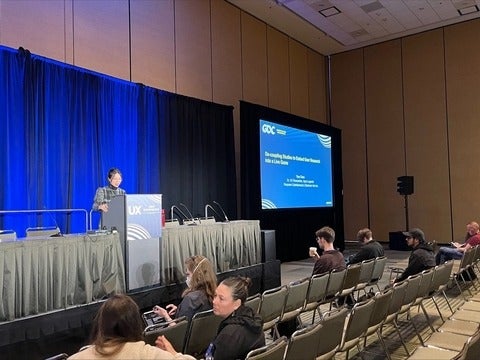
Games Institute (GI) members are no strangers to the annual Game Developers Conference (GDC), and this year is no different with two GI alums, Alexandra Orlando and Tina Chan, leading sessions about their ongoing work within the games industry.  

On February 10, the Critical Media Lab with support from members of Feminist Think Tank and the GI held a virtual data jam and discussion on the issues of big data, machine learning, and how discrimination is encoded into our technology.

The GI Game Jam ran from September 29th to October 2nd, led by Jam co-captains, PhD students Joseph Tu (Systems Design Engineering) and Alexander Glover (Management Sciences). The Jam saw the development of 17 games.

The Winter semester GI Jam was hosted as part of the Global Game Jam from January 26 – 30. Game makers of all ages and abilities came together to improve their game design skills. The four-day long jam provided tutorials and discussions on how to brainstorm, prototype, and develop games. Game Jam captains Alexander Glover (PhD) and Arielle Grinberg (PhD) led participants through paper prototypes and game concepts and helped them explore game mechanics, narrative, and artwork in addition to programming. At the end of the event, two games were created and presented.

In Spring 2022, UWaterloo welcomed thirty-four Ukrainian students whose, education had been disrupted by the war, to continue their studies at Waterloo. They were sponsored by the Waterloo Artificial Intelligence Institute (Waterloo.AI).

On Wednesday, October 5th the Games Institute opened its doors to the public for its annual Open House. Guests were able to explore the entire 9000-square-foot GI space, including lab spaces, to discover the interactive and immersive technologies research conducted in the GI’s collaborative interdisciplinary environment.