“It can be hard to be the only woman in the room, or to express your thoughts to people who aren’t always inclined to listen,” says Sheena Zeng, a fourth-year math PhD student at the University of Kansas. “Being part of a kind and supportive community is so important, and I’m so grateful to be able to contribute to this one.”
Zeng is a mentor in the EDGE for Women program, a one-month intensive program that provides mentorship and training to women and gender-minority students at the beginning of their PhDs. Though its alumni work and do research around the world, EDGE has historically been an American program. That all changed this summer, when the program came to the University of Waterloo – and by extension, Canada – for the first time.
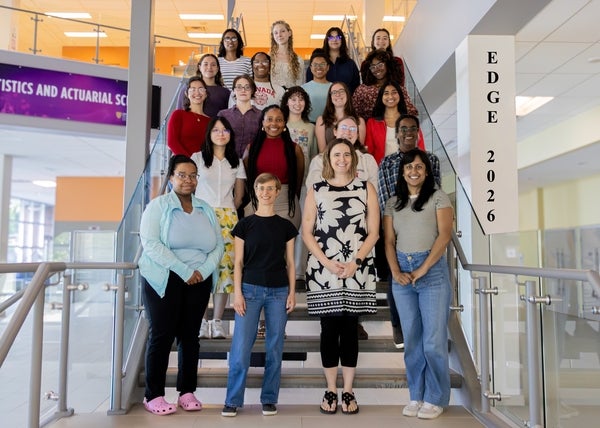
The EDGE program was created in 1998 by Sylvia Bozeman and Rhonda Hughes to help counter high attrition rates among female students in mathematics. “It’s an intensive crash course intended to prepare students for success in their PhD programs,” explains Dr. Anila Yadavalli, local director of this year’s program and an Assistant Professor, Teaching Stream in the Centre for Mathematics and Computing at Waterloo. “You do a series of academic modules to refresh your undergraduate knowledge and prepare for qualifying exams, while also building community through colloquiums, dialogues, and social events.”
EDGE fully funds fourteen incoming or first-year graduate students to travel to a university campus for a month, and provides them with housing, meals, and a stipend while they are there. It also pays for former program participants to work as mentors, helping contribute to a networked community that endures after one-month intensive is over. “Over the last three decades, we’ve seen a huge success rate from EDGE,” Yadavalli says. “If you go to almost any math department in the States, someone on the Faculty has a connection to this program.”
Creating Global Connections
Unfortunately, due to growing restrictions around equity, diversity, and inclusion programs in the United States, organizers were not allowed to use state or federal funding to run the EDGE workshop this year. That’s when Dr. Anita Layton, professor of Applied Mathematics and Canada 150 Research Chair in Mathematical Biology and Medicine, stepped in. She used some of her funding to sponsor the EDGE program coming to Waterloo, and as a result, 14 beginning students – alongside graduate and faculty mentors – spent the month of June on Waterloo campus. Under the guidance of Yadavalli and other math faculty from universities around the US and Canada, students strengthened their mathematics foundation, attended colloquia, and learned from each other and mathematics mentors.
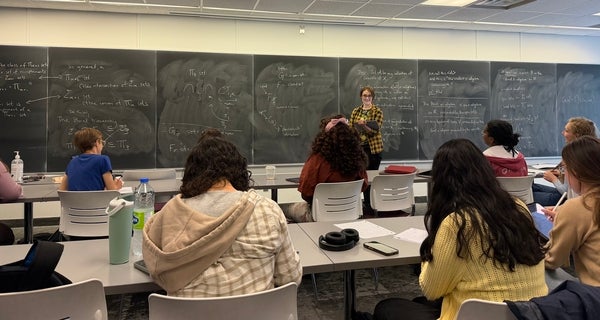
While a few of the students were entering Canadian universities, most of them were American, and many had never been to Canada before. Participants in the program expressed not only excitement about the opportunity to build a community of like-minded scholars, but also gratitude at being welcomed to a dedicated Faculty of Mathematics. In between seminars on Measure Theory, Applied Mathematics, and Statistics, they also enjoyed trivia nights, dinner at local restaurants, and a day trip to explore Toronto.
Cultivating Community
Participants emphasized, however, that the most valuable part of the EDGE program was its intentional cultivation of community. “While the classes were interesting, I think what was most impactful were the people I met and friendships I formed,” says Nzingha Joseph, a participant entering the second year of her PhD at the University of Minnesota-Twin Cities. Though Joseph’s graduate program is supportive, there are relatively few women in it, and even less Black people. “I really enjoyed the Difficult Dialogues series we did here at EDGE,” she says. “It helped us open up to each other about imposter syndrome, being one of only a few women in our cohorts, things like that.” She also particularly appreciated the advice and guidance of professors and upper division graduate students who could provide reassurance and commiseration.
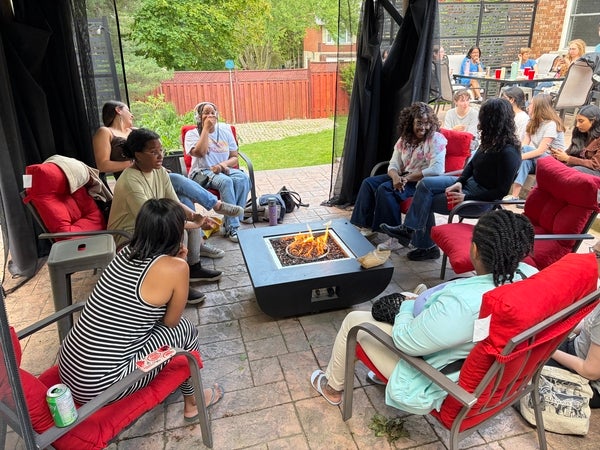
One of those graduate mentors is Naima Nader, a third-year PhD student at the University of Illinois-Chicago. “I’m the only woman studying algebraic geometry in my program,” she says. When she joined the EDGE program as a participant in 2024, she made connections that have sustained her through her graduate career thus far. “We have a group chat where we rant and celebrate each other, and Zoom regularly,” she says. “Plus, we’re all over the country, so when I travel I can catch up with people.” These relationships endure for decades: the EDGE program hosts regular alumni reunions, and many of the faculty members who help run the program were once participants themselves.
Nader and Zeng both enjoyed returning this year as mentors, and felt that it allowed them to “pay forward” the support they received as students. Zeng shares how one of the mentors she met in 2024 when she was an EDGE participant volunteered to meet with her daily for the rest of the summer so they could study and review together. Being a mentor this year allowed her to “help people” and to work on her own research, all in the company of other women doing math PhDs.
While programs like EDGE are under threat, participants are confident that the community they have cultivated is resilient and will endure. “We’re all benefiting, emotionally and academically, from building these networks,” says Joseph. “Programs like this are good for women and non-binary people in the math community specifically, but they’re also good for the mathematics community as a whole.”
To learn more about the EDGE program, visit their website.