A recent UNESCO report revealed that girls worldwide are falling behind boys in mathematics at higher rates than they did just ten years ago, with 85% of educational systems showing “a significant male advantage in reaching the advanced international mathematics benchmark at fourth grade.” The research also demonstrates that the disparity in math performance is not a matter of differing aptitude, but rather the result of “persistent gender stereotypes, teacher expectations and classroom interactions,” which result in lower confidence and interest in mathematics among girls and young women.
The Faculty of Mathematics is dedicated to increasing equity and diversity in mathematics and computer science, and features support and mentoring programs for women and gender minorities including Women in Math and Women in Computer Science. Intervention at the university level, however, can only go so far – and that’s where the Centre for Education in Mathematics and Computing (CEMC) comes in. “In our classrooms here at Waterloo, we get students at the end of their K-12 education, and many of them have been failed by the system,” explains Dr. Anila Yadavalli, Assistant Professor, Teaching Stream in the CEMC. “It’s not their fault. We need to instill joy in mathematics early.”
The CEMC’s outreach mission is to increase interest, enjoyment, confidence, and ability in mathematics and computer science. Here are three of the CEMC’s many programs that are specifically helping to address the gender equity gap.
Think About Math (TAM)
Think About Math (TAM) is a three-day free camp held in August for girls and gender minority students entering Grade 9. Students participate in mini workshops where they tackle math-related problems with real world implications, like the math behind epidemiology or voting. They also get to hear from undergraduate mentors , and learn about different math-linked careers at a job fair featuring industry professionals.
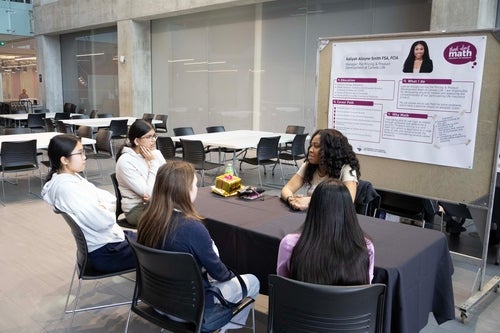
“What kids think in Grade 8 or 9 about their math ability can impact them in a lot of ways,” Yadavalli says. “It’s not just relevant if they want to get a math degree. For example, if a kid doesn’t feel confident that they could complete the math requirements of a nursing degree, they might end up in an entirely different career path.”
TAM is particularly aimed at those who are already structurally disadvantaged, including students from racial backgrounds underrepresented in mathematics, low-income neighbourhoods, and under-served schools. “We’re really hoping that TAM and similar initiatives can be an inflection point for students during their development,” Yadavalli explains. “There are so many kids who can thrive in math if we can help remove some of the existing barriers to entry.”
Canadian Informatics Workshop (CIW)
The Canadian Informatics Workshop (CIW) invites top female and gender minority performers of the senior level Canadian Computing Competition (CCC) to come to campus for a week, completely free, and connect with peers who share their passion for competitive programming. The program is open to elementary and high school students of any age: the only requirement is a strong performance on the CCC Senior. At the end of the week of mentorship, CIW attendees participate in an on-campus coding contest, and the results help determine who will be selected to represent Canada internationally at the European Girls’ Olympiad in Informatics (EGOI).
Thanks to the sponsorship of Hudson River Trading, attending the CIW – and travel to Europe for the Olympiad if participants qualify – is completely free, which breaks down barriers to accessibility.
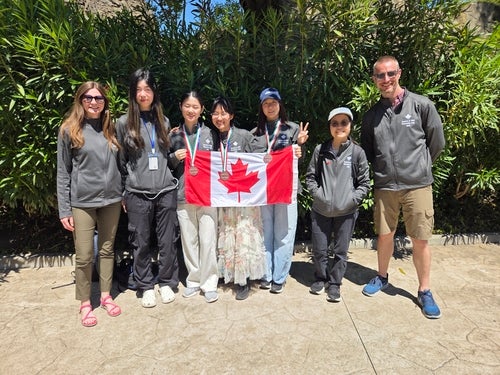
In 2026, four young women from the CIW traveled to Italy alongside two faculty members from the CEMC, and earned three bronze medals. “We’re incredibly proud of our team and their performance at EGOI 2026,” says Dr. Paul McGrath, Associate Professor, Teaching Stream in the CEMC and one of the EGOI team leaders. “Bringing home three bronze medals is an amazing achievement and is evidence that Canada has a talented and gender diverse competitive programming community.”
Seeing Possibilities and Rewards in Computer Science (SPARCS)
Seeing Possibilities and Rewards in Computer Science (SPARCS) is a week-long workshop designed to introduce Grade 9 and 10 girls and gender minority students to the breadth of computer science through workshops, lessons, , and other hands-on experiences. “Many students aren’t aware of the wide range of opportunities in computer science, or don’t have computer science courses at their high school, so SPARCS aims to address that,” says Valentina Hideg, Assistant Professor, Teaching Stream in the CEMC. While the program – which includes food, lodging, and workshops on campus – costs $350, the CEMC covers students’ travel costs, and financial support to cover the cost of the registration fee may be arranged for students in need.
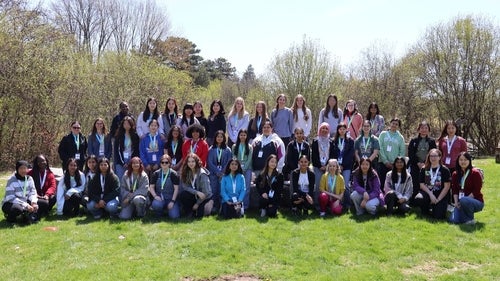
“Growing up, especially in more rural areas, kids might not know anyone in computer science, let alone someone who has the same background and experience,” Hideg says. “Introducing students to the breadth of computer science topics and connecting them with peers and people in the field can make a difference. These connections help students see the possibilities within computer science and perhaps see themselves as part of the field in the future.”
To learn more about the CEMC’s workshops, contests and events for learners from all backgrounds, visit their website.