The Centre for Education in Mathematics and Computing (CEMC) is devoted to increasing interest, enjoyment, confidence, and ability in mathematics and computer science among learners and educators in Canada and internationally. While they’re most famous for their national and international math and computing contests, they also run many other types of projects designed to spark interest in mathematics.
The Mathematician Mosaic was created in 2024 by Dr. Anila Yadavalli, an Assistant Professor, Teaching Stream in the CEMC and Sachin Kotecha, an Assistant Professor, Teaching Stream in the Mathematics Undergraduate Group. In the Mathematician Mosaic, classes of students from grades 1-12 work together to create educational posters about contemporary and historical mathematicians and computer scientistsfrom underrepresented backgrounds.
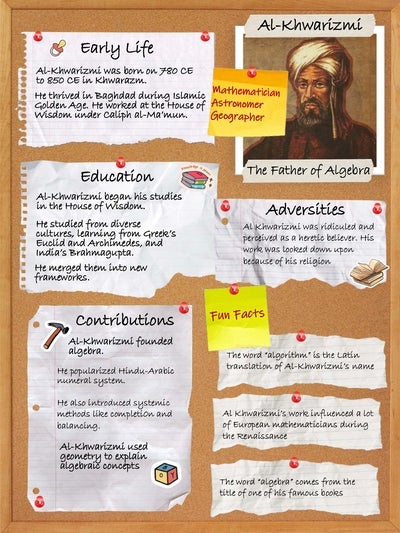
Submitted by students from Mrs. Holman's Grade 12 class at Estevan Comprehensive High School, Estevan, Canada
The goal of this project was to allow students to explore their creative side while researching the lives of mathematicians who may have been historically overlooked. The program organizers decided to frame the Mathematician Mosaic as a contest, one that is accessible and welcome to all students, with no entry fee or prize involved. The project runs every fall and winter, with a stronger focus in classrooms during December, when students often have more time to engage in collaborative group activities.
The first year, the Mathematician Mosaic received 80 posters from around the world, and the CEMC team chose 18 posters to feature on their website and social media. This past year, they received 150 submissions and chose 16 to feature. “It has been exciting to see just how far across the globe the project has reached,” Kotecha says. “This year, we received submissions from Pakistan, China, and Belgium – just to name a few. The accessibility and relatability of the project are key.”
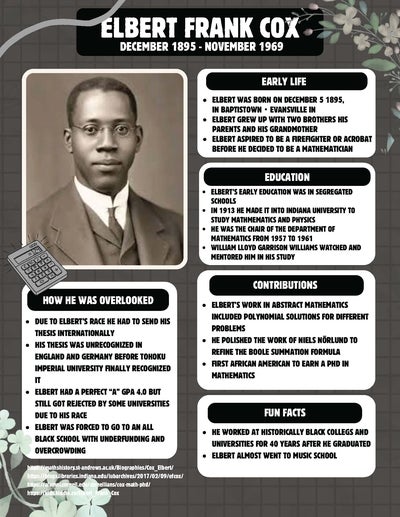
Submitted by students from Ms. Thompson's Grade 7 class at EJ James P.S., Oakville, Canada
The Mathematician Mosaic also aligns closely with the CEMC’s objectives of increasing representation and participation in mathematics and computer science. “I learn so much every year,” Kotecha says. “I think if students are inspired by this and it resonates with them – they can see a mathematician who looks like them or has overcome the same hardships as them.”
Featured mathematicians are promoted through the CEMC’s social media channels, helping to highlight their contributions during observances such as Black History Month, Women in Mathematics Day, and other relevant dates. Although the Mathematician Mosaic project is relatively new, it has already reached a diverse group of students worldwide. By exploring the lives of mathematicians, engaging with their creative side, and examining how these role models have overcome adversity, the project encourages students to recognize their own potential to succeed in STEM.
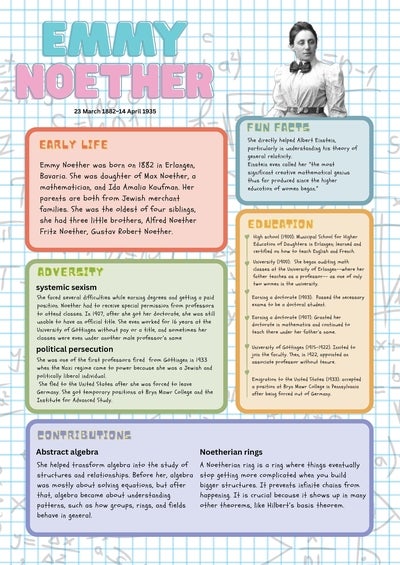
Submitted by students from Ms. Yang's Grade 8 class at Hong Wen International School, Taichung, Taiwan
To learn more about the Mathematician Mosaic and other CEMC initiatives, visit their website.