Current students

Congratulations to WIN member Marina Meilă on being awarded a Tier 1 Canada Research Chair in Reliable Structure Discovery. Her work focuses on developing advanced methods to ensure machine learning results are accurate and trustworthy, strengthening the reliability of data-driven discoveries and advancing innovation across scientific disciplines.
Congratulations to the recipients of the Joint CityUHK–UW Seed Fund. Launched this term by WIN, the Faculty of Health at the University of Waterloo, and the City University of Hong Kong (CityUHK), the program supports early-stage collaborative research in health and life sciences. Funded projects focus on innovative solutions for Alzheimer’s disease and advanced tissue engineering, highlighting the strength of international partnerships and high-impact research collaboration.

Congratulations to Sushanta Mitra, Boxin Zhao, and Nasser Mohieddin Abukhdeir on receiving $600,000 in federal funding to advance research on microplastic pollution. Their project focuses on developing an innovative, made-in-Canada platform that enables the real-time detection and removal of microplastics using advanced materials, sensors, and AI. This work supports more efficient monitoring, improved identification of pollution sources, and contributes to Canada’s goal of reducing plastic waste.

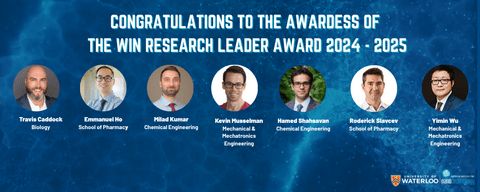
WIN Day 2026 was particularly impactful as it combined the WIN Research Celebration with the main event, uniting recognition and research sharing into a single platform. A key highlight was the presentation of the WIN Research Leader Awards, honoring seven outstanding researchers—Travis Craddock, Emmanuel Ho, Milad Kamkar, Kevin Musselman, Hamed Shahsavan, Roderick Slavcev, and Yimin A. Wu—for their excellence and contributions to advancing research.

Professor Boxin Zhao has been elected a Fellow of the Canadian Academy of Engineering in recognition of his pioneering work in advanced functional materials, adhesion science, and sustainable nanotechnology applications.

Researchers at the University of Waterloo developed a water-based, nanotechnology-enabled pesticide formulation that enhances droplet adhesion, reduces environmental runoff, and improves pest control compared to conventional methods

The University of Waterloo signed a five-year Memorandum of Understanding (MOU) with the University of Split’s Faculty of Electrical Engineering, Mechanical Engineering and Naval Architecture (FESB) in April 2026 to strengthen international collaboration in nanotechnology and advanced engineering research. The agreement establishes a flexible framework to support joint research projects, academic exchanges, and the mobility of students, faculty, and staff, while encouraging shared funding opportunities and the exchange of knowledge. It also outlines guidelines for intellectual property and includes limited binding provisions related to confidentiality. Overall, the partnership aims to enhance global cooperation, drive innovation, and create new opportunities for research and student development between Canada and Croatia.

The Waterloo Institute for Nanotechnology (WIN) and Concordia University’s Volt‑Age Research Group have signed a Memorandum of Understanding to formalize a growing collaboration in advanced energy and nanotechnology research. Building on the momentum of Professor Karim Zaghib’s WIN Distinguished Lecture, the agreement establishes a framework for joint research focused on carbon‑neutral energy technologies, including next‑generation batteries and sustainable energy systems. The partnership also emphasizes graduate training through shared workshops, research exchanges, and access to specialized facilities, while encouraging joint national and international funding initiatives. Together, the collaboration reflects a shared commitment to accelerating innovation, developing highly trained researchers, and advancing nanotechnology‑driven solutions for a low‑carbon future.