Future students

A new, battery-free sensor can detect water leaks in buildings at a fraction of the cost of existing systems.

The tiny device, developed by researchers at the University of Waterloo, uses nanotechnology to power itself and send an alert to smartphones when exposed to moisture.

By eliminating a battery and related circuitry, researchers estimate their sensor could be commercially produced for $5 each, about a tenth of the cost of current leak detection devices on the market.

Yannick in the labWhen he was a young boy growing up in Burkina Faso, Yannick Traore’s dad didn’t like to buy him toys. Yannick had a habit of taking things apart just to figure out how to put them back together. Even as a child, he needed to understand how things worked.
Today, Yannick’s putting that curiosity to good use as a PhD candidate in Professor Emmanuel Ho’s lab.

A nanotechnology engineering undergraduate team won first place at this year’s Ontario Engineering Competition (OEC) in the Innovative Design category.

Hosted by the University of Guelph from January 17 to 19, OEC brought together engineering students from across the province to compete in eight unique challenges designed around the theme of Improve Life.

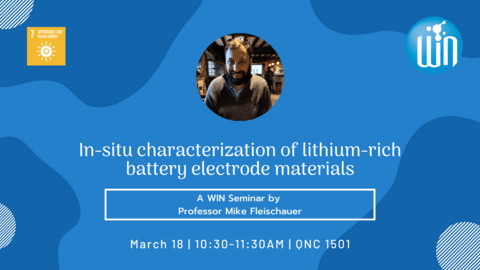
Wednesday, March 18, 2020 10:30 am - 11:30 am EDT (GMT -04:00)

WIN Seminar Series: In-situ Characterization of Lithium-rich Battery Electrode Materials

The Waterloo Institute for Nanotechnology is pleased to present a Seminar Series talk by Professor Mike Fleischauer, an Associate Research at the NRC-Nanotechnology Research Centre (NRC-NANO, Edmonton), an adjunct professor of Physics at the University of Alberta, and on the City of Edmonton’s Energy Transition Advisory Committee.

In-situ Characterization of Lithium-rich Battery Electrode Materials

Abstract

Professor Todd Holyoak is an expert in the dynamic aspects of the enzyme structure-function relationship, or “conformational plasticity” in enzymology and how these dynamic aspects of enzyme structure can be altered/influenced to alter and enzyme function. Currently, the Holyoak lab is exploring the structure-function relationship in several diverse enzyme families with a current focus upon the GTP-dependent phosphoenolpyruvate carboxykinases (PEPCK) and the IgA1 protease family of bacterial proteins.

Wednesday, October 16, 2019

Research Breakthrough - David Rose

The research in Professor David Rose’s laboratory in the Department of Biology is focused on the human enzymes that recognize and act upon carbohydrates. These enzymes play key roles in multiple aspects of health and disease, including deriving glucose from components of our diets, such as starch and sucrose, and in the synthesis of glycoproteins (proteins that consist of carbohydrates as well as amino acids).

Thursday, November 15, 2018

Nanogenerators and the Future of Energy

There are many researchers searching for new and clean sources of energy. However, few are conducting research at the intersection of nanotechnology and quantum phenomenon. Professor Dayan Ban, from the Department of Electrical and Computer Engineering, is conducting seminal research in the area of quantum photonics and nanoelectronics.