Future students

Wednesday, September 19, 2018

Personalized Medical Care

Personalized medicine, or precision medicine, will be central to a robust and efficient health care system in the future. Professor Shirley Tang’s research in the area of Smart and Functional Materials will help lead to a more personalized medical system.

According to the Canadian Institute for Health Information, total health care spending in Canada reached $242 billion in 2017. This represents 11.5 percent of Canada’s gross domestic product. Over the coming decades the Canadian healthcare system will change. 

Monday, June 29, 2020 1:00 pm - 2:00 pm EDT (GMT -04:00)

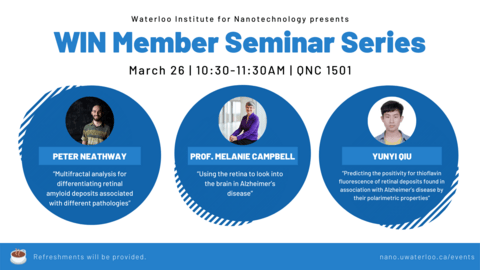
WIN Member Seminar Series: Melanie Campbell Group

The Waterloo Institute for Nanotechnology (WIN) is comprized of many talented faculty members, students and researchers from various backgrounds of study. We wanted to showcase their incredible work through our Member Seminar Series! Each month a professor and 2 of their researchers will present their research to our community. This series is an opportunity for our WIN community to come together, learn about ongoing research and potentially foster new partnerships between students, faculty and labs.

Wednesday, February 12, 2020 10:30 am - 11:30 am EST (GMT -05:00)

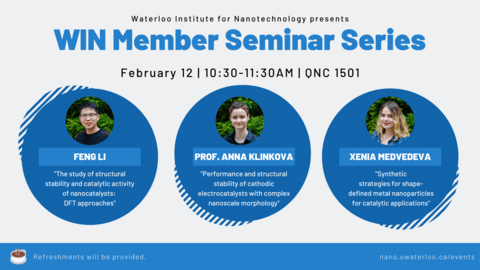
WIN Member Seminar Series: Anna Klinkova Group

The Waterloo Institute for Nanotechnology (WIN) is comprized of many talented faculty members, students and researchers from various backgrounds of study. We wanted to showcase their incredible work through our Member Seminar Series! Each month a professor and 2 of their researchers will present their research to our community. This series is an opportunity for our WIN community to come together, learn about ongoing research and potentially foster new partnerships between students, faculty and labs.

Thursday, February 6, 2020 10:30 am - 11:30 am EST (GMT -05:00)

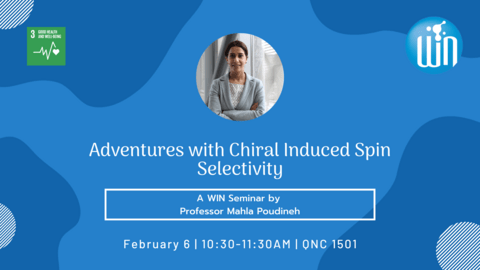
WIN Member Seminar Series: Mahla Poudineh

The Waterloo Institute for Nanotechnology (WIN) is happy to welcome Professor Mahla Poudineh to the WIN family! Professor Poudineh will deliver a seminar in order to introduce herself and her research to our community. Please join us in giving her a warm welcome. 

Next-Generation Enabling Technologies for Diagnosing Disease and Monitoring Therapy

Abstract

Thursday, January 23, 2020 10:30 am - 11:30 am EST (GMT -05:00)

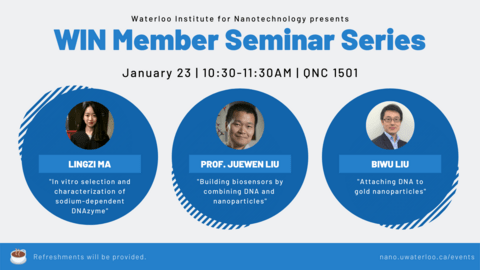
WIN Member Seminar Series: Juewen Liu Group

The Waterloo Institute for Nanotechnology (WIN) is comprized of many talented faculty members, students and researchers from various backgrounds of study. We wanted to showcase their incredible work through our Member Seminar Series! Each month a professor and 2 of their researchers will present their research to our community. This series is an opportunity for our WIN community to come together, learn about ongoing research and potentially foster new partnerships between students, faculty and labs.

The Waterloo Institute for Nanotechnology (WIN) is pleased to present a Seminar Series talk by Professor Tianzhun Wu, an associate professor and the founding director of the Research Center of Micro/nano Systems and Bionic Medicine with Shenzhen Insititutes of Advanced Technology, Chinese Academy of Sciences.

New technologies for high-performance retina prosthesis based on micro/nano engineering

Abstract

Wednesday, February 26, 2020 10:30 am - 11:30 am EST (GMT -05:00)

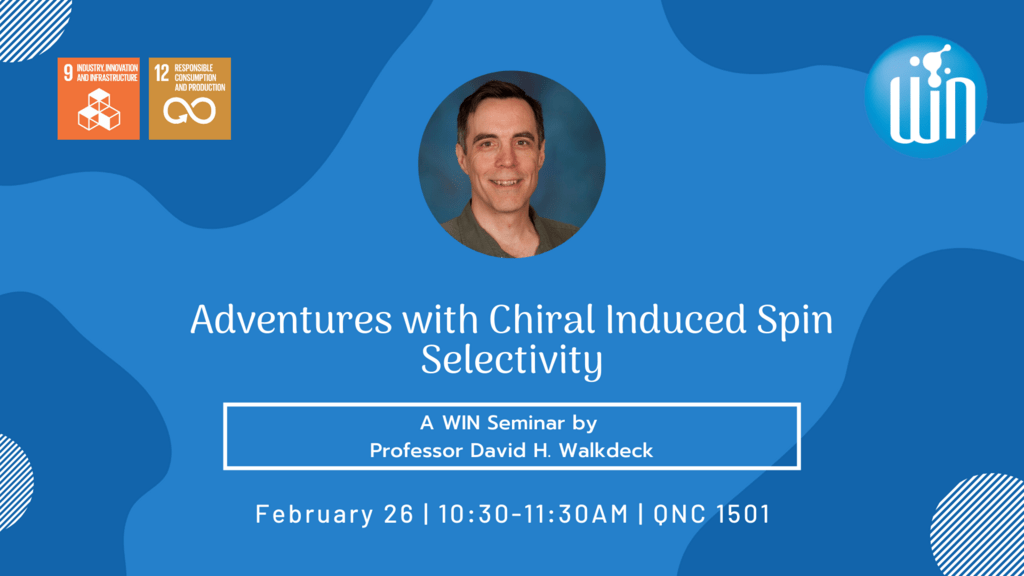
WIN Seminar Series: Adventures with Chiral Induced Spin Selectivity

The Waterloo Institute for Nanotechnology (WIN) is pleased to present a Seminar Series talk by Professor David H. Waldeck, a distinguished professor at the University of Pittsburgh and Director of the Petersen Institute of NanoScience and Engineering.

Adventures with Chiral Induced Spin Selectivity

Abstract

WIN member Emmanuel Ho, an associate professor at the University of Waterloo School of Pharmacy and an international expert in nanomedicine, is developing a 3D-printed intra-vaginal ring (IVR) that would provide highly precise doses of medication to protect women from getting HIV, the virus that causes AIDS and kills one million people globally each year, according to UNAIDS.