News

Filter by:

Limit to news where the title matches:
Limit to items where the date of the news item:
Date range
Limit to news items where the audience is one or more of:
Limit to news items where the faculty or school is one or more of:
Thursday, February 7, 2019

Making homes smart could become easier

Making your house “smart” could soon become cheaper and easier, thanks to new technology developed by researchers at the University of Waterloo.

Their recent study describes an approach that can be used to deploy, for the first time, battery-free sensors into a home using existing WiFi networks. Previous attempts to use battery-free sensors ran into some obstacles making the efforts impractical. These hurdles include the need to modify existing WiFi access points, challenges with security protocols, and the need to use energy-hungry components.

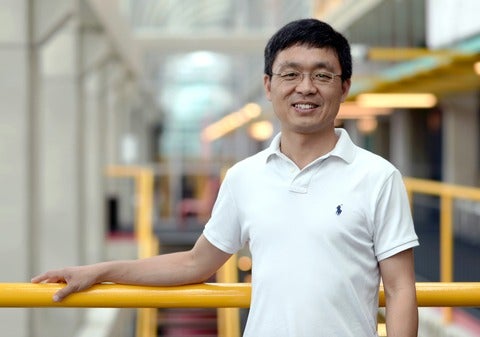
Cheriton School of Computer Science Professor Bin Ma has received $462,998 in research support from Genome Canada for an ambitious three-year project titled “Software for peptide identification and quantification from large mass spectrometry data using data independent acquisition.” Additional funds bring the total amount to $925,987.

Read the full story.

Professor Cameron Stewart is respected and admired for the care, knowledge, insight, and wisdom that he has provided to his students throughout his 40-year long career at the University of Waterloo. Over his career, 22 Master’s students and 11 doctoral students obtained degrees under his supervision and he provided guidance to 18 postdoctoral fellows. Read the full story.

Cheriton School of Computer Science Professor Shai Ben-David, his former PhD student Hassan Ashtiani, now an Assistant Professor at McMaster University, along with colleagues Christopher Liaw, Abbas Mehrabian and Yaniv Plan, have received a best paper award at NeurIPS 2018, the 32ndAnnual Conference on Neural Information Processing Systems.

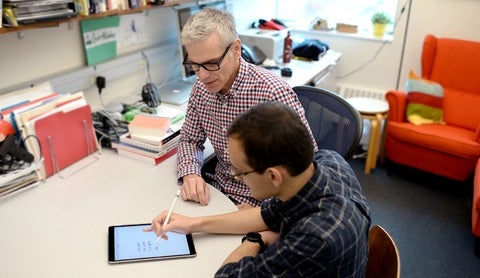
Anyone who’s used a pen with a tablet appreciates how precisely the instrument allows them to write, draw, and manipulate objects. A pen is natural input device, one that’s much more nuanced than a mouse or touchpad. Despite its precision and ease of use, many tablet applications still need menus, buttons, and widgets for a user to switch between tools, to set their attributes, and to issue commands.