Classroom activities, notes, and lessons
Thank you for your interest in learning more about how to bring quantum to the classroom. Quantum for Educators equips teachers with the ability to bring quantum science into the classroom and confidently teach students about quantum physics, quantum computing, quantum cryptography, and more.
These lesson plans and activities have been developed for high-school classrooms by quantum experts from IQC with feedback from experienced educators.
Quantum Circuit Visualizer
The best way to learn is to experiment! In this online circuit simulator, you can add quantum gates to a circuit and see the probabilities change in real-time. There's a quiz to get you started, and teachers can create their own quizzes using the Question Builder.
Quantum Detectives
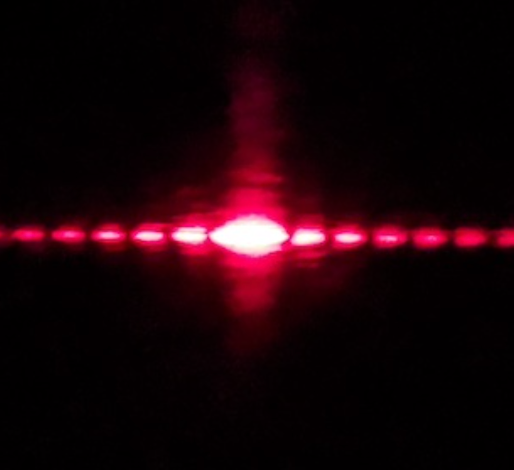
In this three-station hands-on activity designed for Grade 8-10 students, participants explore three important aspects of quantum information science: binary encoding (through light polarization), interference (through laser diffraction), and quantization (through atomic spectra). They will use these tools to solve a mystery about a missing researcher and figure out what quantum experiment they were working on.
This activity was developed in partnership with Let's Talk Science and Waterloo Engineering Outreach with support from the APS Innovation Fund.
Polarization, superposition, and measurement
Investigate the superposition and measurement principles in this hands-on lesson using the polarization of light. Learn about the role of probability in quantum mechanics, wave function collapse, and how a quantum superposition is always relative to a measurement choice.
Polarization Cards: A Qubit Survival Quest
Explore probability and how it relates to polarized photons with this card game, where you must draw measurements and flip coins and hope your polarization qubit survives to the end. Developed in collaboration with the Quantum for All initiative.
Quantum cryptography
Understand how the quantum superposition and measurement principles can be used to build secure communication systems. Learn about quantum information and measurement disturbance through a cryptography protocol based on quantum mechanics called quantum key distribution.
3D-printed quantum key distribution
Build your own quantum key distribution (QKD) set up with lasers, solar panels, Arduinos, and 3D-printed components. This kit allows students to experiment with QKD using components that rely on the real physics of the device, including preparing and measuring polarization-encoded bits in multiple bases. Students may use the kit to exchange a secret key and discover the effect of measurement disturbance when an eavesdropper is present.
Quantum coins
An interactive group role-playing activity where students explore how the mechanics of quantum measurement allow for perfectly secure cryptography. Students will take the role of Alice, Bob, the eavesdropper, and the rules of quantum mechanics
Wave-particle duality and interferometers
Learn how wave and particle behaviour can both be seen in one experiment. Create wave and particle models for describing the Mach-Zehnder interferometer using coins and puzzles and see how they compare to real laboratory data. Explore how quantum objects break the wave-particle binary and can behave like one or the other depending on how they are measured and analyzed.
Quantum computing with interferometers
Learn a simple quantum algorithm that can be implemented with a single photon in an interferometer. Through analyzing the Deutsch-Josza algorithm, learn about how quantum computers use superposition and measurement to solve problems in new ways.
A quantum paradox
How can quantum information help us solve problems that can't be solved classically? A thought experiment can help clarify the role of superposition and measurement and how they are applied to solve problems. In this activity, based on the idea of interaction-free measurements, students will role-play as firework salespeople who can find a quantum solution to their very particular problem.
Quantum search board game
Play Hadamard's Hoard, a card game pitting a classical player against a quantum player to demonstrate the advantage of the quantum search algorithm.
The uncertainty principle
Measure and verify the uncertainty principle in a hands-on activity using laser pointers. Print your own single and double slits from home and learn how more certainty in position leads to more uncertainty in momentum. Understand how the uncertainty principle itself can be used to make accurate measurements.
Quantum entanglement
What makes entanglement special? Using a pictorial language from light polarization, in this activity we'll explore how quantum entanglement can be seen as a shared quantum state of multiple photons. Discover what surprising effects it has as well as its limitations.
Quantum Cats
Quantum Cats is a browser-based physics game developed by IQC and the Games Institute. Players must fling cats across the lab to free kittens, but may take advantage of quantum features like superposition, tunneling, and uncertainty. Quantum Cats can be played in-browser on the Quantum Arcade.