Impact and beyond
The profound impact of early discovery, experimentation, and disruption through research and invention
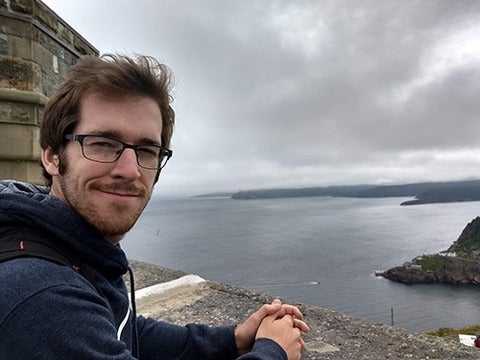

Not long after beginning his graduate program at Waterloo, Matthew Sullivan discovered a passion for Ultimate Frisbee. Today, he serves as the chief of the Ultimate Frisbee intramural program while continuing to referee and play as often as he can. Close to 450 students sign up to play every autumn. “Things like age, gender, or program don’t matter out there,” says Matthew. “Any student can go out and play. Like all the intramural sports at Waterloo, Ultimate provides a great way to de-stress, stay in shape, and balance the academic with the social.”
The start of the Spring Term, at the height of COVID, had instructors moving their courses to a remote format with students spread across time zones. It changed delivery, assignments and testing as in the case of Anton Mosunov, an award-winning lecturer in the Faculty of Mathematics who altered the MATH 135 midterm to an oral exam.
PhD candidate Stavros Birmpilis, co-supervised by Cheriton School of Computer Science Professors George Labahn and Arne Storjohann, has won one of two Distinguished Student Author Awards at ISSAC 2020, the 45th International Symposium on Symbolic and Algebraic Computation.
A world-leading University of Waterloo spinoff company, that decodes blood samples for potential treatments for illnesses like cancer and COVID-19, is expanding operations with the help of a $5-million USD investment.
Bin Ma, a University of Waterloo computer science professor who cofounded Rapid Novor in 2015, says the company’s technology is the most advanced in the world when it comes to deciphering the complex workings of antibody proteins, a process called sequencing.
Irene Melgarejo Lermas has never been one to shy away from a challenge. At the recommendation of a friend who studied at Waterloo, she moved from her native Spain to study quantum field theory at the Institute for Quantum Computing (IQC). In addition to tackling a complex subject in her second language, she was assigned to teach a class of 200 undergraduate students during her first semester. “I didn’t have any teaching experience at the time,” she remembers.
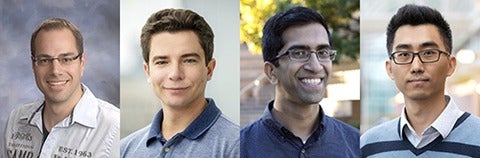
Department of Statistics and Actuarial Science professor Marius Hofert and David R. Cheriton School of Computer Science professors Sergey Gorbonuv, Gautum Kamath and Jian Zhao have each been awarded a Natural Sciences and Engineering Council of Canada (NSERC) Discovery Accelerator Supplement (DAS).
The Defence and Security Foresight Group (DSF-G) is cohosting a lunch-and-learn webinar with the Waterloo Cybersecurity and Privacy Institute (CPI).
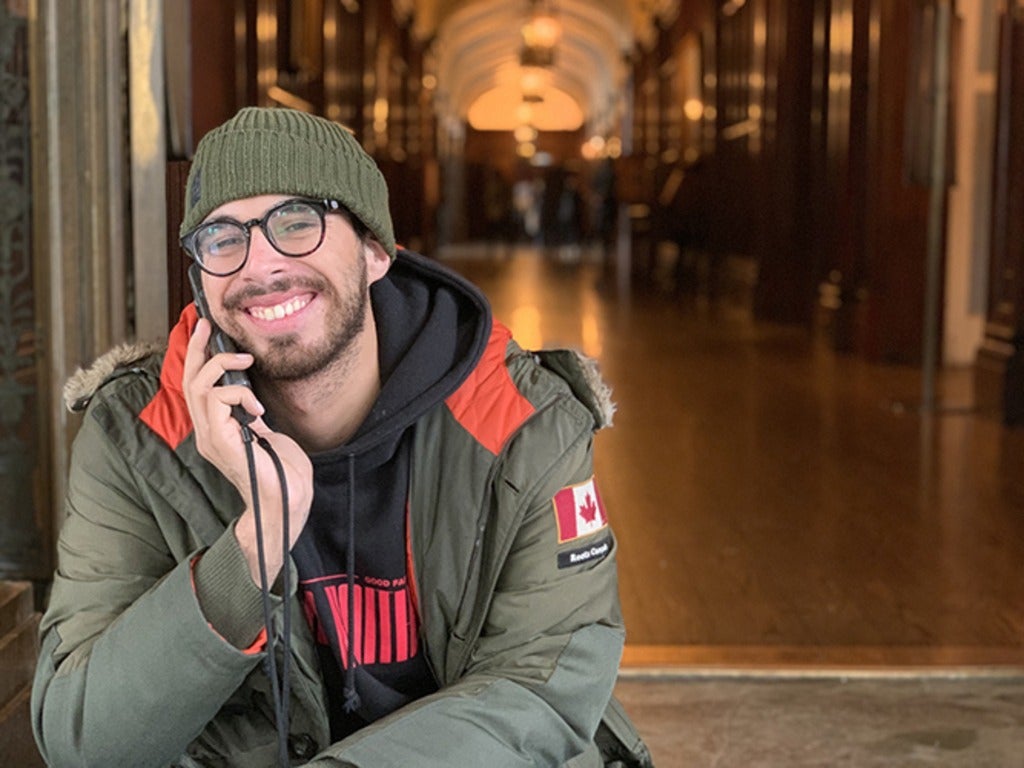
With some basic English, Andres Garcia Rodriguez left his family and home in Mexico to finish high school. He arrived first in Vancouver, attended a camp to improve his English. After he learned that there was a spot at a high school in Toronto, Rodriguez moved across the country.