News

Filter by:

Limit to news where the title matches:
Limit to items where the date of the news item:
Date range
Limit to news items where the audience is one or more of:
Limit to news items where the faculty or school is one or more of:
Wednesday, September 9, 2020

Chasing a dream

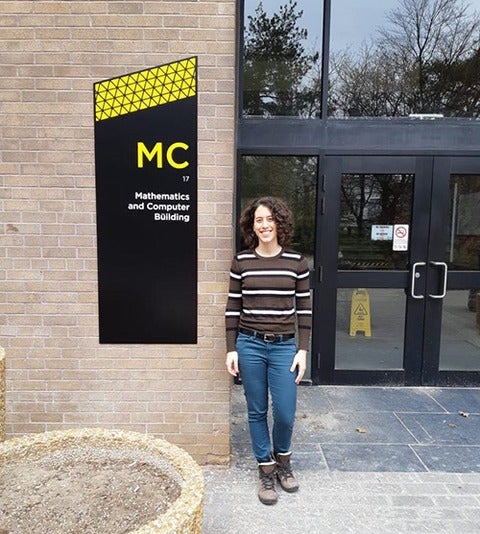
“While working as an instructional support assistant (ISA), I remember the first time a professor asked for a volunteer to teach a lecture while he was at a conference,” remembers Josué Kurke. “My hand shot up. I donned a professorial kind of jacket with the elbow patches and went all out. Over time, I’ve realized that I feel most at home in front of a classroom. I want to spend my career talking to people about math.”

With most classes continuing online in response to the COVID-19 pandemic, the University of Waterloo’s Faculty of Mathematics has had to adapt other aspects of campus life, such as orientation.

The Fall 2020 orientation week, which runs from September 1st to September 7th, is completely virtual.

The nearly 2,600 incoming Faculty of Mathematics students are therefore experiencing an orientation like none before. The faculty’s orientation teams have expended great effort to recreate the fun and interactive aspects that are usually experienced by incoming students.

The University of Waterloo and Rogers Communications partner on advanced research for Canadian-made 5G solutions in a real-world setting

The University of Waterloo has become one of the first 5G smart campuses in Canada as part of a partnership with Rogers Communications that leverages the University’s global leadership in computing, engineering and co-operative education.

Motivated by prior research that reports elevator buttons as a huge source of contamination, a new study co-authored by Waterloo Faculty of Math student presents a touchless elevator concept to slow the spread of COVID-19.

Prior research shows that elevator buttons produce the highest rate of bacterial contamination (97 per cent) and can house more germs than toilet stall surfaces. However, for many people (especially health-care and front line workers), elevators are a daily necessity.

Suppose you’re an archivist, librarian, or historian who’s trying to document and preserve for posterity a narrative of the COVID-19 pandemic or the ongoing Black Lives Matters protests. You’ll naturally be gathering documents from the web, and with tools available today it won’t be difficult to accumulate thousands or even millions of relevant records. How can you make sure that a scholar down the road can actually use the material that you’ve collected?

Friday, July 24, 2020

Rising to the challenge

Irene Melgarejo Lermas has never been one to shy away from a challenge. At the recommendation of a friend who studied at Waterloo, she moved from her native Spain to study quantum field theory at the Institute for Quantum Computing (IQC). In addition to tackling a complex subject in her second language, she was assigned to teach a class of 200 undergraduate students during her first semester. “I didn’t have any teaching experience at the time,” she remembers.