Exoskeletons that work with humans, not against them
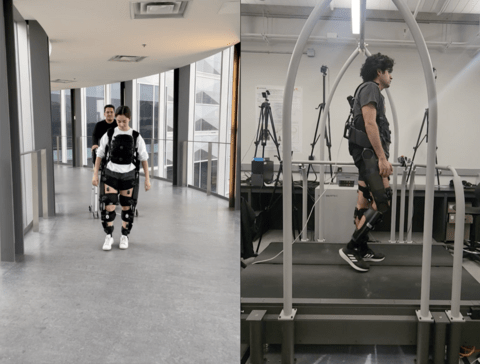
In the Arami Research Lab, researchers are developing next-generation exoskeletons that better align with natural human movement, rather than forcing patients to adapt to the device.
Dr. Sushanta Mitra, a professor in the department, along with two professors in chemical engineering, have been awarded $600,000 by the Natural Sciences and Engineering Research Council of Canada (NSERC) and Environment and Climate Change Canada (ECCC) through the Call for Proposals on Plastics Science and Innovation for a Cleaner and More Sustainable Future.
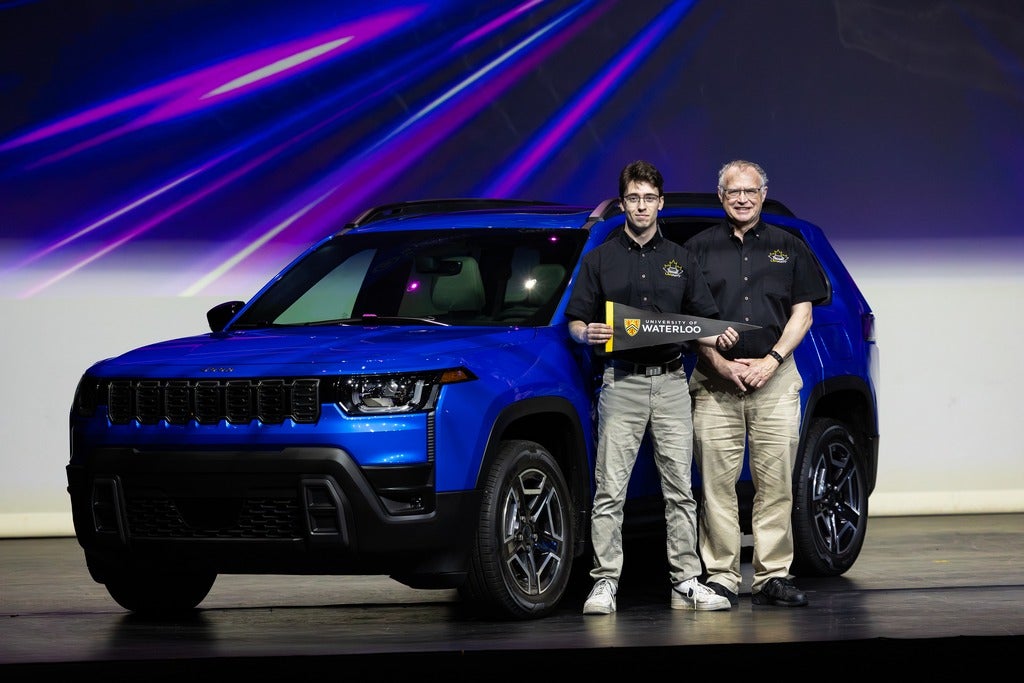
University of Waterloo Alternative Fuels Team (UWAFT), a mechanical and mechatronics-focused team, has been selected from among 20 universities across North America and is one of two Canadian universities to compete in the EcoCAR Innovation Challenge on the Stellantis track.
MME professor Amir Khajepour has been elected as a fellow to the Canadian Academy of Engineering (CAE)--one of the highest honours the profession bestows in Canada.
Capstone team Project Sisyphus designed and built an engine that uses regenerative cooling, circulating fuel through built-in channels to prevent the chamber from melting. The 3D-printed copper parts made through additive manufacturing also help with this.
For over three decades, co-op students like Smita Basak have helped drive innovation at Toyota Motor Manufacturing Canada.
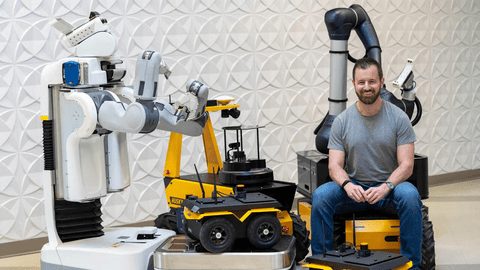
A research team led by Dr. Amir Khajepour, professor of mechanical and mechatronics engineering, has developed a new technology that uses cloud-based autonomous robots for routine tasks, such as moving equipment and supplies in hospitals and long-term care facilities.
Every year, students across engineering, including those in MME, culminate their program with a Capstone Design project to develop innovative ideas to advance an area of interest. Students also have the opportunity to take part in the Norman Esch Entrepreneurship Awards for Capstone Design, open to a broad audience, with the chance to win their share of $100,000 in prize money.
Cristiano Da Silva, a current mechanical engineering undergraduate, was part of the group Dreaming Objects, which won $50,000 at HARD MODE, an invite-only hardware and artificial intelligence hackathon hosted by the MIT Media Lab.
As research into cancer and potential treatments advances, life expectancy from past treatments continues to grow. However, this amazing progress is not without challenges; lymphedema remains a difficult-to-address complication. Lymphedema happens when lymph nodes are damaged or removed during radiation treatments, which stops lymphatic fluid from properly draining and can cause painful swelling. This is treated with compression therapy. However, the devices used are large and bulky, requiring significant power to operate. These factors make the device quite expensive, often costing up to $3,000, and require the patient to sit still while it runs.