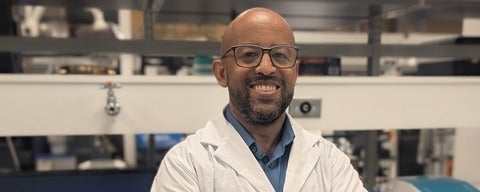
Tizazu Mekonnen’s water filtration innovation
Professor Tizazu Mekonnen’s research group has engineered a new method of capturing microplastics in water systems with 90 percent efficiency. The approach is customizable, inexpensive, easy to produce, and uses no toxic ingredients, making it promising for commercial and residential use.
Microplastics are ubiquitous and found in every corner of the planet. The problem is so prevalent that microplastics are also found in our bodies. A study from the National Institute of Health found microplastics can even be found in breast milk and can come from unexpected sources like your laundry.
“Our clothes are mostly a mix of Polyethylene terephthalate (PETs) in the form of polyester and cotton or pure polyester. When you pull out the dryer filter, you can see how much fiber it captures. Those are all microplastics and that filter can capture only a portion of it,” says Professor Tizazu Mekonnen.
Due to the high-speed spinning washing machines release even more microplastics, sending them into wastewater systems.