For Andrew Faller-Saunders, studying health meant looking beyond individual illnesses and understanding the bigger picture.
Drawn to the Waterloo's Health Sciences program, he wanted to explore how healthcare systems, policies, and social conditions influence health outcomes and contribute to inequities in care.
"What drew me to Health Studies (now Health Sciences) at Waterloo was the focus on understanding health at the systems level. The program pushed us to think beyond individual illness and examine the policies, structures, and social conditions that shape health outcomes and create inequities in care."
Today, Andrew works as an Evaluation Research Coordinator within Emergency and Mental Health Programs at North York General Hospital, where he helps assess innovative healthcare initiatives designed to improve patient care and health system performance.
Learning that health starts with communities

One of the most influential experiences during Andrew's time at Waterloo came through working with faculty and community partners.
He had the opportunity to support an evaluation of A Better Tent City in Kitchener-Waterloo, a community initiative focused on providing housing and support for individuals experiencing homelessness.
Working alongside residents transformed his understanding of health, equity, and community engagement.
"Being welcomed into that community and learning directly from residents deeply shaped how I think about health, equity, and care," he says.
The experience reinforced a lesson that continues to guide his career: meaningful healthcare improvement begins by listening to the people most affected by health challenges.
"Meaningful healthcare improvement starts with relationships, listening to communities, building trust, and designing care that reflects people's real lives."
What does an evaluation research coordinator do?
Many students interested in health careers are familiar with roles such as doctor, nurse, or therapist. Fewer know about the growing field of healthcare evaluation and research.
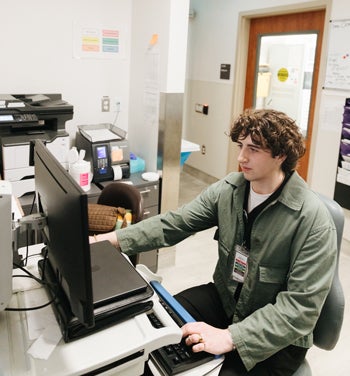
As an Evaluation Research Coordinator, Andrew helps healthcare organizations understand whether programs and innovations are improving care and achieving their intended outcomes.
"Evaluation is a tool that helps healthcare systems understand whether programs and innovations are improving care, and for whom," he explains.
His work sits at the intersection of research, clinical practice, and healthcare decision-making. He collaborates with clinicians, hospital leaders, community organizations, and funders to study how healthcare programs operate in real-world settings and identify opportunities for improvement.
The role requires balancing multiple perspectives, integrating evidence into decision-making, and adapting to the evolving challenges facing healthcare systems.
Evaluating innovative mental health and emergency care programs
At North York General Hospital, Andrew contributes to projects focused on emergency medicine, mental health, substance use care, and healthcare innovation.

His work includes evaluating:
- trauma-informed mental health crisis services in emergency departments
- programs designed to improve addiction and substance use care
- healthcare initiatives that connect hospital and community-based services
- emerging artificial intelligence tools that support clinical decision-making
- projects aimed at improving discharge planning and patient safety
Many of these initiatives involve partnerships between hospitals and community organizations.
"Improving healthcare often requires thinking beyond hospital walls and strengthening connections across the system."
By evaluating what works, for whom, and under what circumstances, his research helps healthcare teams make informed decisions that improve patient experiences and outcomes.
How Waterloo Health Sciences prepared him for this career
Andrew credits Waterloo's Health Sciences program with helping him develop a systems-thinking approach that remains central to his work.
The program encouraged students to consider how policies, social determinants of health, and community experiences influence health and healthcare access.
This perspective is particularly valuable in healthcare evaluation, where success depends on understanding the complex relationships between patients, providers, organizations, and communities.
The program also emphasized collaboration, critical thinking, community engagement, and evidence-based decision-making, skills that Andrew now applies daily as he works with healthcare leaders, researchers, clinicians, and community partners.
The hidden side of healthcare
One of the biggest misconceptions Andrew encounters is that healthcare improvement happens only through direct patient care.
In reality, countless professionals work behind the scenes to ensure healthcare services are effective, equitable, and responsive to community needs.
"One thing many people don't realize is how much work happens behind the scenes to understand whether healthcare programs are making a difference," he says.
Evaluation helps connect research, clinical expertise, and lived experience to guide decisions about how healthcare services should evolve.
"Evaluation is not just about measuring outcomes. It is about asking whether our systems are actually working for the people who need them most."
Why health sciences matters
Andrew's career highlights the diverse opportunities available to graduates of Waterloo's Health Sciences program.
For students interested in healthcare but not necessarily pursuing a clinical profession, Health Sciences offers pathways into health policy, research, evaluation, public health, healthcare administration, community health, and system improvement.
His journey demonstrates how understanding health from a systems perspective can lead to meaningful work that impacts patients, providers, and entire communities.
Whether evaluating innovative mental health programs, strengthening partnerships between hospitals and community organizations, or helping healthcare leaders make evidence-informed decisions, Andrew continues to apply lessons first learned in Waterloo's Health Sciences classrooms.
As he puts it, "better healthcare starts with listening."
Next steps
- Learn how co-op can help you explore career paths and gain work experience.
- Take our quiz to find the Health program that's right for you.
- Sign up for our monthly newsletter to get program updates, tips and event invitations.