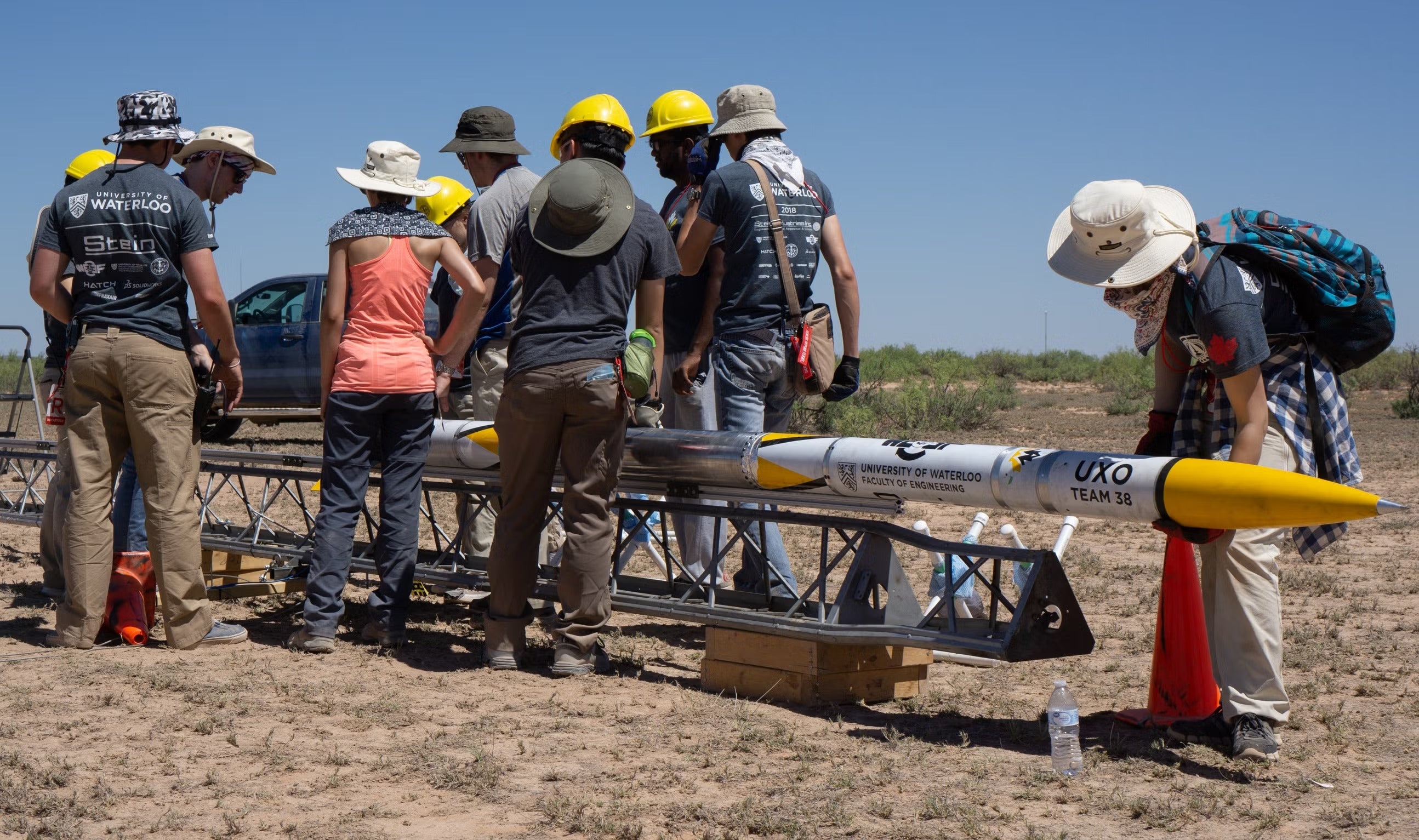
What does it take to build a world-record-setting rocket? For students on the University of Waterloo Rocketry Team, it takes teamwork, innovation, and plenty of hands-on learning.
The Rocketry Team has reached a new milestone, breaking the world record for the highest altitude achieved by an amateur liquid-fuel rocket. At the 2026 Launch Canada Challenge in Timmins, Ontario, Waterloo's Polaris rocket soared to an altitude of 63,497 feet, surpassing the previous record of 56,590 feet.
Built by engineering, math, science, and arts students, Polaris is the result of years of innovation, teamwork, and hands-on learning. As Luca Scavone, a fourth-year Systems Design Engineering student and team co-lead, says “our success is built on years of consistent incremental improvements and carefully reigned in ambition.”
From designing and testing rocket systems to analyzing flight data, team members gain practical experience that complements their classroom studies while tackling real-world engineering challenges.
My favourite part is working through it all together as a team and making an impossible challenge possible.
The Rocketry Team is one of Waterloo’s 25+ student design teams, giving students the opportunity to build technical skills, make industry connections, and work on ambitious projects outside the classroom.
From internships and co-op opportunities with organizations like SpaceX and the Canadian Space Agency to world-record breaking accomplishments, the Waterloo Rocketry Team shows what students can achieve when they take their learning beyond the classroom.
Read the full story: Waterloo’s student rocketry team breaks a world record!