Future students

Enriched narratives can reduce cybersickness in virtual reality (VR) for people with little-to-no video game experience, according to a new study by researchers from the University of Waterloo’s Multisensory Brain and Cognition (MBC) Lab in the Department of Kinesiology and the Games Institute.
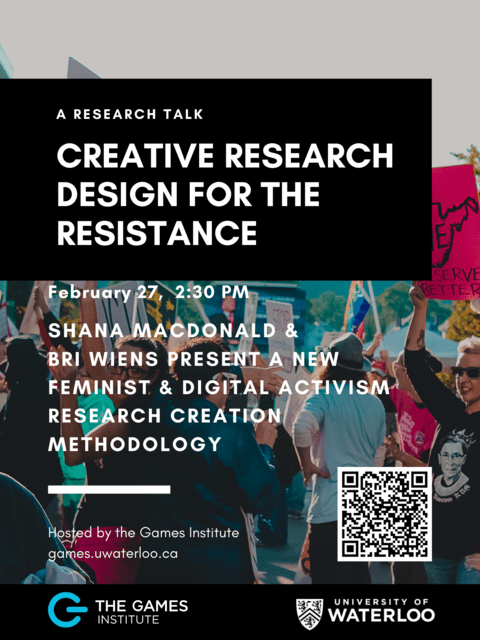
Thursday, February 27, 2020 2:30 pm - 2:30 pm EST (GMT -05:00)

Brown Bag Talk: Creative Research Design for the Resistance with Bri Wiens & Shana MacDonald

Abstract

This research talk draws on new materialist and intersectional, trans, and queer feminist modes of social inquiry to situate all bodies, human and nonhuman, and affects in relations of matter and mattering. Through a discussion of three of our projects–-Reconstruction (2016), Feminists Do Media (2019–present), and Let Us Speak (2020)––we will explore how our existing research creation methodologies developed thro

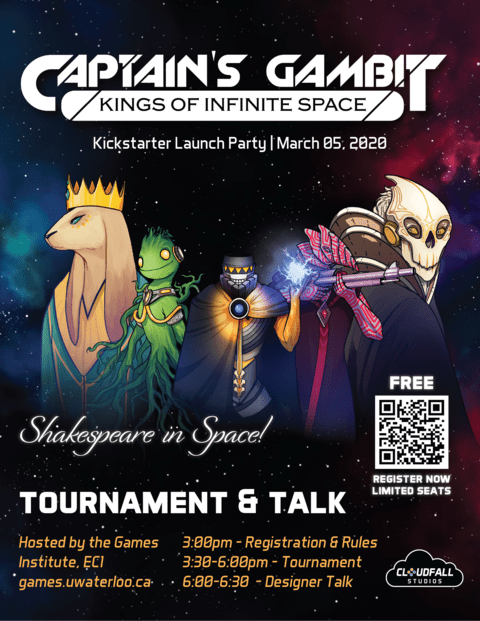
Friday, March 6, 2020 3:00 pm - 6:30 pm EST (GMT -05:00)

Captain's Gambit Kickstarter Launch Party: Talk & Tournament

Register on Eventbrite

We're hosting a Captain's Gambit launch party, followed by a research/industry talk by the game's UX designer, AC Atienza. Play the game and then learn firsthand about the game development process: AC will discuss the process behind the research, international collaborative efforts, and iterative playtesting at the Games Institute.

The Haptic Computing Lab (HCL), led by Human-Computer Interaction (HCI) Prof. Oliver Schneider, launched their website this week. HCL is a group of interdisciplinary scholars from the University of Waterloo, joined in their collective goal to research haptic computing tools and touch systems to better understand how to assist the creation, deployment, and study of haptic technologies.

Dr. Aynur Kadir, GI faculty member and Assistant Professor from Communication Arts, presented "Collaborative Indigenous Media: Participatory design for Indigenous Art and Cultural Heritage" at Waterloo Women's Wednesdays event about Community-Based Digital Storytelling.

Wisdom science, an interdisciplinary field of studies that looks at sound judgment and decision making, suggests that people can be guided by rational or reasonable standards when making gaming decisions. How can we better understand the difference between rationality through studying behaviour in socially-oriented games?

The interdisciplinary Games and Narrative reading group is a newly launched initiative, imagined by Dr. Ken Hirschkop, Professor of English Language and Literature. With Dr. Hirschkop's guidance, graduate students who join the reading group will explore how the fields of Narrative Theory and Game Studies intersect and inform one another.

NB: This blog article was written by Grace VanDam who worked here as our wonderful Operations Assistant from September-December, 2019