PhD Seminar • Data Systems • On Sampling From Data With Duplications
Please note: This PhD seminar will be given online.
Alireza Heidarikhazaei, PhD candidate
David R. Cheriton School of Computer Science
Supervisor: Professor Ihab Ilyas
Alireza Heidarikhazaei, PhD candidate
David R. Cheriton School of Computer Science
Supervisor: Professor Ihab Ilyas
Andrew Beach, Master’s candidate
David R. Cheriton School of Computer Science
Supervisor: Professor Peter Buhr
The Cforall programming language is an evolutionary refinement of the C programming language, adding modern programming features without changing the programming paradigms of C. One of these modern programming features is more powerful error handling through the addition of an exception handling mechanism (EHM).
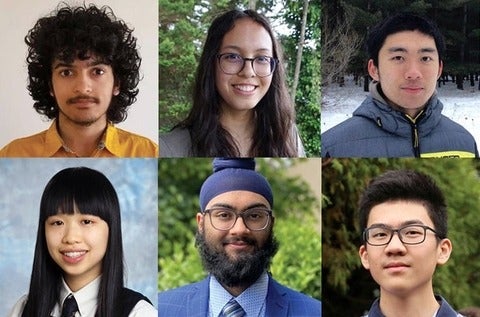
The Cheriton School of Computer Science welcomes Saptarshi Bhattacherya, Alicia Bremer, Andrew Dong, Heidi Hon, Kushal Mujral and Eric Pei — six outstanding first-year students who have distinguished themselves academically as recipients of the prestigious Schulich Leader Scholarship.
Saira Rizvi, Master’s candidate
David R. Cheriton School of Computer Science | Department of Statistics and Actuarial Science
Supervisor: Professor Charles Clarke
Futian Zhang, Master’s candidate
David R. Cheriton School of Computer Science
Supervisor: Professor Edward Lank
Smart TVs are getting popular in recent few years. Given the emerging feature of distant bare hand control, one challenge is how to perform common tasks with this new input modality. Two tasks are discovered in this thesis including video timeline control task and object pointing task.
Researchers at the Cheriton School of Computer Science are working on new systems that increase the correctness and reliability of health-related searches.
Xue Jun Wang, Master’s candidate
David R. Cheriton School of Computer Science
Supervisor: Professor Maura Grossman
Akshay Ramachandran, PhD candidate
David R. Cheriton School of Computer Science
Supervisor: Professor Lap Chi Lau
It’s no secret that our everyday technologies gather personal data. But these increasingly entrenched conveniences, from Internet of Things–enabled smart TVs to online voting systems to crowdfunding platforms, can also perform harmful surveillance.
Knowing how tools track user behaviour and collect personal information is important. Understanding their implications for social inequality within Canada and globally is perhaps even more pressing. What’s more, the challenge demands multiple areas of expertise.
Jay Henderson, PhD candidate
David R. Cheriton School of Computer Science
Supervisor: Professor Edward Lank