PhD Seminar • Algorithms and Complexity — Approximate Shortest Paths and Distance Oracles in Weighted Unit-Disk Graphs
Dimitrios Skrepetos, PhD candidate
David R. Cheriton School of Computer Science
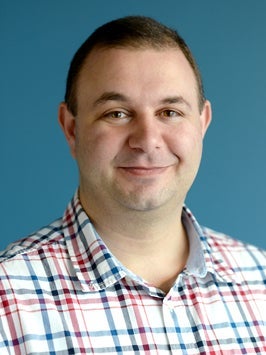
Dimitrios Skrepetos, PhD candidate
David R. Cheriton School of Computer Science
Rachel Pottinger, Department of Computer Science
University of British Columbia
Users are faced with an increasing onslaught of data, whether it's in their choices of movies to watch, assimilating data from multiple sources, or finding information relevant to their lives on open data registries. In this talk I discuss some of the recent and ongoing work about how to improve understanding and exploration of such data, particularly by users with little database background.
Barzan Mozafari, Department of Computer Science and Engineering
University of Michigan
Lei Zou, Institute of Computer Science and Technology
Peking University
Edward Cheung, PhD candidate
David R. Cheriton School of Computer Science
The following is excerpted from an article by Simona Chiose, published in the Globe and Mail on April 16, 2018
When Joanne Atlee was an undergraduate student in computer science, more than a third of her class was made up of women. In graduate school, those ranks began to thin out, a decline that has continued through much of her career as a professor at the University of Waterloo.
“All of a sudden I am an instructor at Waterloo and 10 per cent of the class is female and it’s ‘Oh no, what happened?’”
Rafael Olaechea Velazco, PhD candidate
David R. Cheriton School of Computer Science
Software behavioural models, such as finite state machines, are used as an input to model checking tools to verify that software satisfies its requirements. As constructing such models by hand is time-consuming and error-prone, researchers have developed tools to automatically extract such models from systems’ execution traces.

Weicong Ma, Master’s candidate
David R. Cheriton School of Computer Science
Chunhao Wang, PhD candidate
David R. Cheriton School of Computer Science
We present a quantum algorithm for simulating the dynamics of Hamiltonians that are not necessarily sparse. Our algorithm is based on the assumption that the entries of the Hamiltonian are stored in a data structure that allows for the efficient preparation of states that encode the rows of the Hamiltonian. We use a linear combination of quantum walks to achieve a poly-logarithmic dependence on the precision.