Seminar • Systems and Networking • Co-designing Distributed Systems and Storage Stacks for Reliability and Performance
Please note: This seminar will be given online.
Ramnatthan Alagappan, Postdoctoral Researcher
VMware Research Group, VMware
Ramnatthan Alagappan, Postdoctoral Researcher
VMware Research Group, VMware
Aishwarya Ganesan, Postdoctoral Researcher
VMware Research Group, VMware
The biosphere, the zone in which life on Earth is found, contains an estimated 10 million multicellular species. But perhaps the most surprising fact about life on Earth is how little we know about its diversity. Only 2 million species are known to science — organisms that have been studied in sufficient detail to at least be described, classified and given a scientific name. With at least another 8 million species yet to be discovered, cataloguing the diversity of life is in many ways a moonshot — a vast endeavour that succeeds by bringing together specialists across many disciplines.
Andrew Tinits, Master’s candidate
David R. Cheriton School of Computer Science
Supervisor: Professor Stephen Mann
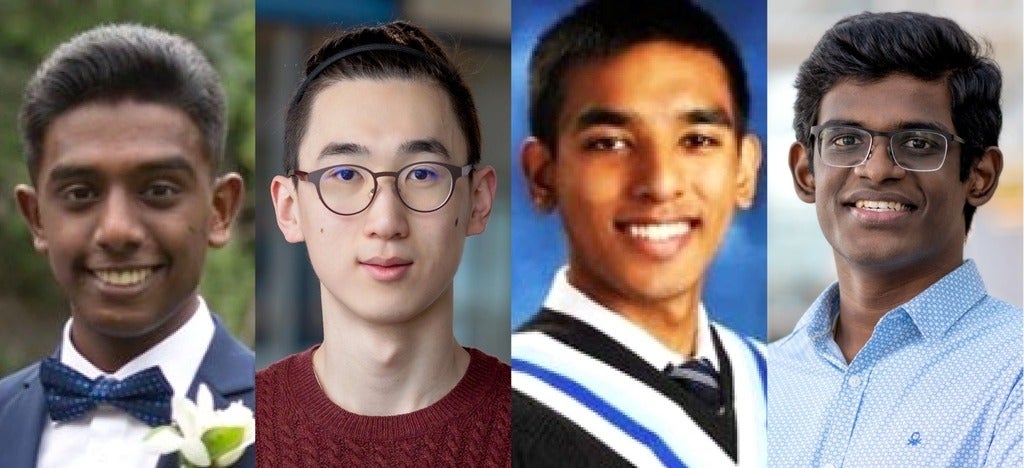
Four students at the Cheriton School of Computer Science are recipients of the Computing Research Association’s 2022 Outstanding Undergraduate Researcher Awards. The annual CRA awards program recognizes undergraduate students from universities across North America who have distinguished themselves by conducting exceptional research in an area of computer science.
Priya Donti
Computer Science Department
Department of Engineering & Public Policy
Carnegie Mellon University
Thierry Delisle, PhD candidate
David R. Cheriton School of Computer Science
Supervisor: Professor Peter Buhr
What is the polite way for computer programs to procrastinate?
Postponing work politely means not preventing the progress of others, which requires taking turns letting others make eventual progress. When this happens quickly, there is the illusion of simultaneity and possibly real simultaneity.
David Doermann
Department of Computer Science and Engineering
School of Engineering and Applied Sciences
Institute for Artificial Intelligence
University at Buffalo
A team of computer scientists has developed a new system that recognizes near-keyboard hand gestures to expand laptop interaction.
The new technology is an innovation in the field of human-computer interaction and allows users to give commands that would otherwise involve keyboard shortcuts or mouse round-trips.
Egill Gudmundsson, Master’s candidate
David R. Cheriton School of Computer Science
Supervisor: Professor Olga Vechtomova