Seminar

Monday, November 26, 2018 10:30 am - 10:30 am EST (GMT -05:00)

Seminar • Cryptography, Security, and Privacy (CrySP) — Securing Cloud-assisted Services

N. Asokan, Department of Computer Science
Aalto University, Finland

All kinds of previously local services are being moved to cloud settings. While this is justified by the scalability and efficiency benefits of cloud-based services, it also raises new security and privacy challenges. Solving them by naive application of standard security/privacy techniques can conflict with other functional requirements. In this talk, I will outline some cloud-assisted services and the conflicts that arise while trying to secure these services.

Verena Kantere
School of Electrical Engineering and Computer Science, University of Ottawa

Big Data analytics in science and industry are performed on a range of heterogeneous data stores, both traditional and modern, and on a diversity of query engines. Workflows are difficult to design and implement since they span a variety of systems. To reduce development time and processing costs, some automation is needed.

Monday, November 26, 2018 2:00 pm - 2:00 pm EST (GMT -05:00)

PhD Seminar • Quantum Computing / Information — Perfect Embezzlement of Entanglement

Li Liu, PhD candidate
David R. Cheriton School of Computer Science
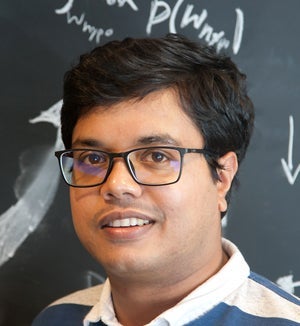
Entanglement is a type of resource used in quantum information theory that gives correlations that cannot be simulated using classical probability theory. It is known that entanglement cannot be created locally. 

Andreas Stöckel, PhD candidate
David R. Cheriton School of Computer Science

The artificial neurons typically employed in machine learning and computational neuroscience bear little resemblance to biological neurons. They are often derived from the “leaky integrate and fire” (LIF) model, neglect spatial extent, and assume a linear combination of input variables. It is well known that these simplifications have a profound impact on the family of functions that can be computed in a single-layer neural network. 

Thursday, November 29, 2018 10:30 am - 10:30 am EST (GMT -05:00)

Mathematics Education Seminar • Penny For Your Thoughts? The Power of Mathematical Reflection

Nick Rollick, Graduate student
Department of Pure Mathematics

For this week's seminar, I invite you to join me for an informal chat about my experiences using "reflective responses" in my elementary number theory course. In these bi-weekly formal reflective assignments, my students were asked to set and monitor learning goals, identify gaps in understanding, and ponder the value and importance of their course material. Most importantly, I responded in detail to every student's reflection, creating a meaningful course-long conversation.

Wednesday, November 28, 2018 12:15 pm - 12:15 pm EST (GMT -05:00)

PhD Seminar • Data Systems — Generalized Transaction Durability Model

Jaemyung Kim, PhD candidate
David R. Cheriton School of Computer Science

Transaction durability guarantees the ability to recover committed transactions from failures. However, making every transaction durable impacts transaction processing performance. Some ad-hoc durability mechanisms (e.g., delayed durability) improve performance, but they risk transactions losing their effects due to failures. The current one-size-fits-all transaction durability model does not solve this problem.

Anastasia Kuzminykh, PhD candidate
David R. Cheriton School of Computer Science

Video-mediated communication has long struggled with asymmetrical constraints on situational awareness, especially in hybrid work meetings between collocated and remote participants. Advances in computer vision offer exciting opportunities to augment mediated situational awareness, but we must first understand what is meaningful to capture and present.