Princess Margaret Cancer Centre has awarded resources equivalent to $250,000 to Professor Ana Crisan through its Cancer Digital Intelligence team, supporting her research under the 2025–26 Grand Challenge: From AI Algorithm to Implementation.
The resources will support MedDataOS: A Human-Centered Multi-Agent Framework for Biomedical Data Analysis, a research project led by Professor Crisan that aims to develop a multi-agent AI system to integrate and analyze clinical data on head and neck cancers. Support from Princess Margaret Cancer Centre is provided as in-kind resources, and includes project management, analyst, developer and data scientist expertise.
“Congratulations to Ana on receiving this support to help improve healthcare outcomes for patients with cancer,” said Raouf Boutaba, University Professor and Director of the Cheriton School of Computer Science. “This award is an important part of Waterloo’s recent partnership with Princess Margaret Cancer Centre. It brings together Ana’s strengths in data visualization and artificial intelligence with Princess Margaret’s clinical expertise to create a collaborative tool to integrate patient data.”
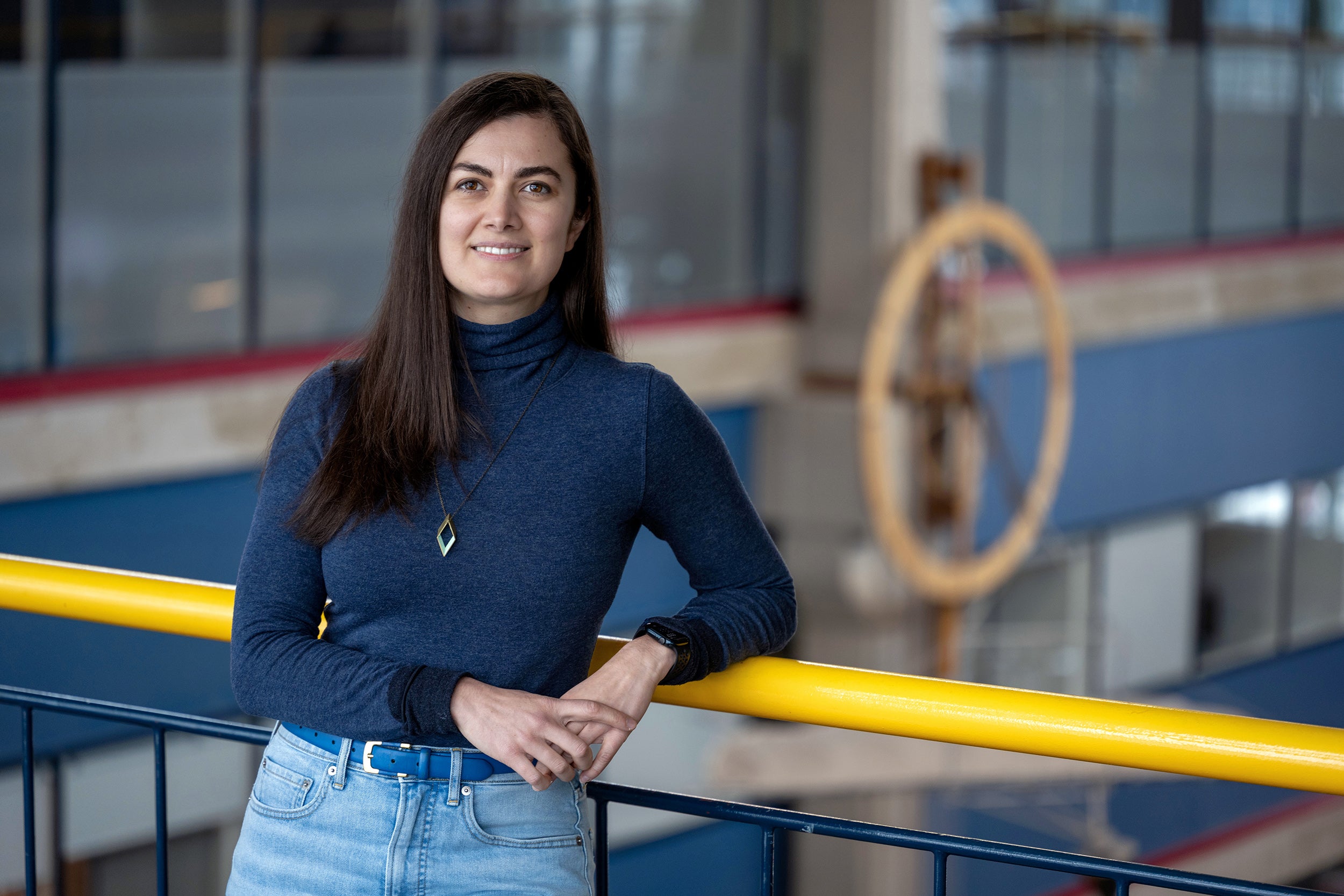
Ana Crisan is an Assistant Professor at the Cheriton School of Computer Science. Her interdisciplinary research lies at the intersection of human–computer interaction, data visualization, and applied AI and machine learning, with a focus on developing human-centered, transparent and trustworthy AI systems. She also designs interactive visualization tools to support data-driven decision-making and applies data science and visualization to advance research in medicine, healthcare and public health.
She leads the Intelligent Systems for Guided, Human-Centered Technology (INSIGHT) Lab, a research team advancing the next generation of intelligent systems that empower people to make complex, data-driven decisions.
More about this research
Diagnosing head and neck cancers requires clinicians to synthesize diverse clinical information from multiple sources and systems. These data range from imaging studies such as CT scans and pathology reports to surgical notes and electronic health records. Because no single tool can manage all of these data types, clinicians often integrate information manually, a process that is both time consuming and prone to error. While artificial intelligence has been proposed as a solution, the heterogeneity and complexity of biomedical data challenge even the most advanced models.
Professor Crisan’s newly funded project will address this challenge by developing an iterative, modular system that combines specialized AI agents with human oversight.
Over the year-long funding period, Professor Crisan will collaborate with Dr. Benjamin Haibe-Kains, Senior Scientist at Princess Margaret Cancer Centre and Executive AI Scientific Director and Co-Director of the UHN AI Hub, along with Dr. Jun Ma, AI Scientist at Princess Margaret Cancer Centre, and Princess Margaret’s Cancer Digital Intelligence team to advance the capabilities of MedDataOS. Their work will focus on enabling the platform to ingest and analyze a broader range of clinical data types and enhancing the application to ensure strong clinical impact.
“With support from Princess Margaret Cancer Centre, we will develop MedDataOS, a human-centered, multi-agent system that jointly queries and analyzes diverse biomedical data to support diagnosis and biomarker identification in patients with head and neck cancers,” Professor Crisan explains. “Our approach will integrate smaller, specialized AI models with existing biomedical tools tailored to specific data sources such as electronic health records, CT scans and surgical reports, and then orchestrate them using a central AI agent that allows natural language interaction with patient data.”
The research builds on an existing prototype developed by Professor Crisan’s team that uses two AI agents, one for tabular clinical data and another for CT image data. These agents are coordinated through a central orchestrator that processes clinician queries through a web-based conversational interface.
“Working with Ana and the INSIGHT Lab is an exciting step toward solving the real-world challenge of data fragmentation in oncology,” says Dr. Ma. “By integrating diverse sources such as pathology and clinical data into a single modular system, we look forward to improving healthcare outcomes and diagnosis for patients with head and neck cancer.”
This modular design offers several key advantages. It is more flexible and often more cost-effective than large foundation models. Moreover, individual agents can be updated or replaced without retraining the entire system. It also improves transparency by clearly showing how each type of data is processed and analyzed.
“Agentic AI systems have enormous potential to carry out complex analyses efficiently and comprehensively,” says Dr. Haibe-Kains. “But they also come with real risks. Agents can confabulate or follow the wrong analytical path, so we need to design the right kind of human supervision to keep these systems trustworthy and clinically safe.”
The goal for MedDataOS is to serve as a real-time collaborative tool that allows clinicians to interact with multiple patient data sources during diagnosis, while also acting as an always-on analyst capable of scanning patient cohorts to identify candidate biomarkers for treatment. The project’s ultimate goal is to improve patient care directly while providing a transparent, practical alternative to costly foundation models.