Drug development is an arduous process that costs billions of dollars and can last for years or even decades. Whether scientists are trying to understand the potential interactions of two drugs or develop new applications for an existing medication, pharmaceutical research features frequent wrong turns and dead ends.
An interdisciplinary team of researchers at the University of Waterloo are using machine learning to dramatically increase the speed of drug development. “We have a lot of existing data across a broad spectrum of medical domains, but it’s extremely complex, and often not as complete or extensive as we would like,” explains Dr. Helen Chen, professor of practice in Public Health Sciences. “It’s like a very shallow ocean.”
Professor Chen teamed up with Bing Hu, a PhD candidate in Computer Science, to build a machine learning model that can analyze and synthesize large amounts of pharmaceutical research data and predict a drug’s properties and interactions.
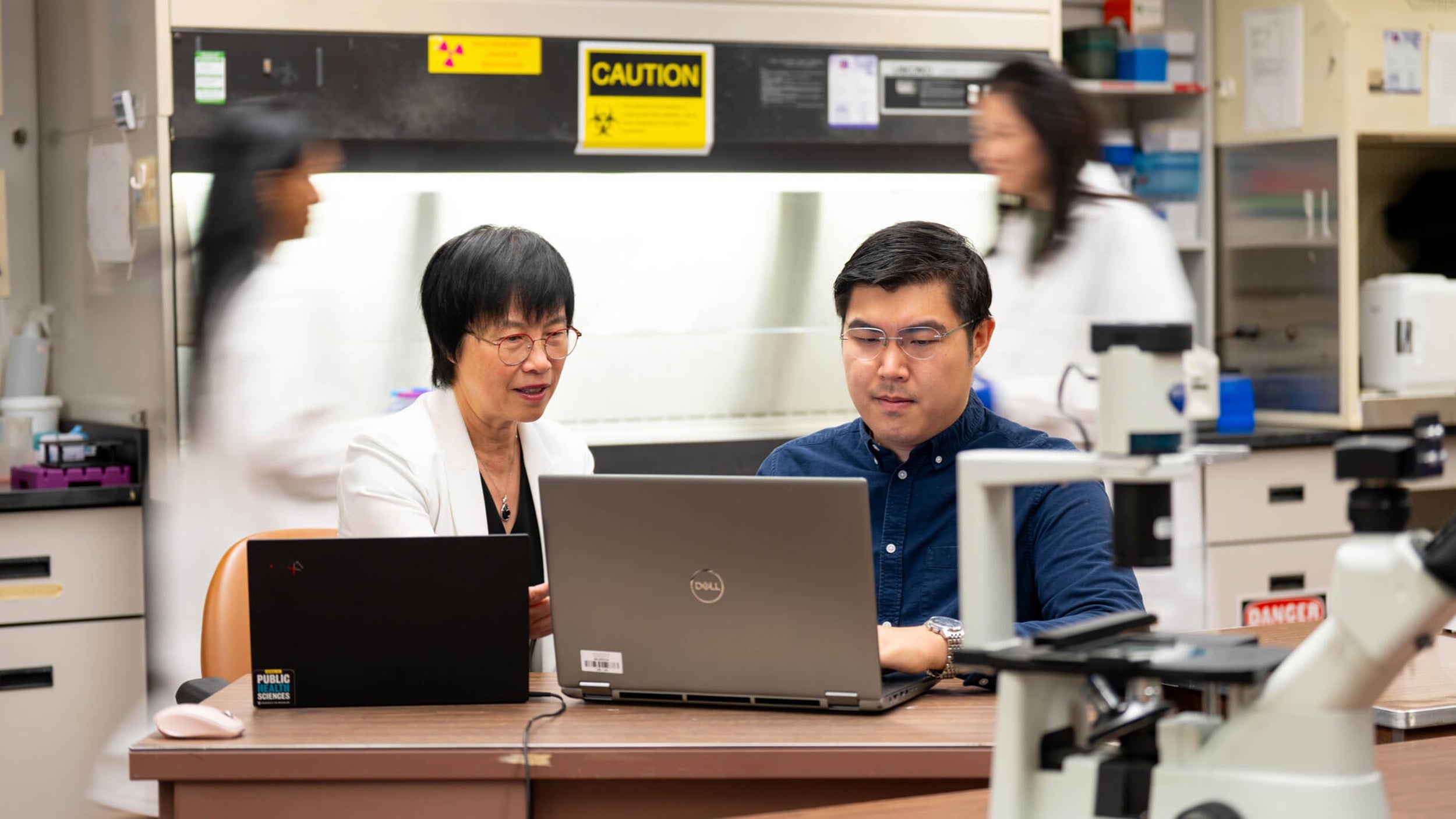
Left to right: Professor Helen Chen of the School of Public Health Sciences, cross-appointed to the Cheriton School of Computer Science, and Computer Science PhD candidate Bing Hu
Bing Hu’s research focuses on applying artificial intelligence to drug discovery and use of synthetic data. His work applies generative AI diffusion models to solve the challenge of data overlap sparsity to accelerate drug discovery research by generating high-quality synthetic data.