Current students

Please note: This master’s thesis presentation will be given online.

Colin Vandenhof, Master’s candidate
David R. Cheriton School of Computer Science

Reinforcement learning (RL) is a powerful tool for developing intelligent agents, and the use of neural networks makes RL techniques more scalable to challenging real-world applications, from task-oriented dialogue systems to autonomous driving. However, one of the major bottlenecks to the adoption of RL is efficiency, as it often takes many time steps to learn an acceptable policy. 

Please note: This master’s thesis presentation will be given online.

Johann Wentzel, Master’s candidate
David R. Cheriton School of Computer Science

Please note: This PhD seminar will be given online.

Sasha Vtyurina, PhD candidate
David R. Cheriton School of Computer Science
Voice-based assistants have become a popular tool for conducting web search, particularly for factoid question answering. However, for more complex web searches their functionality remains limited, as does our understanding of the ways in which searchers can best interact with audio-based search results.

A team of Waterloo computer science students have helped create a web-based data-gathering platform that has been promoted by the City of Montreal’s public health authority to its citizens in an effort to flatten the curve of COVID-19 cases in that city.

Professor Shai Ben-David has been appointed a University Research Chair in recognition of his outstanding contributions to machine learning theory, logic, the theory of distributed computation and complexity theory. This prestigious title may be held for up to seven years and is conferred to recognize the exceptional achievements of Waterloo faculty members and to acknowledge their pre-eminence in a field of knowledge.

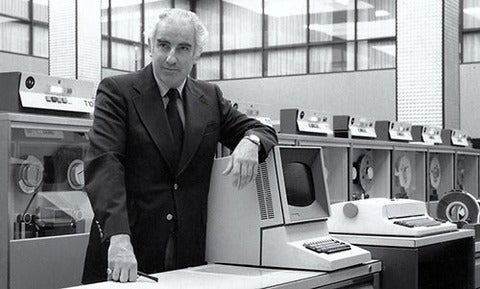
In 1967, Canadians celebrated the country’s 100th birthday and the future seemed full of hope and boundless potential. But at the University of Waterloo the future had already arrived in the newly built Math and Computer building’s Red Room. It was there that an IBM 360 Model 75 was housed — the most powerful computer in Canada at the time and the same model NASA used to do the critical calculations to send astronauts to the moon.