News

Filter by:

Limit to news where the title matches:
Limit to items where the date of the news item:
Date range
Limit to news items where the audience is one or more of:

In 1967, Canadians celebrated the country’s 100th birthday and the future seemed full of hope and boundless potential. But at the University of Waterloo the future had already arrived in the newly built Math and Computer building’s Red Room. It was there that an IBM 360 Model 75 was housed — the most powerful computer in Canada at the time and the same model NASA used to do the critical calculations to send astronauts to the moon.

Tuesday, April 7, 2020

Calculating the future

With the sweeping arrival of COVID-19, Marcelo Cortes, a former computer science undergraduate student, was quick to realize the devastating impact it could have on small, local businesses.

As chief technology officer and co-founder of Faire, an online wholesale marketplace that helps emerging brands and boutique retailers grow their business, Cortes recognized that more help needed to be offered.  

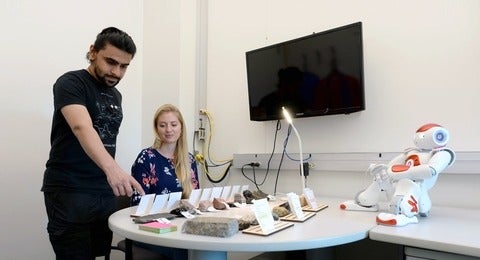
Cheriton School of Computer Science Professor Jesse Hoey has had a curious career trajectory.

His academic life began with an undergraduate degree in physics, followed by a master’s in physical oceanography, then a PhD in computer science with specialization in artificial intelligence. He even had a stint working with occupational therapists as part of his postdoctoral studies, where he applied his expertise in AI to develop assistive technologies for people with dementia.

Media, government, and industry commonly frame security and privacy as diametrically opposed: protecting one requires sacrificing the other. 

Privacy, Infrastructures, Policy brought together researchers with international speakers from journalism, national security, academia and the corporate world to challenge these misconceptions. A central thread of each of the talks is the design, implementation, and benefits of privacy-enhancing social and technological infrastructures.

University Professor Ming Li, the Canada Research Chair in Bioinformatics, and his colleague Professor Paul Vitányi at Centrum Wiskunde and Informatica in the Netherlands have received one of seven 2020 McGuffey Longevity Awards from the Textbook & Academic Authors Association for An Introduction to Kolmogorov Compl