Hasan Ahmet Gokce | MA graduate, Rhetoric and Communication Design
For Hasan Ahmet Gokce, a graduate of the University of Waterloo’s MA in Rhetoric and Communication Design, language has always been more than words on a page—it’s a bridge between cultures, a tool for empathy, and a means to inspire the next generation.
“As someone who has lived through the experience of learning new languages and adapting to new cultures, I know how powerful words can be in helping children feel at home,” he says. “That personal journey is what drives my work.”
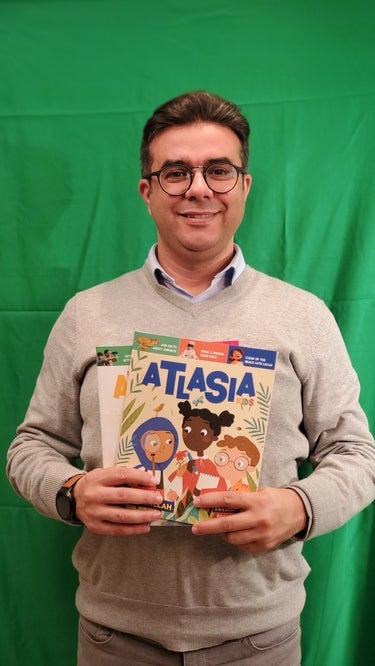
Today, that philosophy comes to life through Atlasia Kids, a globally distributed, multilingual magazine that helps immigrant children embrace their identities while adapting to life in new environments.
From literary scholarship to cross-cultural innovation
Before arriving at Waterloo, Hasan Ahmet had already completed multiple graduate degrees and spent years studying the literature and languages of the Eastern world, including Arabic, Persian, and Turkish. A visiting research position at Conrad Grebel’s Peace and Conflict Studies program deepened his interest in bridging Eastern and Western narratives—and led him to Waterloo’s Rhetoric and Communication Design program.
“Waterloo was the perfect place to connect my academic background with new frameworks,” Hasan Ahmet says. “The program’s interdisciplinary focus helped me turn research into real-world impact.”
His Major Research Project (MRP) laid the groundwork for Atlasia Kids. Focused on how a children’s magazine could support the integration of immigrant children into Canadian society, the project explored language development, emotional well-being, and cultural connection. “I wanted to create something that helped newcomer children feel seen and supported,” Hasan Ahmet explains. “That project became the foundation for Atlasia Kids. It also showed me that research doesn’t have to stay in the library. It can transform into initiatives that touch lives far beyond academia.”
A magazine with global reach
One of the most transformative courses Hasan Ahmet took at Waterloo was The Rhetoric of the Selfie, led by Dr. Aimée Morrison. A project analyzing Instagram selfies of children reading magazines revealed patterns in engagement and identity-building—insights that shaped the digital strategy for Atlasia Kids.
“Social media became more than a marketing tool—it was a way to listen, connect, and understand what kids respond to,” Hasan Ahmet says.
Launched shortly after graduation in 2021, Atlasia Kids has expanded far beyond Canada. Published in English, German, Russian, and Dutch—with French, Turkish and Arabic editions on the way—the magazine recently won The Best of Stories award from Narrative House and was featured at the Bologna Children’s Book Fair.
Today, it reaches families in more than 50 countries and has become a trusted resource for educators, libraries, and community programs that work with newcomer children.
“It’s more than a magazine,” he says. “It’s a space where children can see themselves reflected, improve their language skills, and connect with their culture.”
Themed editions, like the Atlasia Ramadan Journal, have also been introduced and have been widely embraced by families and communities across North America.
Beyond Atlasia: A broader publishing mission
In addition to leading Atlasia Kids, Hasan Ahmet is Editor-in-Chief of two other periodicals—Nevbahar, a family magazine, and Filozof, a children’s publication—while also publishing bilingual books through multiple international imprints.
His goal? To build a library of inclusive, empowering content for children around the world.
His publications have been recognized in international forums on education, intercultural dialogue, and children’s media—further establishing him as a voice in global conversations on inclusivity.
With plans to launch digital tools, expand into more languages, and collaborate with schools and community programs, he envisions Atlasia Kids becoming a global leader in inclusive children’s media.
“I want it to be a trusted companion for children everywhere—a friend that celebrates who they are and helps them grow into curious, confident individuals.”
A degree with lasting impact
Reflecting on his time at Waterloo, Hasan Ahmet credits the program with equipping him to lead meaningful, global projects. “The critical thinking, creativity, and cross-cultural awareness I developed at Waterloo were instrumental,” he says. “It wasn’t just an education—it was the beginning of something much bigger. My philosophy is simple: every story is a bridge, and when we build enough bridges, we make the world a connected, compassionate place for the next generation.”
From theory to practice, and from research paper to global publication, Hasan Ahmet’s story is a powerful reminder of the far-reaching impact of language, literature, and the pursuit of inclusive narratives.