Brian Kim | MA candidate, Psychology
For Brian Kim, a master’s student in Psychology at the University of Waterloo, the path to graduate research began with a deep curiosity about how we remember. That interest took root during his undergraduate degree—also at Waterloo—when he worked as a research assistant in Dr. Myra Fernandes’ Cognitive Neuroscience of Memory and Language lab and later completed his honours thesis on memory under her supervision.
Now in graduate school, Brian has co-authored a published paper exploring how different memory strategies impact vocabulary retention in second language learning.
“Copying characters when learning Korean worked best for recall and recognition, while verbal repetition was more effective for listening comprehension,” Kim explains. The findings from that study, published in the Canadian Journal of Experimental Psychology, suggest that the way we study should align with how we’ll later need to use the information. “It’s about matching the learning method to the kind of memory task—whether it’s writing, speaking, or listening.”
Brian is now co-supervised by Fernandes and developmental psychology professor Dr. Katherine White. His current MA thesis research shifts into another area of memory: the Emotional Enhancement of Memory (EEM). “The EEM effect is when we remember emotional stimuli better than neutral ones,” he says. “We’re trying to figure out whether that’s due to the arousal caused by emotional content—or if it's because emotional words are more related to one another, which could also improve memory.”

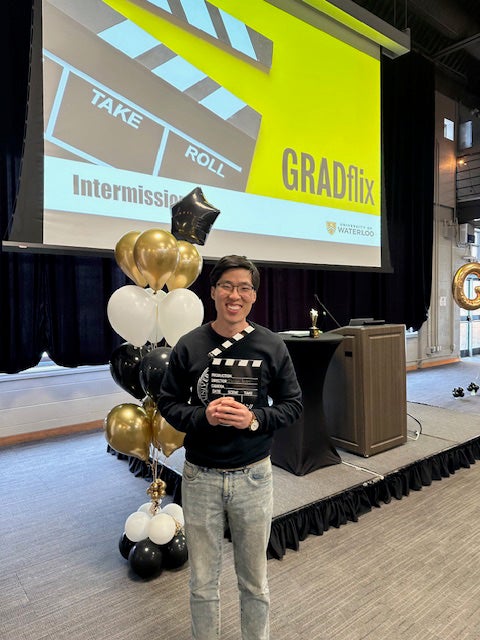
Brian Kim competes in GradFlix competition.
Originally, Brian hoped to compare emotional memory between monolinguals and bilinguals, a topic that combines his interest in language and cognition. While his thesis focuses on monolinguals, he’s still pursuing his passion for bilingualism in a side-project that explores how monolingual and bilingual individuals express emotion and remember emotional events differently after watching video clips.
Looking back on his academic journey, Brian says one of his biggest discoveries came during his undergraduate studies. “I realized I learn best by writing things down by hand. That tactile process of physically writing helped the information stick.” That personal insight echoes the findings of his published research—and helped spark his interest in how learning techniques affect memory.
Outside of the lab, Brian recently participated in GradFlix, a university-wide research communication competition, where he created a one-minute video highlighting a project separate from his master’s project. The project explored how monolinguals and bilinguals express emotion and remember events after watching video clips. “It was a great experience,” he says. “It helped me think about how to present my research in a way that’s accessible to everyone.”
As he approaches the end of his master’s program, Brian is setting his sights on a future in data science and behavioural research. Throughout his studies, he’s developed a versatile skill set—from data analysis and project management to data visualization—that he sees as highly transferable. His goal is to apply research and data to real-world decision-making, particularly in areas where language and behaviour intersect.
And while his next steps might lead him outside the university, Brian remains passionate about the pursuit of good research. “Even when I’m hearing talks in areas outside my own—like developmental or social psychology—I find myself fascinated by sound scientific methods and clear thinking. That’s what I hope to carry forward.”