Kinesiology 101L. Instructor: Caryl Russell
Biophysical Evaluation Lab
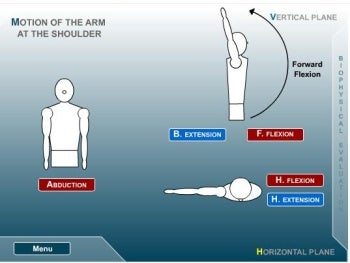
Students prepare for the lab and review key concepts through interactive animations.
This laboratory course provides exposure to practical measurement skills which are relevant to field settings in kinesiology. The laboratories are designed so that students acquire the skills to measure cardiovascular function, neuromuscular function and body composition and work toward to gaining the knowledge to evaluate human motion accurately.
Students work in small groups in the lab with access to teaching assistants who can answer their questions. Each lab has a specific set of objectives and students complete an online quiz to test their level of preparedness prior to the lab. In addition simple interactive learning tools help students understand the terminology of motion.
Kinesiology 140L. Instructor: Robert Burns
Sport Injury Management Lab
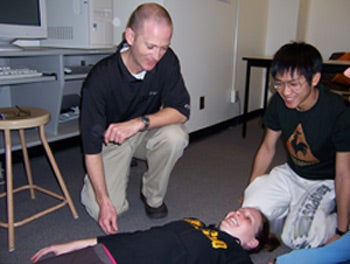
Interacting with online learning objects helps prepare students for the hands-on lab, and is particularly helpful as the number of students in this blended course increases.
This lab provides exposure and training in the management of injuries in an athletic population. Techniques include musculoskeletal assessment, emergency treatment, taping and splinting supports, heating, icing, stretching, and fitting protective equipment. Students learn to perform a basic musculoskeletal assessment, basic taping and wrapping techniques. They must demonstrate the basics of on-field emergency care of injured athletes and confidently palpate a number of major anatomical structures. Students also develop an understanding of the basics of massage techniques and mechanisms of common athletic injuries.
Students prepare for a weekly face-to-face lab through an online learning object which incorporates video, audio and quizzes. Other online video demonstrations and audio explanations created by the instructor introduce students to what they will learn in the lab and summarize what they should have learned in the lab. Online quizzes are used weekly for assessment purposes.
Sexuality, Family, and Marriage Studies 206. Instructor: Tracy Penny Light
Couples, Marriages, and Families
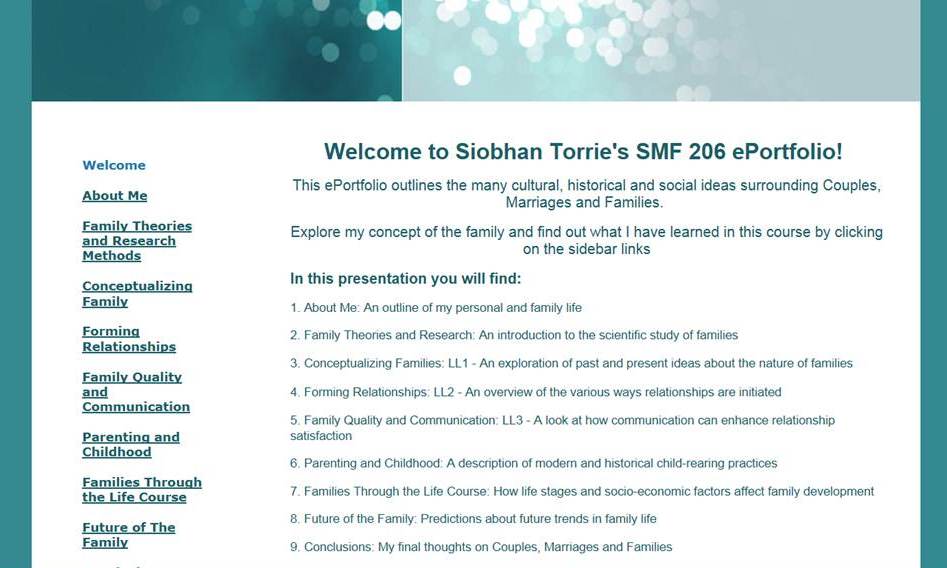
This is a blended, block course. Formerly offered over the traditional 12 week term, this course can now be completed by students in 4 weeks and this change has been made possible by the blended format that relies on both face-to-face and online lecture components and face-to-face and online discussion and group work.
This course uses both online and face-to-face lectures, discussions and group work to critically explore the dynamics of couple and family relationships throughout the life cycle situating these within the various theories regarding couple and family relationships. Students are assessed primarily through an online eportfolio (see an example here) where they collect evidence of their learning and reflect on how their own culture and family experiences have influenced their attitudes about family and relationships.
Environment and Resource Studies 253. Instructor: Mary Louise McAllister
Politics of Sustainable Community
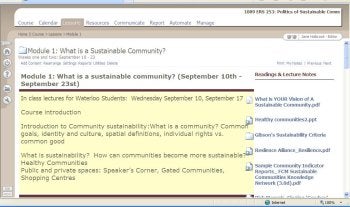
Students have the opportunity to interact with course concepts and then discuss them online in this blended course.
The Politics of Sustainable Communities considers a variety of contemporary issues and challenges. The themes of the course are democratic governance, biophysical sustainability of a community, and social sustainability of a community and its goal is to help students develop an understanding of sustainable communities and to explore a variety of factors, specifically how institutions and political processes work. Field trips and engaging in-class activities such as debates, break-out groups and experiential learning activities are all important in achieving this goal.
Online modules present practical applications of such concepts as environmental ethics, social justice, participatory democracy, rights vs. responsibilities and sustainable community development though readings and videos which students discuss online before or after a weekly face-to-face class.
Environment and Resource Studies 283. Instructor: Brendon Larson
Ontario Natural History
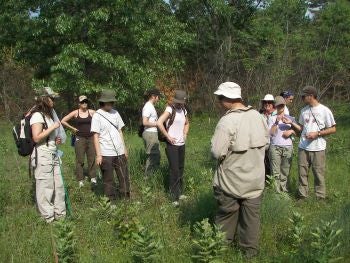
Students prepare in advance for an intensive eight day field course though online activities.
This course is an introduction to natural history, the art and science of identifying organisms and observing their behavior and ecological interactions. Students reside in an Ontario biodiversity hotspot for an eight-day period to learn about local species, human history and conservation initiatives and to complete a project on a group of organisms and an ecological “pattern.”
Students work independently online over a period of five weeks to prepare for the intensive hands-on field course. Each week, they read 1-2 chapters from a course textbook and an online learning activity in LEARN, and then complete a corresponding quiz and short assignment. In the field, they apply their knowledge and also work on a small research project.
Pharmacy 227. Instructor: Barry Power
Health Systems in Society
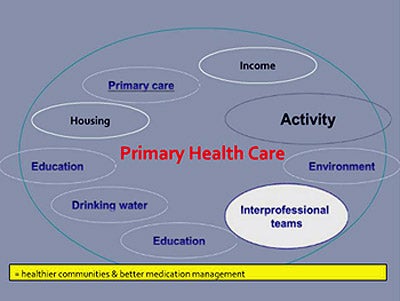
Aspects of the Canadian health care system and current issues facing the pharmacists are presented to students through a variety of interactions in this course. Online lectures, video conferencing and face-to-face guest lectures are used to present course concepts. Students are assessed through individual assignments, small group online discussions and a midterm and exam.
This course focuses on the Canadian health care system, including its structure, financing, regulation and policies. Students apply the basic principles of public policy analysis, political science, economics, and quality measurement to relevant health care examples.
In this course, the instructor is at a distance (in Ottawa) while the students are on-campus in downtown Kitchener. The videoconferencing capabilities of the School of Pharmacy lecture halls are used during class time to connect students with the instructor for lectures. Some weeks concepts are presented through online narrated slide presentations that are accompanied by detailed speaker notes. Online discussion forums are an important vehicle for students’ questions to the instructor and discussion forums are also an integral component of one assessment. Guest lecturers from Waterloo and elsewhere are incorporated into the schedule each term to address current issues in our health system and federal pharmacy policy.
Accounting & Financial Management 361. Instructor: Kevin Markle
Taxation 1
A combination of class exercises and online lectures are used to teach the principles of Canadian income taxation. Both the face-to-face and online environments are integral to the learning experience in this course.
For some classes students are required to watch online videos where the taxation aspects of topics such as the exchange of property and business income are presented and practice problems are introduced. Students then come to class to continue with higher level problem solving and more in-depth discussion of the topics. Students are assessed on their preparation for classes through short, unannounced in-class quizzes.
OneNote and Evernote files are the basis of all in class presentations and that students are able to use them to record their own additional notes and solve problems that are worked on in class. A question and answer style of discussion forum is also used for students’ questions. Students are encouraged to answer the questions of their peers and their contribution to the class learning community both online and in class is evaluated through contributions to this Q and A discussion forum and through contributions to class discussions. Before term starts Prof Markle sends his students a request via a YouTube video to submit short videos of themselves prior to the first class so that he can learn their names. See this video here.
Social Work 365. Instructor: Sandra Loucks Campbell
Social Work in Health Care
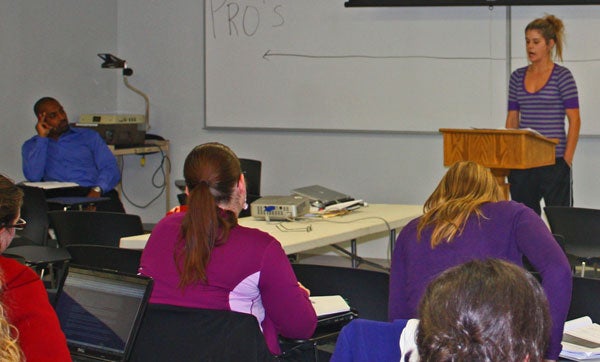
The blended approach helps students learn how to develop their arguments for in-class debates.
This course provides an overview of social work in health care. Students analyse social work in the medical setting, concentrating on identification and treatment of emotional, family, and community aspects of illness. There is an emphasis on the concrete application of professional social work to health care while comparing medical and social work values and concepts of illness.
An objective of the course is to make students aware of specific current health issues that are relevant to those in helping professions and the instructor takes advantage of the online environment to link students to relevant materials each term. During the course students work in groups online to prepare arguments for and against a current topic, such as privately funded health care, and then students engage in a face-to face debate in class. The online environment also supports the discussion of other current topics and an online mid-term quiz.
Systems Design 441. Instructor: Paul Calamai
Optimization and Numerical Methods
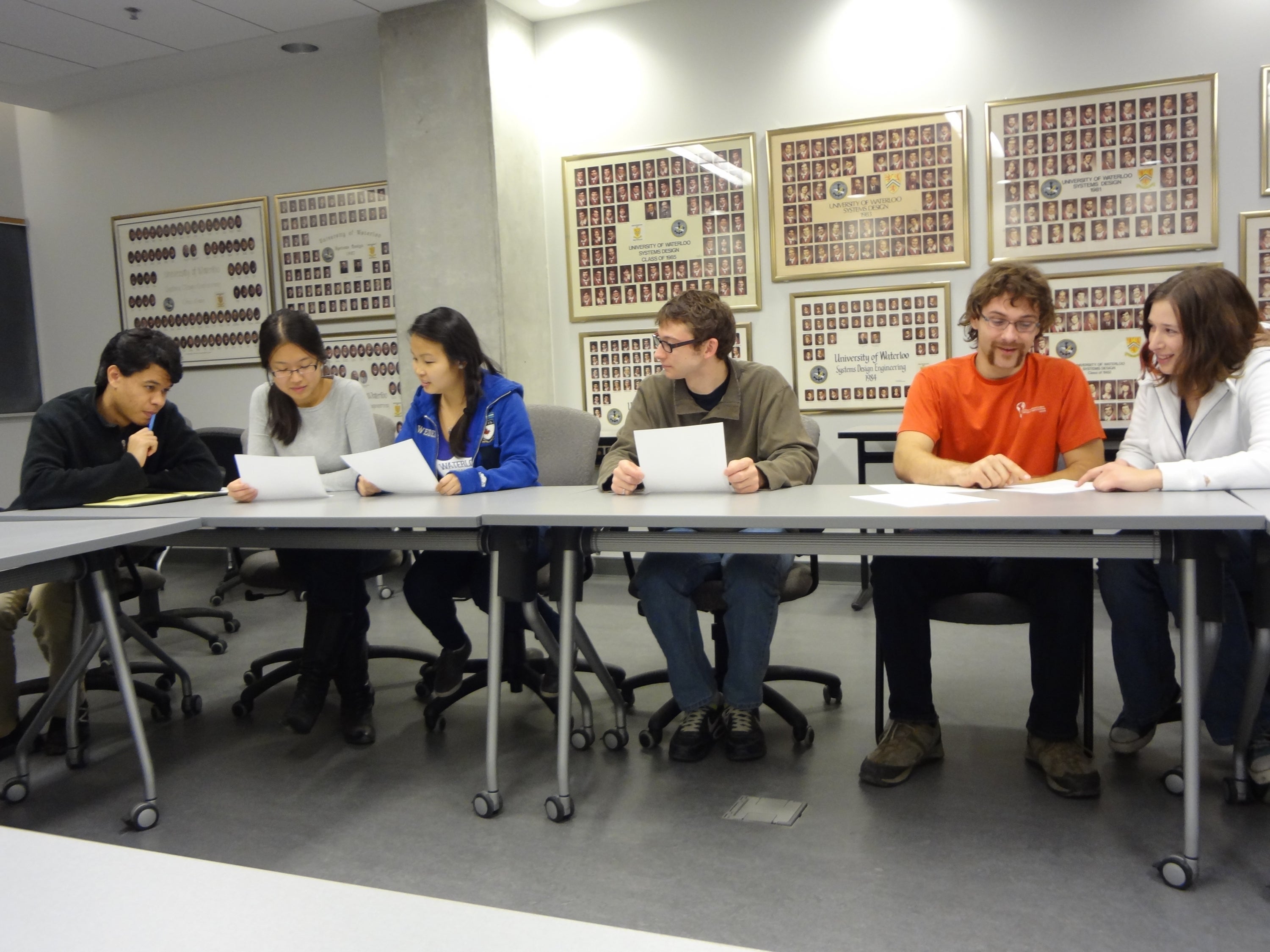
This is a fourth year required Engineering course with an emphasis on understanding and applying numerical methods and optimization techniques as tools for problem solving and systems design. Students are placed in groups and together each group presents a tutorial on an assigned problem set. The online environment helps facilitate the exchange between the teaching assistants and individuals in the presenting group to develop optimal solutions for the tutorial problems which they will then teach to their peers.
Group projects are also an important learning experience in this course and pairs of groups present a specific topic to each other and provide feedback to each other that is implemented before the groups present to the whole class. In addition the presentations are shared with the class online through a discussion forum where specific “reviewing” groups pose questions that are later addressed during the in class 30 minute presentation. An online group evaluation tool CATME, the “Comprehensive Assessment for Team-Member Effectiveness” tool, is used for peer evaluation of their group member’s performance twice during the term.
Systems Design 543. Instructor: Jonathan Histon
Cognitive Ergonomics

Discussion forums play an integral part in the success of two unique activities in this course which explores the role engineering psychology research in the assessment of human performance in simple and complex cognitive tasks, and the design of information displays and controls that support those tasks.
Each week class members use online discussion forums to pose questions to pairs of students who are responsible for running a “press conference” on a critical incident or accident. The pairs of students act as experts, bringing different perspectives and insights into the interpretation of the incident or accident and answer the questions at the press conference. This activity helps students learn how system design impacts user decision making and helps students practice their communication skills.
Discussion forums are also used as a means for peer review. Students investigate a researcher that interests them in the human factors field and three of their classmates provide feedback to their posting of their findings, suggesting edits and improvements to their posting. Students are assessed on their ability to provide constructive feedback and to implement the feedback that they receive.
Photo by NATS Press Office, Creative Commons, flickr.com