Teaching in the GenAI era involves thinking critically about challenges and opportunities. This page offers key links to resources related to GenAI and assessment and an overview of Gen-AI related workshops. We also provide a sample of research and resources that inform our human-centric approach to GenAI in teaching and learning.
Please note that this page is primarily intended for faculty and instructors in a teaching and learning context. For guidance in other areas, see GenAI resources for students and other institutional-wide resources.
Resources on Assessment and GenAI
These resources address various facets of assessing student learning to assist you in your assessment (re)design and decision-making. If you would like to engage in a workshop setting, please refer to the next section on workshops.
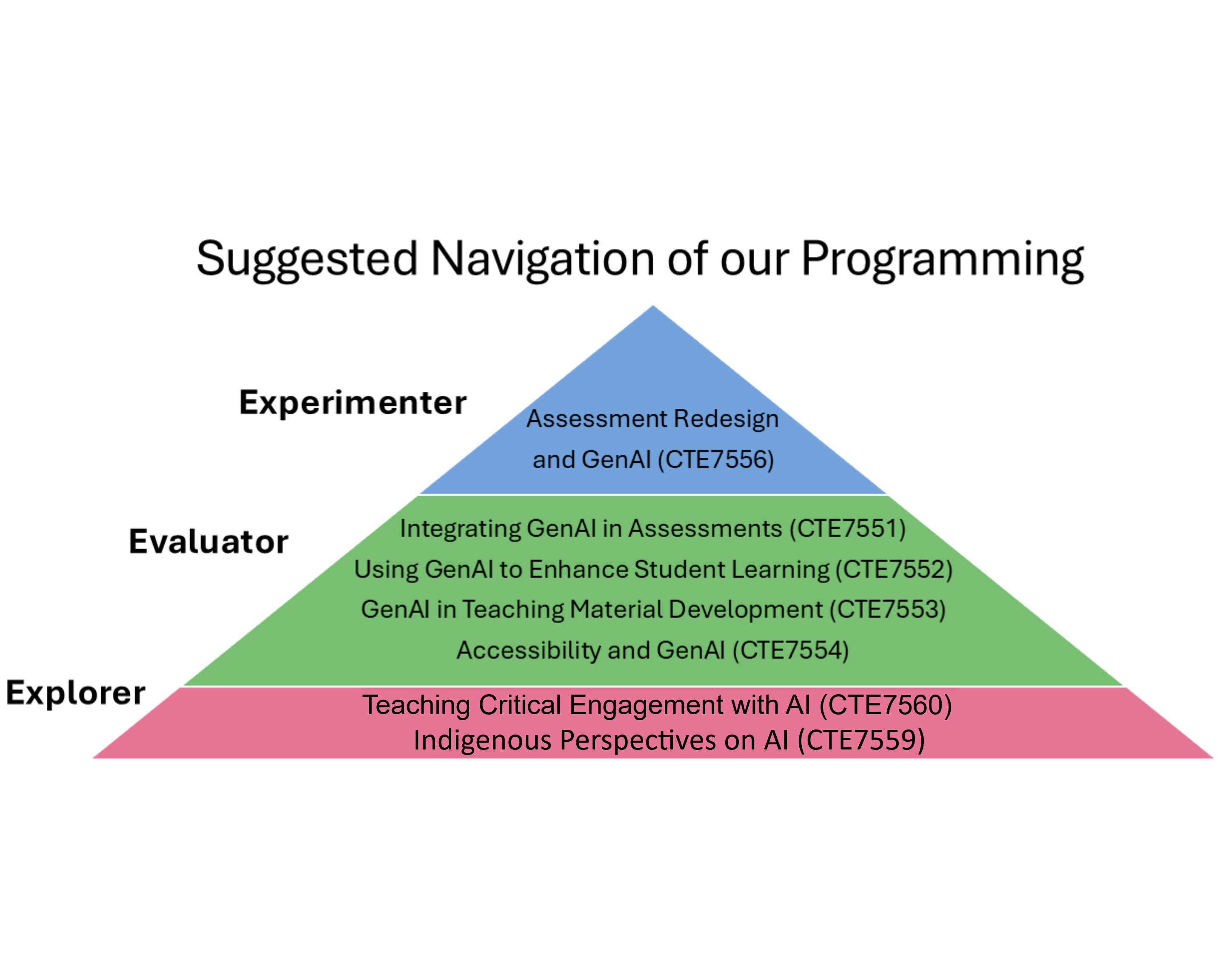
Interested in attending any of these workshops? Check the events page for their next offering. If you are interested in organizing an offering specifically for your unit, department, or Faculty, please contact cte@uwaterloo.ca.
If you are seeking individual support, our Faculty Liaisons are often the best point of first contact.
Additional Campus Resources
Informing our Work
Although not comprehensive, the following represents a selection of research and resources that shape our approach to GenAI.
Learning
- Anderson, B. R., Shah, J. H., & Kreminski, M. (2024). Homogenization effects of large language models on human creative ideation. Proceedings of the 16th Conference on Creativity & Cognition.
- Gerlich, M. (2025). AI tools in society: Impacts on cognitive offloading and the future of critical thinking. Societies, 15(1).
- Pratschke, B. M. (2024). Generative AI and education: Digital pedagogies, teaching innovation and learning design (1st ed.). Springer.
- Wang, J., & Fan W. (2025). The effect of ChatGPT on students' learning performance, learning perception, and higher-order thinking: Insights from a meta-analysis. Humanities and Social Sciences Communications, 12(1).
- Zhai, C., Wibowo, S., & Li, L. D. (2024). The effects of over-reliance on AI dialogue systems on students’ cognitive abilities: A systemic review. Smart Learning Environments, 11(1), 28.
Assessment
- Chatfield, T. (2025). AI and the future of pedagogy (White Paper). Sage.
- Corbin, T., Bearman, M., Boud, D., & Dawson, P. (2025). The wicked problem of AI and assessment. Assessment & Evaluation in Higher Education.
- Corbin, T., Dawson, P., & Liu, D. (2025). Talk is cheap: why structural assessment changes are needed for a time of GenAI. Assessment & Evaluation in Higher Education, 50(7), 1087–1097.
- Digital Education Council. (2025). The Next Era of Assessment.
- Mao, J., Chen, B., & Liu, J. C. (2024). Generative artificial intelligence in education and its implications for assessment. TechTrends, 68(1), 58–66.
- Xia, Q., Weng, X., Ouyang, F. et al. (2024). A scoping review on how generative artificial intelligence transforms assessment in higher education. International Journal of Educational Technology in Higher Education, 21(40).
Critical Perspectives
- Critical Media Lab. Before you adopt GenAI.
- Bozkurt, A., et al. (2024). The manifesto for teaching and learning in a time of generative AI: A critical collective stance to better navigate the future.
- Djerbal, Y., Brothers, K. (2025, June 11). The AI and Accessibility Paradox: Are We Solving Barriers or Reinforcing Them? [Conference presentation]. Teaching with AI Conference, University of Guelph (Online).
- Ferrara, E. (2023). Should ChatGPT be biased? Challenges and risks of bias in large language models. First Monday, 28(11).
- Tassis, A. (2025, June 9). Unpacking anthropomorphism: How we humanize AI and what it means for education [Conference session]. Teaching with AI Conference, University of Guelph (Online).
Academic Integrity and (Post)plagiarism
- Eaton, S. E., & Keyhani, M. (2025). The Pedagogical Ethics: Navigating Learning in a Generative AI-Augmented Environment in a Post-Plagiarism Era. Navigating Generative AI in Higher Education, 160–178.
-
Gottardello, D., & Karabag, S. F. (2020). Ideal and actual roles of university professors in academic integrity management: a comparative study. Studies in Higher Education, 47(3), 526–544.
-
McCabe, D., Butterfield, K., & Trevino, L. (2012). Cheating in College: Why students do it and what educators can do about it. Johns Hopkins University Press.
-
Stone, A. (2023). Student perceptions of academic integrity: A qualitative study of understanding, consequences, and impact. Journal of Academic Ethics, 21, 357-375
Decolonial and Indigenous Perspectives
-
Hao, K. (2025). Indigenous Chileans resist AI-fueled copper and lithium mining. Rest of World.
-
Lewis, J. E. (2023). Imagining Indigenous AI. In S. Cave & K. Dihal (Eds.), Imagining AI: How the world sees intelligent machines (pp. 210–217). Oxford University Press.
-
Quince, Z., Andersen, A., & Day, K. (2025). Indigenous knowledges and perspectives in the age of GenAI: Ethical considerations for higher education. Southern Cross University Scholarship of Learning & Teaching Research Paper Series.