Chemistry 266/266L. Instructor: Steven Forsey
Organic Chemistry Lab
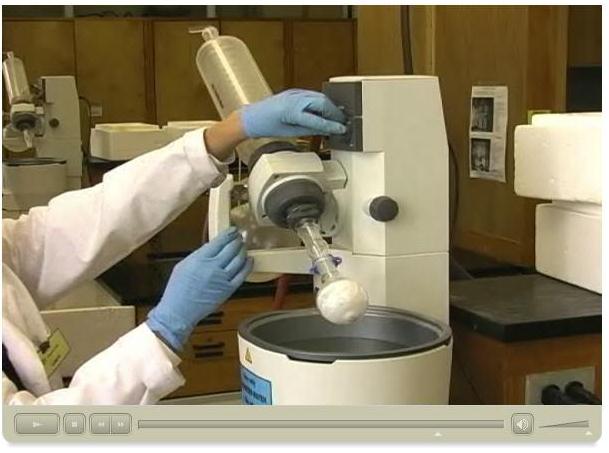
Students in this laboratory course carry out several experiments in organic synthesis including: the separation of a three component mixture containing an acid, a base, and a neutral substance; the synthesis of acetanilide from aniline; the synthesis of benzoic acid by a Grignard reaction; and more.
Before each lab students are expected to read about the experimental procedures and watch online instructional videos of the procedures that they will be performing in the lab. In lab they also see a short face-to-face presentation about the procedures for that day. The students are assessed on their level of preparedness through pre-lab online quizzes. Their successful completion of the quiz requirement automatically generates a confirmation page that students bring to lab and that becomes part of their lab report.
Both Chem 262 and NE 122 are taught using the same blended structure and many Chemistry Laboratory courses use instructional videos to prepare students for labs.
German 203. Instructor: Mat Schulze
Written Communication
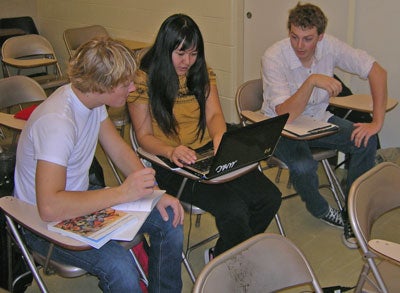
Students develop grammatical and vocabulary skills though writing practice and discussion on topics of everyday life as well as on political, social and cultural aspects of the German-speaking countries.
This course balances classroom contact with face-to-face interaction among students and with the instructor, small-group student meetings outside of class time, individual consultations with the instructor during office hours, and on the other, technology-mediated discussions and exchanges. Collaborative activities are central to the course and all students engage in three small group projects (the verb project, the noun project and the sentence project). Each group creates: a grammar card (Grammatikkarte), a text (Text) on one of three topics given, and a portfolio (Portfolio).
Biology 466. Instructor: Josh Neufeld
Biogeochemical Microbiology
This course is a fourth year course examining topics in biogeochemical microbiology including: the beginnings of life on earth, principles of microbial physiology, nutrient cycles, the roles of microbes in aquatic and terrestrial biospheres, as well as methods for studying microbes in these environments.
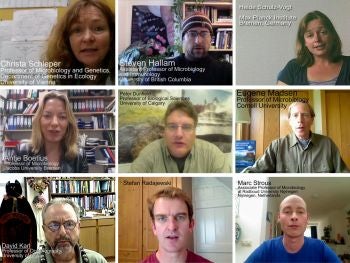
Video tutorials (using Camtasia and a tablet PC) are used for the important and hard to grasp skills of balancing redox equations and calculating free energy yield. Students' presentations of current literature are enhanced by video interviews of the international authors of these papers created for and embedded in the course. A ‘Biogeochemistry in the News’ blog is updated weekly by students and the instructor, and important updates are highlighted at the beginning of each lecture.