Civil Engineering degree
Design and build vital structures
Population growth, climate change, and aging infrastructure are some of the big challenges that today’s civil engineers tackle in the quest for smart cities and a sustainable future. As a civil engineer, you’ll lead the creation, maintenance, and management of the large-scale infrastructure we all depend upon.
During your six paid co-op work terms, you can test drive different career options. Work for major construction and engineering companies, get experience with local or provincial governments, or spend a term abroad.
This is a degree with lots of flexibility. You’ll have access to a wide range of electives, allowing you to customize your education to suit your interests and career goals.
By the end of your degree, you’ll be ready to design, analyze, construct, and manage everything from airports and skyscrapers to bridges, transportation networks, municipal water systems, and more.
What courses will you take in Civil Engineering?
First-year courses
You'll take a mix of math, physics, chemistry, and introductory engineering courses to build the analytical and problem-solving skills needed for your upper-year classes.
This is a sample schedule. Courses are subject to change.
After first year
- Your upper-year courses will cover structural analysis and design, soil mechanics, water supply and treatment, transportation engineering, and project management.
- View all the courses required for your degree.
Customize your degree in Civil Engineering
Explore specializations within your program to enhance your degree.
- Building Science – Learn how to design energy-efficient, comfortable, and sustainable buildings by understanding heat flow, air quality, and materials.
- Geotechnical – Study soil and rock behaviour to design safe foundations, tunnels, slopes, and other structures that interact with the ground.
- Structural – Explore how to design and analyze buildings, bridges, and other structures that are strong, stable, and built to last.
- Transportation – Improve how people and goods move by planning and designing roads, transit systems, and transportation networks.
- Water Resources – Help manage and protect our water by studying the movement, quality, and distribution of water in natural and built environments.
Or choose one of the options available to all Engineering students.
Population growth, climate change, and aging infrastructure are some of the big challenges that today's civil engineers tackle in the quest for smarter cities and a sustainable future. As a civil engineer, you'll lead the creation, maintenance, and management of the large-scale infrastructure we all depend upon.
Faculty:
Faculty of Engineering
Degree:
Bachelor of Applied Science in Civil Engineering
Available as a co-op program?
Co-op only
Available as a regular program?
No
Available as a minor?
No
Develop solutions for a better tomorrow. At Waterloo, you'll have access to high-tech simulation labs where you’ll learn how to test risks before any shovels hit the ground.
Your urban playground. Learn to design and build structures that stand the test of time, including roads, landscaping structures, pavement, and bridges.
Co-op = relevant paid work experience
In the world's leading co-op program, you'll explore potential careers, learn to interview for jobs, graduate with up to two years of valuable experience — and make money!
Sample co-op job titles
- Field technician
- Quality control technician
- Diagnostics civil engineering
- Transportation planner
- Concrete lab technician
- Estimator / project manager
- Structural engineering student
Co-op work-study sequence
Starting in first year, you'll normally alternate between school and work every four months, integrating your classroom learning with real-world experience. You can return to the same employer for a couple of work terms to gain greater knowledge and responsibility or work for different employers to get a broad range of experience.
| Year | September to December (Fall) | January to April (Winter) | May to August (Spring) |
|---|---|---|---|
| First | Study | Study | Co-op |
| Second | Study | Co-op | Study |
| Third | Co-op | Study | Co-op |
| Fourth | Study | Co-op | Study |
| Fifth | Co-op | Study | - |
Your first work term will be at the end of first year (May to August 2027).
Breaking ground in Civil Engineering: From analyzing construction claims in Calgary to fixing $30,000 errors on a Toronto job site, Civil Engineering student Sarra used co-op to build confidence, gain real-world experience, and shape her dream of making a global impact.
What can you do with a degree in Civil Engineering?
Graduates often pursue careers where they oversee projects focusing on planning, design, and construction of the large-scale infrastructures around us.
Recent graduates
- Tunnel Engineer — GHD
- Structural Engineer — AECOM
- Engineer — MMM Group
- Structural Design Engineer — Stephenson Engineering
- Field Engineer — PCL Construction Management
- Civil Engineer — Clifton Associates
- Project Manager — JP2G
Possible professional designation
Learn about the future of careers in engineering.
Common questions about the program
What is the difference between Civil Engineering and Architectural Engineering?
Civil Engineering is a broadly applicable field and the curriculum includes design of large municipal infrastructure components. In contrast, Architectural Engineering focuses heavily on building design. In both programs, you’ll take courses in structural analysis and design (i.e., how to determine forces in structures and size their members, connections, etc.).
In Architectural Engineering, you'll also take courses on building science and systems (such as HVAC) in the place of the courses you'll take in Civil Engineering on transportation networks, water distribution systems, geotechnical engineering and more.
Architectural engineers work for design consulting firms specializing in the design, construction, renovation, and rehabilitation of buildings. Civil engineers are more likely to get jobs with government, provincial highway authorities, and construction companies. There is certainly some overlap between these programs. However, the Architectural Engineering program was developed to address highly specified issues particular to building construction.
What would make me more suited to Civil Engineering than Architectural Engineering?
The skills required from you in these two programs would actually be similar. It's likely that interests and future career preferences would drive you in one direction or the other. In both cases, we hope you'll choose Waterloo if you have a passion for the program and field of expertise to which you’re admitted.
Civil, Architectural, Environmental, and Geological Engineering program comparison chart
| Civil Engineering | Architectural Engineering | Environmental Engineering | Geological Engineering | |
|---|---|---|---|---|
| Ideal for students who... |
Want to design and maintain the massive infrastructure on which society depends. Would like to pursue a flexible degree with numerous subfields. Want to learn about the build components that make up our urban environments (roads, transit, buildings, bridges). |
Want to learn about many aspects behind good building design (structural aspects, energy efficiency, sustainable building design, smart/green building design). Are interested in building design from a structural engineer's perspective as well as an architect's perspective. |
Are interested in physics, chemistry, biology, and geology. Want the technical rigour of an engineering degree combined with scientific know-how and environmental insights. Are interested in cleaning up existing pollution from our water and soils, developing technological solutions to reduce pollutants from future human activities. |
Want a career that allows you to work frequently outdoors. Are interested in strengthening Civil Engineering infrastructure using Earth Sciences knowledge. Are interested in combining laser/GIS/seismic technology and the outdoors. Are interested in designing foundations for all kinds of structures on Earth or Mars. |
| Examples of projects in Canada |
ION light rail transit in Waterloo, Ontario Confederation bridge in Prince Edward Island |
THE MUSEUM in Waterloo, Ontario CN tower in Toronto, Ontario |
Columbia Lake in Waterloo, Ontario Southern Rockies watershed project in Alberta |
Sustainable nickel mining in Sudbury, Ontario |
| Examples of projects globally |
Burj Khalifa in United Arab Emirates Golden Gate bridge in the United States |
Eiffel tower in France Sydney Operahouse in Australia |
Cleanup of Love Canal, New York Mangrove restoration projects in Indonesia |
Three gorges dam in China English Channel tunnel in the United Kingdom |
Student life in Engineering
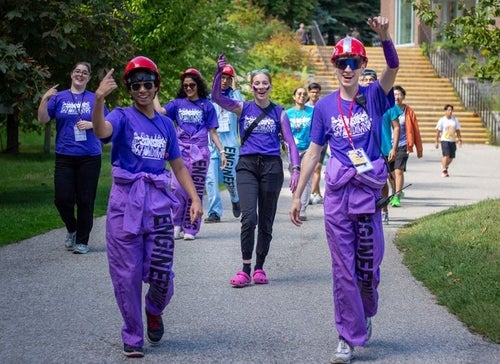
Waterloo Engineering goes far beyond lectures, with a vibrant community that works hard and plays even harder. Sing in an a cappella group, join a varsity or intramural team, compete in design challenges or hackathons, volunteer, or lead a student society! Whatever your interests, you’ll be in good company.
- 96% employment rate within 6 months of graduating, compared to the Ontario average of 89% for Engineering students.
- 90% graduation rate, higher than the Ontario average of 82%.
- 95% retention rate from first to second year.
Student design teams
Have fun and develop hands-on experience through one or more of our 35+ student-led design teams!
Design teams include rocketry, concrete canoe, small airplanes, robotics, solar car, submarine racing, autonomous vehicle, Engineers Without Borders, and more.
Engineering Society (EngSoc)
EngSoc is run by students and provides social and academic events and services to make your experience as a Waterloo Engineering student the best it can be.
Benefit from mentoring for first-year students or meet other students through an annual conference, semi-formal, career fair, charity events, community outreach, and much more!
Women in Engineering
Women in Engineering (WiE) supports women and non-binary engineering students and alumni, while encouraging the next generation to pursue a future career in engineering
Any student is also welcome to join Women in Science, Technology, Engineering, and Mathematics (WiSTEM), a student-run club that promotes equality in STEM through skills workshops, discussions, and guest speakers.
Campus-wide activities
Our campus is packed with opportunities to get involved – no matter how unique your interests.
Between our 200+ student-run clubs, sports and recreation opportunities, student government, and events, student life at Waterloo has something for everyone.
Admission requirements
Ontario students: six Grade 12 U and/or M courses including
- Advanced Functions (minimum final grade of 70% is required)
- Calculus and Vectors (minimum final grade of 70% is required)
- Chemistry (minimum final grade of 70% is required)
- Physics (minimum final grade of 70% is required)
- English (ENG4U) (minimum final grade of 70% is required)
Admission averages: Individual selection from the mid- to high 80s
There are supplementary information forms, including the Admission Information Form, which are required for admission. We'll email you detailed instructions once we receive your application. An online video interview is required for Faculty of Engineering scholarships and is strongly recommended for admission.
Not studying in Ontario? Search our admission requirements.
How to apply
Apply directly to this program on your application.
Get information about programs, applying, and more!
Subscribe to our monthly newsletter
Get valuable updates and tips sent straight to your inbox!
Learn more
Questions about courses, programs, requirements, or careers?
Please contact the Faculty of Engineering which can answer any questions you have.