
Written by the Faculty of Health
Waterloo makes biomechanics come alive for students who want to understand how better movement leads to better living.
Every time you walk to class, text a friend or wrinkle your nose, you’re already an expert in biomechanics. Surprised? Don’t be. “Biomechanics” is simply the word we use to describe how our bodies – and all living things – function and move.


Bio = body
Mechanics = how things work
Although the term seems simple, human motion is anything but. Your body, with its 206 bones, 600 muscles, 4,000 tendons, and litres of blood, is incredibly complex. Each time you reach for, say, a glass of water, hundreds of body parts must work in tandem to perform that seemingly easy task.
Try this
Go ahead and stand on one foot. Are you able to keep your balance with your arms extended? Now pull your arms in so they’re at your side. Is balancing easier or harder?
If you found it harder, that’s biomechanics principles at work. You are making changes to your three anatomical planes: sagittal, frontal, and transverse. In other words, by pulling in your arms (we call this “adduction”), you changed your center of balance and also removed your ability to correct using your outstretched limbs.
By the way, having good balance is important for good health. Research shows that people under 40 should be able to manage balancing on one leg for 45 seconds with eyes open and 15 seconds with eyes closed. Practice makes perfect!
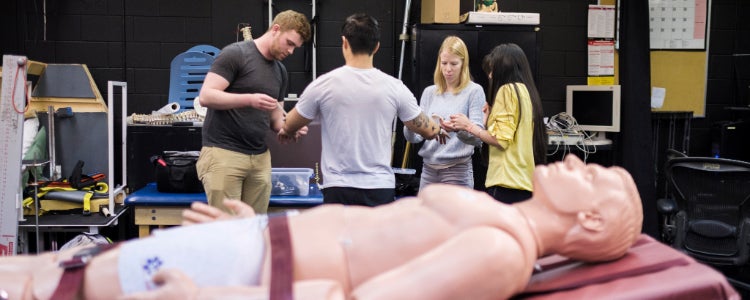
Biomechanics is part of Kinesiology
You’ve heard of chemistry, physics, biology, and even economics, right? These branches of sciences and social sciences have been around for centuries. But there’s another newer area of study you may not know about: kinesiology. It blends physics, chemistry, human biology and psychology – and is sometimes called “exercise science” or “sports science” in other areas of the world. Kinesiology students at Waterloo study the science of human movement through three main areas.
- Neuroscience: how the brain controls movement.
- Physiology: the mechanisms of living things down to the molecular level.
- Biomechanics: how individual body parts work together.
You’ll earn a Bachelor of Science (BSc) in Kinesiology, but can focus on biomechanics if that’s what interests you most!
Biomechanics in the real world
“What I think is exciting about biomechanics is it’s really the study of how the mechanical laws of physics apply to the body. When we care about that, it helps us understand how we physically interact with the world around us,” says Steven Fischer, a Kinesiology professor at Waterloo who runs the University’s Occupational Biomechanics and Ergonomics Lab (OBEL).
No wonder he thinks biomechanics is interesting and exciting. The OBEL group does important research to help make workplaces safer and eliminates injury. Undergraduate and graduate students pitch in.
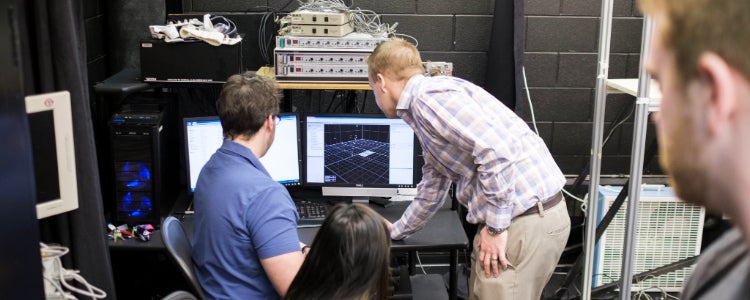
One of his students, Hailey, helped research why helicopter pilots for the Royal Canadian Air Force get so many neck injuries during nighttime flights. The reason? Wearing heavy night vision goggles for two or three hours at a stretch can stress muscles and turn painful.
“If you think about wearing a helmet and then strapping a two-litre bottle of pop to the front of your head, that’s what they have to deal with,” she says.
One solution was to develop strength and stretching exercises for the pilots to help them recover. Or they could add extra weight to the back of the helmet so it would be evenly distributed. Neither option was ideal though.
But what if someone could create a new helmet and night vision goggle set that takes the load off before injury can occur? Hailey looked at working with industry engineers and testing a new product that would bring relief.
Biomechanics helps people
Hailey is as surprised as anyone that she’s focusing on collecting and analyzing data to help pilots, paramedics, and personal support workers who often get injured on the job. In high school she assumed she would take Kinesiology at Waterloo and go on to become a physiotherapist or work in rehabilitation. She wanted to go into a helping profession. But after one co-op term employed as a physiotherapy assistant, she learned a huge life lesson:
Co-op not only helps you learn what you want from a career – it’s also amazing for teaching you what you don’t want.
Then came her first biomechanics lab. Even though it was online during COVID, it was still inspiring. For the first time she realized that understanding how people move can be used to ensure fewer injuries.
“That shifted my whole thinking,” she says. “I still had the same passion of wanting to help certain populations, but through biomechanics and ergonomics, they changed my lens and how I started to go about solving problems.”
A world of opportunity
- There are many other areas where a knowledge of biometrics is incredibly useful.
- Sports, exercise and improving athletic performance
- Developing better sports equipment
- Designing rehabilitation programs
- Inventing the perfect, pain-free sit up
- Aging and fall prevention
- Perfecting personalized prosthetic limbs
- Creating the perfect pair of running or hiking shoes
- Developing humanoid robotics
- Creating an exercise plan for a grandparent with osteoarthritis
- Helping those with physical disabilities live at home
- Developing wearable exoskeletons to boost productivity in factories and reduce discomfort and fatigue
- Tissue regeneration for injured skin
- Forensics for insurance companies and at crime scenes
Take high-tech compression swimwear that reduced turbulence and drag. It’s one of the better-known examples of biomechanics in action at the Olympics. (Biomechanists from NASA helped develop the swim material.) But there’s so much more to what you can do with biomechanics in a career.
“We're trying to optimize how somebody moves so that they get the most power out of their body to do the task they need to perform,” says Fischer. “But the same techniques, math, and fundamentals also apply to helping somebody adapt to a walker.”
Pitchers need biomechanics too!
Why are so many major league baseball pitchers on the injured list lately? Does it have to do with the pitch timer introduced in 2023 requiring them to speed up their game? Or that they can no longer use sticky stuff for grip? Or is the problem related to something else entirely?
Biomechanics experts are looking into the problem by analyzing pitchers’ movements in real time. They need to find a solution that gets players back throwing sliders and fastballs again. Better health and millions of dollars are on the line!
So why study biomechanics at Waterloo?
Waterloo was one of the first schools in the world to have a Kinesiology department and teach biomechanics, and it’s still a leader today.
Latest equipment
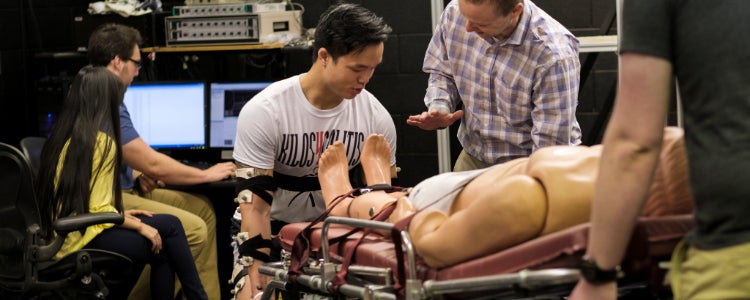
Use the same motion capture technology used in gaming and the movies to understand the mechanics of the human body. Apply electromyography sensors to read muscle movement. Operate a force plate to measure walking and jumping. Not only will you test them on classmates and research participants, but your classmates will also try them on you!
A large faculty
Interested in helping older Canadians avoid life altering falls and hip injuries? How about occupational health? Or maybe you want to follow in our alumni’s footsteps and design shoes for Nike. Chances are you’ll find a professor who conducts research in whichever area interests you. Waterloo has a large faculty of world-renowned biomechanics profs.
The latest and greatest
You’ll learn cutting edge measurement techniques and how to analyse them. The program is built on first principles, so you’ll have an in-depth knowledge and education to think big. It’s what makes our students so competitive.
Opportunities galore
Check out the many labs that are open to students like you: the Structural Biomechanics Lab, the Centre of Research Expertise for the Prevention of Musculoskeletal Disorders (CRE-MSD), the Biomechanics of Human Mobility Lab, and the Injury Biomechanics and Aging Laboratory (IBAL). Each one offers students opportunities to research life-changing technologies and innovations. Our co-op students get plenty of hands-on learning in the real world too.
Biomechanics drives him up the wall!
Jared is a graduate student who is now a teacher’s assistant for undergraduate biomechanics classes. After four-plus years of study, he now uses his biomechanics knowledge while rock climbing! Force and mass analysis come into play as he climbs a 5.11. It gives him a competitive edge.
I’ll think, ‘If I want to reach over there, I need to get my leg up to the left to keep my centre mass balanced so I can have a longer reach.' Biomechanics is the study of the human body, and I can’t just leave my body behind — so I always have something with me related to my studies!
Final advice
Applying to university can feel exciting and scary because so much is unknown. So, ask as many questions as you can think of about Kinesiology and Biomechanics. Professors want to help you! That’s what Hailey discovered after a couple of years in the program.
“Get involved and don’t be afraid to reach out,” she says. “It is a little intimidating when you go to university and it’s a doctor standing in front of you, and you’re in a class of 300. But every time I reached out to anyone within the program, I was met with nothing but helpful advice and opportunities.”
Learn more about Kinesiology at Waterloo and apply now!
Related articles
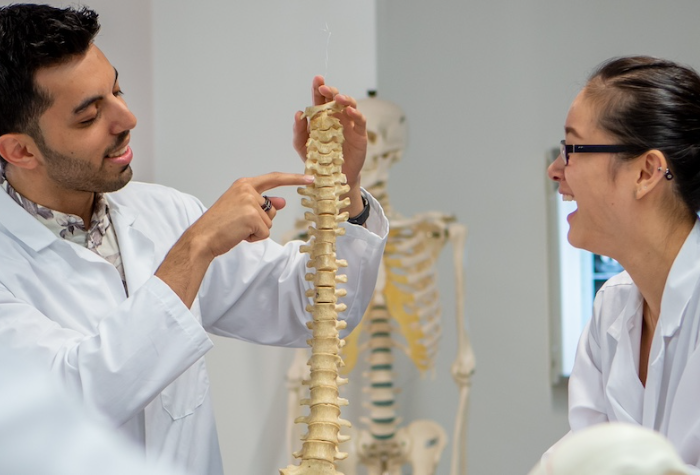
What is kinesiology?
Thinking about studying kinesiology? Learn more about the major, the profession, the skills you’ll gain, and the different career paths a kinesiology degree can lead to.

73 questions with a Waterloo Kinesiology student
Curious about Kinesiology? Get real info about the program from William, a current Kinesiology student.

Taking a kinesiology lab tour?
If you’re thinking about a kinesiology or human kinetics program, taking a tour of the labs and facilities at the schools you’re considering is a great way to find out if they’re right for you.