When There Is No Fire To Gather Around
Table of contents
Theme 1: Storytelling needs physical space
Theme 2: Loss of natural gathering centres
Theme 3: Generational divide around storytelling
Theme 4: Assimilation and the shifting of storytelling traditions
Theme 5: Changing social practices and how people unwind
Theme 6: Reframing what counts as a story
Theme 7: Storytelling as cultural infrastructure
Why Kingston-Galloway-Orton Park (KGO) needs a story archive
Intro to the Author
I was raised in a family of storytellers; in a small town where stories travel faster than your own feet on your way home from school. When I was a teenager and asked my parents for a cellphone. My father said that if I needed him, or my mother, to just yell. When I challenged him, he reminded me that almost every phone in town was available for me to use. My grandparents on both sides of my adoptive family retold stories to the point that when they were older, all of us noticed memory loss, as names of folks and other details changed. My generation was able to quite literally finish their sentences. My parents, of course, are the same, to the point that some stories were so recurring and told in such detail I believed I had been there. It was about five years ago when I was telling the story of our family trip to Algonquin Park, only for my dad to say I wasn’t there, and for my mother to confirm that truth. I, however, “remember” the trip down to the smell of nature, the warmth of the sun through the canvas of the tent, and the crunching of the side mirror when my dad hit a post. I had spent all those years with fond “memories” of the trip and the desire to “return”. It is no surprise that I became a storyteller.
How many places have we fallen in love with only from stories, and is an experience of a person, place, thing, etc. via stories, not still an experience? We travel to new places because of the stories shared about them, maybe we met someone who grew up there, maybe we heard of a festival, or a restaurant, some story that we couldn’t shake, that we wanted to continue creating.
When I moved to Toronto in 2012, it was to continue my story, but I was also chasing other storylines that I felt fed into mine. My biological mother was living in Toronto at the time of my birth, and there was curiosity that she may still be there, or some family would be living there. I was also immensely curious about life in the city and life in a place where people looked like me, where representation in spaces was more common, and I wouldn’t be one of 2-3 Black students in my school anymore.
What I couldn’t have predicted happening was that my love for storytelling would take me to where I am today, as a storyteller who is also very deeply rooted in the process of learning more about storytelling and leveraging it from an anti-oppressive lens. I have spent the last decade plus leveraging stories and studying storytelling to address oppression and put advocacy skills into the hands of young people across Ontario. One area of Toronto in which I do most of my work with youth and communities is the east-end, specifically East York and Scarborough, primarily with the Toronto Public Library through their Poetry Saved Our Lives (PSOL) program.
To ground us in my definition of storytelling to ensure we are on similar pages moving forward, it's simple, really… it is the telling of a story in all its ways. This can be data, painting, poetry, photography, dance, and more. As a storyteller, my quest is to be effective in storytelling, to ensure the stories I tell are “heard”.
But over the years, especially through my work with young people in East York and Scarborough, I began to notice something troubling. The stories had not disappeared. The spaces for them had and even the spaces which were left, they left little space for stories.
shelly grace
creative, arts mentor + educator, marketer

kimberly j. lopez
community organizer, scholar, + author

Intro to the KGO Community Dinners
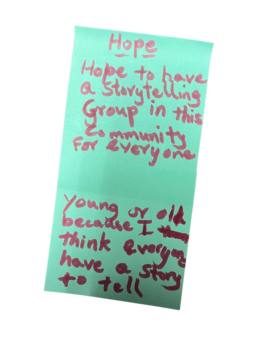
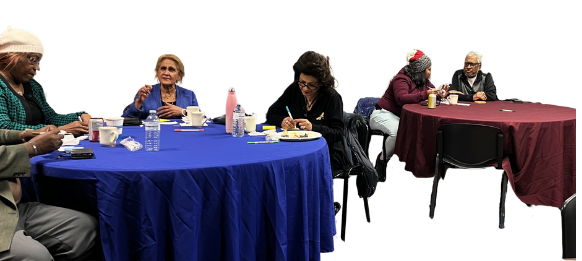
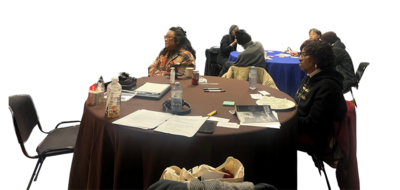
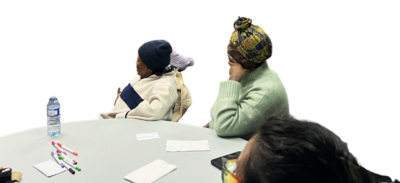
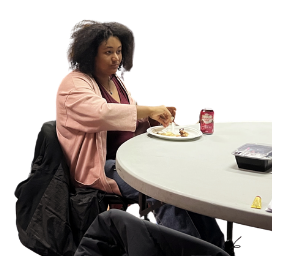
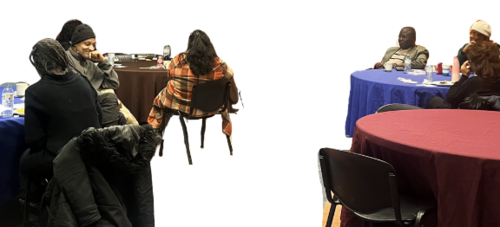
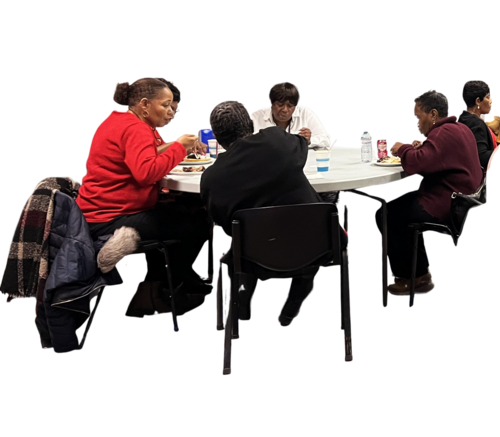
I was honoured in 2025 to facilitate two community dinners for community members of KGO at the East Scarborough Storefront. These dinners were to gather members for a casual evening of storytelling and to learn how changes and realities in the community, such as over policing, construction, and more, impact the culture of storytelling.
During the first dinner, a community member said something I have heard time and time again, that young people aren’t into storytelling. The statement was followed by the fact that young people are always on their phones and on their computers. As someone who likes to pretend I was a young person not so long ago, who is often seen as always on their phone and on their computer, I know both sides of this statement. In a room in which no young people were present, I had ideas as to what led to their absence from this discussion. I countered that young people are not only obsessed with storytelling, but that is the reason they are on their devices so much, texting their friends, watching videos, playing games, and more. They are constantly storytelling or consuming stories, the real concern is the lack of sharing with their more local community, of sharing in real-life with folks sharing physical space with them.
But where would they do that?
Young people who are under the age of 18 can’t book the spaces. Community centres and spaces are often over-scheduled, over-priced, require permits that push you through hoops and often require insurance. Parks often require bookings and permissions. Open fires are no-gos. Transit often stops running before the stories begin. Gathering to share stories becomes hard.
Yet, in this room and in so many others, we wonder why young people don’t show up. In both their absence and presence, we judge them without listening. In fact often when we talk about “the good-ole-days” of storytelling, we talk of young people sitting around just listening to their elders, even in that moment we continue to enforce the messaging from the past that children were to listen and not to speak. The shift that would happen if we listened to young people is a shift that can change the world.
In-depth reflections from the dinners
There is no way to summarize the conversations and stories shared at the dinners that keeps all the substance. Across both dinners, several patterns surfaced again and again. They revealed less about whether people cared about stories, and more about the conditions that allow stories to exist. These conversations were not structured interviews, but open exchanges where people reflected on their experiences with storytelling, community, and the spaces where stories are shared.
What became clear through these discussions was that storytelling has not disappeared. People still want to tell stories, share memories, and connect through narrative. What has shifted are the conditions that make storytelling possible.
Participants spoke about the importance of physical space, the loss and limitations of informal gathering places, generational differences in how stories are shared, and the ways cultural assimilation has reshaped storytelling traditions. They also reflected on how modern life, its pace, its economics, and its systems of surveillance have changed how and where people gather.
The themes that emerged from these dinners help illuminate not just the role of storytelling, but the broader social and cultural environments that either support or constrain it.
Theme 1: Storytelling needs physical space.
Storytelling has never existed in isolation. It has always required a place, not always physical, but there is something special about stories shared in physical space.
In "All About Love: New Visions", bell hooks speaks about how modern-day practices and structures upheld by capitalism remove the kinds of spaces and moments that are often used for storytelling.
And even the spaces that still exist are often overly surveilled.
Storytelling requires a level of openness. It requires people to reveal things about themselves, their families, their culture, and their experiences. But when spaces are monitored or controlled, people become more guarded. For some people who experience the world with a level of privilege, they may believe that surveillance allows them to share more openly, but know that these folks are not talking about surveillance of self but of “others” who they feel challenge their “safety.”
When surveillance increases, comfort decreases, along with folks' ability to be vulnerable. Vulnerability is necessary for storytelling to exist authentically, especially within a community, where the idea of love is often unfairly closely tied to judgment. We innately want to protect who and what we love, and thus judgment often happens.
For those seen as “other,” this becomes complicated. Many communities are already over-surveilled in other areas of life. That awareness doesn’t disappear when people enter public or communal spaces. It follows them. It becomes a filter we put on our stories and how we show up. So the vulnerability required for storytelling becomes harder to access.
Something that was discussed during the dinners was access to physical spaces for young people. A few participants for one of the dinners shared with great pride about their storytelling group and how, for years, the spaces they have used have changed, many of those changes being upgrades, from coffee shops to community spaces. Young people under the age of eighteen often cannot book spaces at all. There are requirements around permits, insurance, and formal organization. There are limits placed on gathering. There are restrictions on when and how spaces can be used. All of these barriers create friction, and when the barriers to entry for physical environments that support gathering increase, storytelling changes. In-person storytelling doesn’t disappear because people suddenly stop wanting them, it disappears when the environments that allow it to exist become harder to access. We saw during the pandemic how much unperson storytelling was valued around the world.
Theme 2: Loss of natural gathering centres
Another theme that came up was the loss of natural gathering centres. For a lot of people living in the KGO area, and honestly for a lot of people living across Canada, there is also a layer of migration that shapes how storytelling works. Many people come from places around the world where storytelling and gathering outside happen almost year-round. When people move to Canada, that changes dramatically. Even something as “simple” as the weather reshapes how gathering happens. The ability to gather outside becomes seasonal, and sometimes extremely limited.
We saw this clearly when we hosted the community dinners at the end of 2025. It was very, very cold. Under normal circumstances, if those dinners had taken place in the summer, or even late spring, what likely would have happened is that once our access to the community centre ended, people would have naturally continued the conversation outside. This is something that happens organically in many cultures. Conversations don’t just end when the building closes. They spill onto sidewalks, into parks, into small clusters of people standing and talking. But because of the time of year, that didn’t happen. When the time in the community centre ended, the conversation essentially stopped. People went home. It was simply too cold to stand outside and continue gathering.
For people who come from warmer climates where outside gathering happens almost 365 days a year, that change can be significant. Natural gathering centres, places that are not institutional, play a huge role in storytelling. These spaces are often centered around elements like fire and water. These elements create natural focal points where people gather, sit, and share stories. These kinds of environments are communal and organic. They don’t require booking systems or insurance policies. They are not programmed spaces. They simply exist, and people gather within them.
As cities modernize, access to these spaces changes. Sometimes that change is temporary. Construction projects close off public spaces or make them harder to reach. Entire neighbourhoods can feel like they are constantly under redevelopment, which means the places where people might naturally gather disappear for long periods of time. There are also the more permanent changes. Natural gathering spaces become regulated. Parks become more restricted. Fire is not allowed. Spaces become overly surveilled. Transit doesn’t always reach them easily. And when those spaces do remain available, access often becomes formalized; you may need permits, reservations, or rental agreements to use them. What were once organic gathering places become regulated environments. And once again, the ability to gather casually, to linger, to sit, to talk, becomes more complicated.
Theme 3: Generational divide around storytelling
Another theme that surfaced was a generational divide around storytelling. As someone who has worked with young people for many years, I hear a particular statement repeated time and time again. I hear it when I go into schools, when I go into community centres, when I go into libraries, spaces where I am not only working with young people but also alongside adults who are often more permanent or recurring presences in children’s lives. What I hear, again and again, is that young people don’t care about stories. The statement is almost always followed by the same reasoning: that young people are always on their phones or on their computers. As someone who likes to pretend I was a young person not so long ago and who was often seen as always on my phone or computer, I know both sides of this statement.
During one conversation where this idea came up, no young people were present in the room. Hearing the statement repeated, I began thinking about what might actually explain their absence from the discussion itself. My response was that young people are not disconnected from storytelling. In fact, they are consuming stories more than ever before. The very reason they are on their devices so often is storytelling. When young people text their friends, they are sharing stories. When they watch videos, they are consuming stories. When they play games, they are moving through narrative worlds.
Even something as simple as a text conversation requires people to be storytellers and listeners at the same time. Young people are constantly engaging with stories. So the concern is not that storytelling has disappeared. The real concern is that the sharing of stories within local communities, face to face, in physical spaces, across generations, has weakened. Young people are still telling stories. They are just not always telling them in the same places, or with the same audiences, that previous generations might expect. And that raises a deeper question.
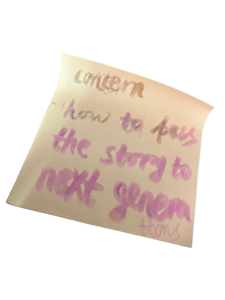
If young people are so immersed in storytelling online, what conditions would need to exist for them to feel comfortable sharing stories in real life with people who share their physical space?
Theme 4: Assimilation and the shifting of storytelling traditions
One thing that I have had the honour of learning about and talking through with young people, and as much as it is an honour, it is also something that brings a deep sadness, is assimilation.
When we talk about people from other cultures and other countries, storytelling often looks very different. In many places around the world, storytelling is expressive, embodied, and communal. It shows up not only through spoken words, but through dance, through food, through music, through painting, and through so many other forms of cultural expression that carry stories within them. But when viewed through a “Canadian” lens, or through a more Eurocentric North American lens, specifically in the U.S. and Canada, these forms of storytelling can sometimes be perceived very differently. They may be seen as dramatic. Over the top. Sometimes inappropriate. Sometimes embarrassing. And so what happens, particularly for young people and younger generations, is that they begin to feel the pressure to assimilate.
We know many of the reasons why assimilation happens. Assimilation can look like safety. It can look like attempts at belonging. It can look like trying to navigate spaces where you feel different, or where you have been made to feel othered. For many young people, assimilation becomes a form of survival. And this does not only apply to young people. It also applies to adults who are trying to find their place in a new country, in new communities, and in environments where their cultural ways of being may not always be understood or welcomed.
In response, something subtle but significant happens. We begin to dilute who we are, and our authenticity dissipates. The ways that we tell our stories shift. Our expressions become more palatable, more digestible to the dominant culture. But in that process, something else happens too. Traditions, especially storytelling traditions, can slowly begin to disappear. Whole languages have been lost through processes like this. Cultural practices change to fit Canadian norms. Ways of gathering and expressing community shift. And sometimes, without even realizing it, we leave behind practices like liming culture, those informal, communal ways of being together that not only uphold storytelling but uphold community itself.
Theme 5: Changing social practices and how people unwind
Another theme that surfaced, mentioned earlier, was the changing social practices around how people unwind. The conversation raised questions about how young people, and honestly adults as well, are expected to rest, socialize, and decompress within the increasing pressures that shape our daily lives. There are social pressures. There are monetary pressures. There are systems that many of us did not build, but that many of us are still part of and, in some ways, help uphold. Many of these pressures are deeply tied to capitalism, and we see their effects day after day, year after year.
Young people are especially affected. We see it in the decline of mental health among young people. We see it in the growing pressure placed on them to perform academically, to study more, to do better in school. We see it in the rising costs that families face, such as groceries, housing, and education, and the ways those pressures increasingly shape young people’s lives.
More and more young people are working jobs not simply for spending money, but to help support the growing cost of post-secondary education or to contribute to their families’ financial needs.
These societal pressures are not always ones that people can choose whether or not to participate in. Many of them are tied directly to financial survival. And when participation in these systems, or success within them, determines whether someone can maintain stable housing, access food, or protect their health, the room for choice becomes very small. This is why we see so many young people making decisions that might appear, on the surface, to be choices.
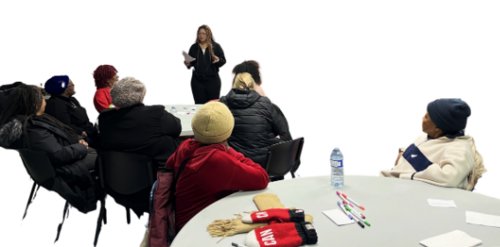
But the word “choice” can be misleading. For many young people, the sense of choice is limited. They do not necessarily feel that they have options. During the community dinners, when we asked people in the room who they learned storytelling from, the answer came up again and again: older generations. Stories were passed down from parents, grandparents, aunties, and uncles. They were shared at dinner tables, in living rooms, during family gatherings. In present-day life, those environments are becoming harder to maintain.
It is increasingly rare for families to be able to gather for dinner every day. It is rare for families to have the time to sit together and simply share stories when so much of life is structured around hustle culture. And I put emphasis on the phrase hustle culture. Much like the word resilience, it is often used in situations where there is no real choice, yet we still glamorize it.
It is not hustle culture to have five jobs if five jobs are required to put food on your table and pay your rent. Not in the way we try to frame hustle culture as something admirable or aspirational, as though someone working endlessly is proof of dedication or success. No one should have to work that many jobs simply to afford the necessities of life. When survival requires that much labour, the time and space for gathering, storytelling, and connection start to disappear.
And so we return to the questions:
- What does unwinding look like for young people if they are constantly surveilled?
- What does rest look like if they are seen as guilty or irresponsible simply for gathering?
- What does socializing look like for young people who are also trying to make sure there is food on their family’s table?
- And what does gathering look like when society reacts with fear at the sight of young people gathering together?
If we believe that children and young people represent the future, and that society shares responsibility for that future, then we also have to ask some other questions:
- What are we afraid of?
- And what part of that fear requires accountability from us?
Theme 6: Reframing what counts as a story
Another theme that came up, very similar to the generational divide discussed earlier, is the question of what actually counts as a story. Not only is there a divide between generations about storytelling, but there is also a limited understanding, for many people within the Canadian context, of what qualifies as a story in the first place. Many people uphold certain types of stories, or certain types of storytellers, as legitimate. A story is often valued or dismissed based on signals that have little to do with the story itself.
If the grammar is not proper.
If the pronunciation is not perfect.
If the storyteller does not speak in ways that signal a certain level of education.
Those things are often used to determine whether a story is worthy of being heard. I have seen this happen many times. Someone will pause a
young person mid-story to correct their grammar, interrupting the flow of what they are trying to share. In doing so, the focus shifts away from the story itself and toward the mechanics of language. Language is, first of all, made up. It is also flexible. Most importantly, if a story is understood, even when grammar or pronunciation is imperfect, then it has still been heard. It has still been received. We have to meet people where they are.
This is not to say that education is not important. Education absolutely matters. But when we decide that a story is less valuable because of how the storyteller expresses it, or because of the level of formal education reflected in their speech, we narrow the possibilities of communication. If the only stories someone is willing to value are those told in perfectly structured language, then perhaps they would be most comfortable going back in time and listening only to the stories shared in their Grade 9 to Grade 12 English classes.
In the world we live in now, where communication is essential for building empathy, understanding, and connection, we cannot afford to limit storytelling in that way. Community is nothing, absolutely nothing, without communication. Communication requires listening, not qualifying, not filtering stories through rigid expectations before we decide whether they deserve our attention, but listening, because stories already exist all around us.
You cannot say that a young person does not care about stories while criticizing them for constantly listening to rap music. Rappers are sharing stories. You cannot say that young people do not care about stories because they spend time playing video games. Many games are built entirely around narrative worlds where players move through characters, choices, and plotlines. You cannot say someone does not care about stories, and they spend every other weekend going to the movies.
Stories exist in many forms and across many mediums. That does not mean every medium needs to be something that you personally enjoy, but that we have to become better at recognizing stories when they show up in ways that fall outside of our personal expectations. We have to stop devaluing stories simply because they do not fit what our eyes, ears, or hearts are currently willing to receive.
Theme 7: Storytelling as cultural infrastructure
Earlier, I said that community is nothing without communication. It’s something I have been saying for years now, really trying to get down to the roots of words and the roots of community. If community depends on communication, then storytelling becomes a form of infrastructure within communities, not just locally, but across the wider world.
Storytelling builds the bridges that allow people to understand one another. One thing I was blessed to hear throughout my childhood came from my father. He would often say that if you spend even five or ten minutes speaking with someone, you will almost always find something in common. You will hear a story and resonate with it. You might discover that you know similar people. You might find shared experiences. Sometimes those connections come not from similarities, but from differences.
What I have learned over time is that sometimes it is within our differences that we find the most beautiful commonalities. Someone may grow up in a completely different household, within a completely different religion, or within a very different culture. Yet the relationship they have with their parents, with their siblings, or with their community might feel deeply familiar.
Stories allow us to recognize those connections.
Stories build community.
Stories transfer culture.
Stories keep culture alive.
Stories bridge generations.
And they create belonging.
At its core, storytelling relies on two very important things. First, the storyteller must believe that their story is worthy of being told. Second, the listener must be willing to receive that story. Receiving a story does not mean agreeing with it. It simply means listening, really listening. When a storyteller feels that their story has been received, something powerful happens. They begin to understand that their story is not only deserving of being told, but deserving of being heard. What that does for a person, or a community, for many communities, is life-changing.
Stories do so much work. When we think about storytelling from a folklore perspective, which came up often during the community dinners, we see that storytelling can also function as protection. Stories have embedded warnings, signs, symbols, and messages of who and what to watch for and subsequent consequences if we don’t listen carefully.
Stories can carry cultural knowledge forward, even when communities are no longer directly tied to the places those traditions came from due to immigration or displacement. Through storytelling, the core messages remain alive. The roots remain present. The story may shift slightly in how it is told. It may adapt to the time, the place, or the audience. The deeper meaning, the connection to culture, to memory, to identity, continues to speak to people in ways that reach both the mind and the soul.
So what?
So what does all of this mean?
It means that storytelling was never the issue.
During the two dinners and my work throughout the years, what remains clear to me is that people still care deeply about stories. Young people are still telling them, communities still carry them, and culture is both held and created within them. What has changed, and continues to, is the set of conditions that allow storytelling to happen in ways that build connection.
The systems in which we live with make gathering harder. Access to physical space is limited. Informal gathering spaces are both disappearing and becoming regulated and surveilled at alarming levels. Stories exist still, as life continues, stories continue being lived, how they are being told and consumed is changing, and as we gain global reach through technology, we often lose local reach in the same swoop. The days of gathering in-person for storytelling aren’t behind us, they are here, just limited in frequency. For some, maybe they are behind.
Storytelling is foundational for communities in how folks build trust, share knowledge, and ultimately find ways to co-exist in a world that challenges us all. Limitations on storytelling within communities and for communities pose a real threat to how we as people connect with one another, and thus co-exist in ways that go beyond survival.
The questions I want to leave us with are:
- How can we value stories but not the storyteller?
- If we value the storyteller, how do we show the care to allow their stories to be both told and received?
These are not questions with simple answers, but they are necessary ones.
Looking at storytelling as integral to cultural infrastructure, we then have a responsibility to support storytelling. This responsibility requires use challenging not just systems, and others, but ourselves as well. This is not just about storytelling. This is about giving people spaces for their voices to be heard, and understanding that listening is a skill we all need to work on.
FIRE + FOLKLORE
Before I was
I was a story
Made up of prayer
And worry
I like to believe there was a moment
I was held in fire
In my family we become ash
When the flames goes out
In the final flicker
We dance
Before breath
I was a spark
There was a time where stories were born
Out of kindling and kindness
A time where fire became centrepiece
For feasts and folklore
Community gatherings forged through fire
Before hustle culture
I wonder if ghost stories had commercials
Moments in which children need to use the washroom under the moon
You see where my people come from
Stories become bigger than you
Make it home faster than your own feet from school
My momma taught me it ain’t matter
What they say
Or how they write you
As long as you have a pen
As long as you remember your voice
I am made up of too much prayer
To be anyone's prejudice
A story is still a story if no ONE is listening
But it goes out like a flame
With the storyteller
Does it final dance for no ONE
A story is a conversation when ears make space
When shared over fire
A story takes shape in new ways
Is retold, becomes folklore
And reason
And magic
And memory
And culture
It becomes you
A flame that refuses to burn out
Shelly Grace

Why Kingston-Galloway-Orton Park (KGO) needs a story archive
Cities are full of stories, but not all stories are treated as worth preserving. In Toronto, neighbourhoods like Kingston, Galloway, Orton Park (KGO), a group of neighbourhoods in Scarborough KGO hold deep reservoirs of memory, culture, and everyday knowledge that rarely make their way into formal archives. Yet these stories are precisely the ones that sustain community life. In December 2025, a small initiative called the KGO Archive for Story Preservation set out to ask a simple question: how do people in this neighbourhood share and keep their stories alive? Through two facilitated community dinners, roughly 40 residents, artists, and facilitators gathered to talk, listen, and reflect together. The goal was not simply to collect stories but to understand the practices that allow storytelling to happen in the first place.
What emerged was a powerful reminder that storytelling is not just about words - it is about space, relationships, and the rhythms of everyday life.
Throughout the evenings, participants discussed the subtle ways stories move through communities. Stories surface while sitting on stoops, while sharing meals, while chatting outside apartment buildings, or while elders recount memories to younger relatives. These are not formal performances. They are living practices embedded in daily routines and cultural traditions.
But the conversations also revealed how fragile these practices have become.
One of the clearest themes was that storytelling needs physical space. Many residents spoke about the quiet disappearance of informal gathering spots,places where people once lingered long enough for stories to unfold. As neighbourhoods change, these natural meeting points become harder to find. Frigid winters push us indoors interrupting possibilities for outdoor gathering or shortening passing interactions with familiar neighbours.
Participants also spoke about a loss of gathering centres that once anchored community life. Recreation spaces, common areas, and neighbourhood institutions have shifted or disappeared, leaving fewer places where people can simply spend time together.
At the same time, residents noted a growing generational divide around storytelling. Younger people often connect through digital spaces, while elders hold memories tied to face-to-face conversation. Neither approach is wrong, but the gap between them can make it harder for stories to travel across generations.
Assimilation and migration were also part of the discussion. For many families, storytelling traditions shift as cultural practices adapt to new contexts. Languages change, routines change, and with them, the ways stories are told and remembered.
Participants also reflected on something more subtle: how people unwind today is different from the past. Time pressures, economic strain, and the pace of urban life mean that fewer moments exist for the kind of unstructured conversation where storytelling thrives.
Yet the gatherings also expanded what participants thought of as a story. Stories are not always long narratives or dramatic life events. They can be quick jokes exchanged at a bus stop, memories tied to a corner store, or shared experiences that shape how neighbours understand a place.
In that sense, storytelling is not simply cultural expression—it is cultural infrastructure. It is part of what makes a neighbourhood feel alive, connected, and recognizable to the people who live there.
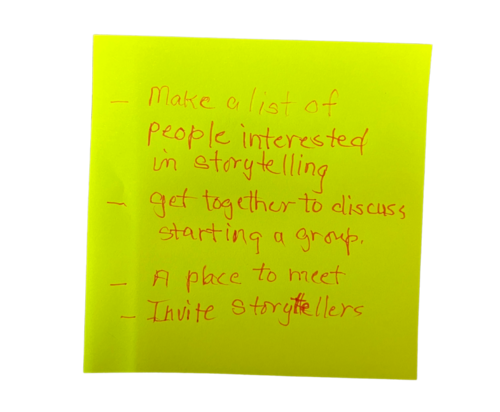
During the dinners, poet and community facilitator Shelly Grace helped guide the conversations and documented key ideas emerging from the room. Through collaborative discussion and visual recording, the group began mapping what storytelling looks like in KGO today—and what it might look like in the future.
The gatherings were intentionally modest in scale, but their ambition was larger. They served as an ideation phase toward developing a longer-term archive that reflects the neighbourhood’s lived experiences and culturally rooted practices of sharing stories.
Archives are often imagined as quiet rooms filled with documents. But a community archive can be something different. It can be a living platform that honours the peoplewho shaped a neighbourhood—their conversations, traditions, humour, and everyday acts of connection.
In a city where rapid change can erase local memory, preserving these stories is an act of recognition; a practice that shows residents who built cultural community pockets, like KGO, that they are valued.
If the future residents of Kingston Road, Galloway Road, and Orton Park Road are to understand the neighbourhood they inherit, they should be able to hear the voices of the people who built it; voices carried not only through official histories, but through the everyday storytelling that has always held communities together.
Take a look at our other projects: