Electrical Engineering degree
Power the future
Our modern world is built on electricity. Learn to harness its power to create the next generation of electronics, sensors, and information networks. Your career will be super-charged by a degree from Waterloo. We're ranked 1st in Canada and 31st in the world for electrical engineering (Academic Rankings of World Universities 2024).
You’ll study the fundamentals of electromagnetism, circuits, algorithms, and instrumentation. You will be able to specialize in a range of technologies such as power generation and clean energy, electric vehicles, Internet of Things, quantum computing, integrated circuit design, and machine learning.
You'll also gain hands-on experience starting right in first year, thanks to paid co-op work terms and some of the best student labs in North America.
When you graduate, you’ll have hundreds of career paths open to you, from designing power stations and aircraft control systems to pioneering the future of microprocessors and telecommunications systems.
What courses will you take in Electrical Engineering?
First-year courses
You’ll take courses in math, physics, circuits, and programming to build a strong foundation in electrical systems, signal analysis, and problem-solving techniques.
September to December
This is a sample schedule. Courses are subject to change.
After first-year
Your upper-year courses will cover power systems, embedded systems, signal processing, control theory, and electronics, with technical electives and labs to customize your learning.
View all the courses required for your degree.
Explore specializations within your program to enhance your degree.
- Communications & Signal Processing – Learn how to transmit, receive, and interpret data in everything from smartphones to satellites using advanced signal technologies.
- Quantum Engineering – Explore the emerging world of quantum devices and technologies to help build the next generation of ultra-fast, ultra-secure systems.
Or choose one of the options available to all engineering students.
Faculty:
Faculty of Engineering
Degree:
Bachelor of Applied Science in Electrical Engineering
Available as a co-op program?
Co-op only
Available as a regular program?
No
Available as a minor?
No
Energize the world. Learn to design, create, and integrate more efficient and reliable technologies, like wind turbines, GPS devices, hybrid cars, communication systems, and other circuits and systems.
Smart power. With one of the largest power energy research groups in North America, Waterloo is home to leading experts in photovoltaic panels, wind turbines, and smart grids.
Co-op = relevant paid work experience
In the world's leading co-op program, you'll explore potential careers, learn to interview for jobs, graduate with up to two years of valuable experience — and make money!
Sample co-op job titles
- PCB hardware designer
- Electrical engineering sensor developer
- Hardware design engineer
- Artificial intelligence undergraduate researcher
- Test systems engineering
- Electrical engineer intern
- Hardware designer
- Junior designer - electrical
Starting in first year, you'll normally alternate between school and work every four months, integrating your classroom learning with real-world experience. You can return to the same employer for a couple of work terms to gain greater knowledge and responsibility or work for different employers to get a broad range of experience.
Your first work term will be halfway through first year (January to April 2027).
| Year | September to December (Fall) | January to April (Winter) | May to August (Spring) |
|---|---|---|---|
| First | Study | Co-op | Study |
| Second | Co-op | Study | Co-op |
| Third | Study | Co-op | Study |
| Fourth | Study | Co-op | Study |
| Fifth | Co-op | Study | - |
What can you do with a degree in Electrical Engineering?
Waterloo Electrical Engineering graduates often pursue careers in software development, manufacturing, telecommunications, aerospace, and more. They often work for engineering firms, technology companies, and manufacturing companies.
Recent graduates
- Hardware Engineer — Intel
- Electrical Designer — Mulvey Banani International
- Business Technology Analyst — Deloitte
- Programmer — Kubra Data Transfer
- Software Engineer — Dropbox
- Application Specialist — Ceridian
- Engineering Product Management — IBM Canada
Possible professional designation
Hear from a recent graduate
Sefunmi Osinaike (BASc '17) talks about how he co-founded Co.Lab while studying at Waterloo—a company that’s helped over 1,000 learners in 50+ countries launch tech careers at top companies like Apple, Google, and Amazon, earning him a spot on Forbes’ 30 Under 30 list. Listen to his story here.
Learn about the future of careers in engineering.
Common questions about the program
What's the difference between Electrical Engineering and Computer Engineering?
Electrical Engineering and Computer Engineering are closely related fields, but they focus on different aspects of technology. Electrical Engineering is broader and deals with the study, design, and application of electrical systems, including power generation and distribution, electronics, control systems, and telecommunications. It involves a lot of work with circuits, electromagnetics, power systems, signal processing, and control systems, and graduates may find careers in industries like energy, telecommunications, electronics, and automation.
In contrast, Computer Engineering is a specialized branch that combines elements of electrical engineering and computer science, focusing specifically on the design and development of computer systems, hardware, and software integration. It focuses more on digital systems, microprocessors, computer architecture, software development, and embedded systems, and graduates might find careers in designing and developing computer hardware, software, networking, and cybersecurity.
Both fields share a strong foundation in mathematics, physics, and basic electronics, and both may involve programming and digital design, but Computer Engineering delves deeper into computer-specific topics.
Student life in Engineering
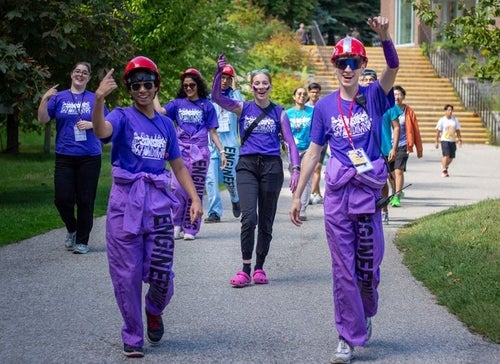
Waterloo Engineering goes far beyond lectures, with a vibrant community that works hard and plays even harder. Sing in an a cappella group, join a varsity or intramural team, compete in design challenges or hackathons, volunteer, or lead a student society! Whatever your interests, you’ll be in good company.
- 96% employment rate within 6 months of graduating, compared to the Ontario average of 89% for Engineering students.
- 90% graduation rate, higher than the Ontario average of 82%.
- 95% retention rate from first to second year.
Student design teams
Have fun and develop hands-on experience through one or more of our 35+ student-led design teams!
Design teams include rocketry, concrete canoe, small airplanes, robotics, solar car, submarine racing, autonomous vehicle, Engineers Without Borders, and more.
Engineering Society (EngSoc)
EngSoc is run by students and provides social and academic events and services to make your experience as a Waterloo Engineering student the best it can be.
Benefit from mentoring for first-year students or meet other students through an annual conference, semi-formal, career fair, charity events, community outreach, and much more!
Women in Engineering
Women in Engineering (WiE) supports women and non-binary engineering students and alumni, while encouraging the next generation to pursue a future career in engineering
Any student is also welcome to join Women in Science, Technology, Engineering, and Mathematics (WiSTEM), a student-run club that promotes equality in STEM through skills workshops, discussions, and guest speakers.
Campus-wide activities
Our campus is packed with opportunities to get involved – no matter how unique your interests.
Between our 200+ student-run clubs, sports and recreation opportunities, student government, and events, student life at Waterloo has something for everyone.
Admissions requirements
Ontario students: six Grade 12 U and/or M courses including
- Advanced Functions (minimum final grade of 70% is required)
- Calculus and Vectors (minimum final grade of 70% is required)
- Physics (minimum final grade of 70% is required)
- Chemistry (minimum final grade of 70% is required)
- English (ENG4U) (minimum final grade of 70% is required)
Admission averages: Individual selection from the high 80s to low 90s
Previous experience in programming is recommended.
There are supplementary information forms, including the Admission Information Form, which are required for admission. We'll email you detailed instructions once we receive your application. An online video interview is required for Faculty of Engineering scholarships and is strongly recommended for admission.
Not studying in Ontario? Search our admission requirements.
How to apply
Apply directly to this program on your application.
Get information about programs, applying, and more!
Subscribe to our monthly newsletter
Get valuable updates and tips sent straight to your inbox!
Learn more
Questions about courses, programs, requirements, or careers?
Please contact the Faculty of Engineering which can answer any questions you have.