Mechanical Engineering degree

Banner image showing two students in the Mechanical Engineering program

Put your career in gear.

If you love things that move, this is your program. At Waterloo, you’ll develop the skills you need to design everything from switches to spacecrafts.

You’ll get a broad foundation in all aspects of mechanical design: mechanics, power, control, and manufacturing. You’ll also learn to lead large, multidisciplinary teams, solve problems, come up with high-impact innovations, and have the chance to apply it all to real work experiences in co-op.

Where you use those skills is up to you. Mechanical engineers work in all kinds of fields, constantly looking for ways to make machinery faster, lighter, cleaner, and more reliable.

And with two years of career-relevant experience on your resume by the time you graduate, you'll stand out to employers and be ready to launch a successful engineering career.

What courses will you take in Mechanical Engineering?

First-year courses

You’ll take courses in math, physics, chemistry, and engineering design—building the analytical and technical foundation to understand mechanical systems and physical principles.

September to December

  • ME 100 – Introduction to Mechanical Engineering Practice 1
  • CHE 102 – Chemistry for Engineers
  • MATH 115 – Linear Algebra for Engineering
  • MATH 116 – Calculus 1 for Engineering
  • PHYS 115 – Mechanics

January to April or May to August

  • ME 100B – Seminar
  • ME 101 – Introduction to Mechanical Engineering Practice 2
  • ME 115 – Structure and Properties of Materials
  • ME 123 – Electrical Engineering for Mechanical Engineers
  • MATH 118 – Calculus 2 for Engineering
  • One approved elective course

This is a sample schedule. Courses and/or their offerings may change depending on availability. 

After first-year

  • Your upper-year courses will cover fluid mechanics, thermodynamics, solid mechanics, engineering materials, and mechanical design, with labs and projects in areas like manufacturing, robotics, aerospace, or energy systems.
  • View all the courses required for your degree.

Sample upper-year courses

ME 250 – Thermodynamics 1
ME 321 – Dynamics of Machines and Mechanical Vibrations
ME 435 – Industrial Metallurgy
ME 547 – Robot Manipulators: Kinematics, Dynamics, Control

Customize your degree

Explore specializations within Mechanical Engineering to enhance your degree.

  • Welding and Joining – Master advanced techniques to join metals and materials, enabling the creation of stronger, safer, and more durable mechanical structures.

Or choose one of the options available to all Engineering students.

Faculty:
Faculty of Engineering

Degree:
Bachelor of Applied Science in Mechanical Engineering

Available as a co-op program?
Co-op only

Available as a regular program?
No

Available as a minor?
No

Knowledge is power. Combine technical know-how with knowledge of fluids, power, and energy systems to create new technologies.

Endless career possibilities. Graduates from this program work in various industries, including aerospace, automotive, green energy, and oil.

Co-op = relevant paid work experience

In the world's leading co-op program, you'll explore potential careers, learn to interview for jobs, graduate with up to two years of valuable experience — and make money!

Sample co-op job titles

  • Assistant design / production engineering
  • Mechanical designer
  • Project engineering
  • Quality assurance
  • Machine operator
  • Manufacturing student
  • Product developer

Co-op work-study sequence

Starting in first year, you'll normally alternate between school and work every four months, integrating your classroom learning with real-world experience. You can return to the same employer for a couple of work terms to gain greater knowledge and responsibility or work for different employers to get a broad range of experience.

Your first work term will be halfway through first year (January to April 2027).

Year September to December (Fall) January to April (Winter) May to August (Spring)
First Study Co-op Study
Second Co-op Study Co-op
Third Study Co-op Study
Fourth Co-op Study Co-op
Fifth Study Study -

or after first year (May to August 2027).

Year September to December (Fall) January to April (Winter) May to August (Spring)
First Study Study Co-op
Second Study Co-op Study
Third Co-op Study Co-op
Fourth Study Co-op Co-op
Fifth Study Study -

There are two options for co-op sequences. You can request your preference if you receive an offer of admission.

Engineering in practice: Alex’s co-op at a window-and-door factory gave him full design freedom—turning his ideas into real products. At Waterloo, he thrives in hands-on spaces and encourages new students to aim for small daily growth.
Learn more about co-op →

What can you do with a degree in Mechanical Engineering?

Waterloo graduates often pursue careers in automation, automotive aerospace, and forensics. They commonly work for media companies, technology companies, vehicle manufactures, and more.

Recent graduates

  • Mechanical Engineer – Apple
  • Engineer in Training – Shell Canada
  • Reactor Designer – Candu Energy
  • Mechanical Engineer – Imperial Oil
  • Quality Control Engineer – Toyota Motor Manufacturing Canada
  • Production Engineer – SeedMaster
  • Senior Hardware Engineer – Teledyne DALSA

Possible professional designation

Learn about the future of careers in engineering.

What is the difference between Mechanical Engineering and Mechatronics Engineering?

In Mechanical Engineering, you’ll learn to design and build machines and mechanical systems for transportation, energy systems, buildings, and industrial processes. You’ll understand how things move, how forces affect objects, and how to create efficient and safe machines. Your learning will go beyond the classroom as you participate in paid work terms and learn how to lead large, multidisciplinary teams and problem-solving skills in real-world applications. 

Mechatronics Engineering pulls together mechanical and control engineering, electronics, and computer science to create computer-controlled electromagnetic systems seen in self-driving cars, automated assembly lines, and industrial robots. You'll design and build machines that use both mechanical parts and electronics to move and interact with their surroundings, often with the help of sensors and computer control.  

Both programs use mechanical engineering to design and build innovative machines and systems, but their focus differs. In Mechanical Engineering, you’ll focus more on the physical principles of mechanical systems. In Mechatronics Engineering, your learning will heavily involve electronics, programming, and circuitry with a focus on the computing behind engineering. 

Student life in Engineering

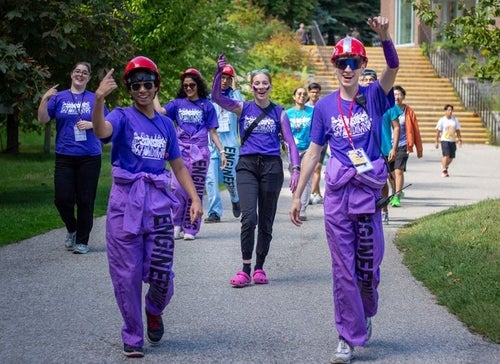
Waterloo Engineering goes far beyond lectures, with a vibrant community that works hard and plays even harder. Sing in an a cappella group, join a varsity or intramural team, compete in design challenges or hackathons, volunteer, or lead a student society! Whatever your interests, you’ll be in good company.

  • 96% employment rate within 6 months of graduating, compared to the Ontario average of 89% for Engineering students. 
  • 90% graduation rate, higher than the Ontario average of 82%.
  • 95% retention rate from first to second year.

Student design teams

Have fun and develop hands-on experience through one or more of our 35+ student-led design teams!

Design teams include rocketry, concrete canoe, small airplanes, robotics, solar car, submarine racing, autonomous vehicle, Engineers Without Borders, and more.

Engineering Society (EngSoc)

EngSoc is run by students and provides social and academic events and services to make your experience as a Waterloo Engineering student the best it can be.

Benefit from mentoring for first-year students or meet other students through an annual conference, semi-formal, career fair, charity events, community outreach, and much more!

Women in Engineering

Women in Engineering (WiE) supports women and non-binary engineering students and alumni, while encouraging the next generation to pursue a future career in engineering

Any student is also welcome to join Women in Science, Technology, Engineering, and Mathematics (WiSTEM), a student-run club that promotes equality in STEM through skills workshops, discussions, and guest speakers.

Campus-wide activities

Our campus is packed with opportunities to get involved – no matter how unique your interests.

Between our 200+ student-run clubs, sports and recreation opportunities, student government, and events, student life at Waterloo has something for everyone.

Admission requirements

Ontario students: six Grade 12 U and/or M courses including

  • Advanced Functions (minimum final grade of 70% is required)
  • Calculus and Vectors (minimum final grade of 70% is required)
  • Chemistry (minimum final grade of 70% is required)
  • Physics (minimum final grade of 70% is required)
  • English (ENG4U) (minimum final grade of 70% is required)

Admission averages: Individual selection from the high 80s to low 90s

How to apply?

Apply directly to this program on your application.

There are supplementary information forms, including the Admission Information Form, which are required for admission. We'll email you detailed instructions once we receive your application. An online video interview is required for Faculty of Engineering scholarships and is strongly recommended for admission. 

Not studying in Ontario? Search our admission requirements.

Get information about programs, applying, and more!

Subscribe to our monthly newsletter

Get valuable updates and tips sent straight to your inbox!

Your date of birth is collected to confirm your identity and to match your details with a current or future application to Waterloo, if applicable. This information will be used solely for this purpose.
Optional newsletter content
I agree that the University of Waterloo may send me emails.
(You can change your preferences or unsubscribe at any time.)
CAPTCHA
This question is for testing whether or not you are a human visitor and to prevent automated spam submissions.

Learn more

Questions about courses, programs, requirements, or careers?

Please contact the Faculty of Engineering which can answer any questions you have.