
Written by Layanne (she/her), student
Some of the biggest challenges facing our world don’t fit neatly into a single subject. So, to solve them, we can’t approach these problems from just one perspective.
If you’re considering Waterloo’s Faculty of Environment, chances are you’re curious about our planet. You want to make a difference. Maybe that means addressing climate change, protecting or rehabilitating habitats and ecosystems, helping businesses become more sustainable, or designing better communities.
Perhaps you’re interested in geography or want to use code and AI to unlock environmental solutions hidden in the data. With all the different programs to choose from, it can be hard to know which path is right for you. So, how do you choose a program in the Faculty of Environment?


Reflect on the problems you want to solve
One of the things that makes the Faculty of Environment unique is that students are united by one common goal: transformative change that benefits people and the planet.
Each student’s path is unique to them. Some are interested in climate change; others in sustainable business, urban planning, geospatial technology, or aviation.
I was inspired to join the Faculty of Environment because I wanted to contribute to positive social and environmental change in local communities. By the end of my studies, I hope to leave with both the knowledge and experience that will allow me to meaningfully influence planning and policy decisions.
When choosing a program, a good place to start is with the subjects you’re drawn to and the issues you’d like to solve. In this field, there are new careers and whole new industries being developed every year. The best thing you can do to find a career you love is to enroll in a program that will equip you with skills you can apply in your area of interest. In a field where careers are evolving, domain knowledge and hands-on skills will always be in demand.
Ask yourself:
- Are you passionate about climate change, conservation, geography, or biodiversity?
- Do you want to use business or finance to create positive change?
- Do you enjoy working with maps, data, technology, and solving complex problems?
- Do you want to help create healthier, more sustainable communities?
- Are you fascinated by aviation and want to take your learning to new heights?
Your answers can help point you toward the Environment program you’ll enjoy!
Think about your learning experience
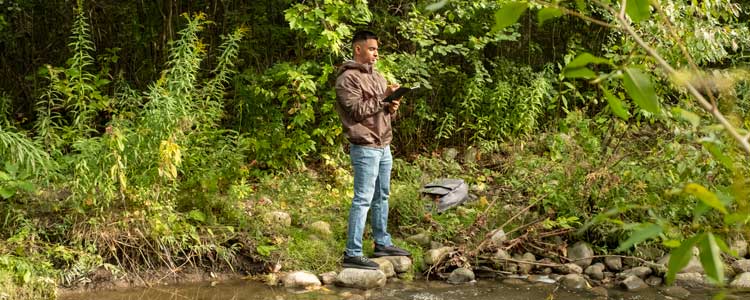
The subjects you’re interested in are important, but so are learning experiences. As an Environment student at Waterloo, your learning often extends beyond the classroom with hands-on experiences that allow you to apply what you learn in real-world settings.
Depending on the program you get in to, you could find yourself conducting research in the field, using Geographic Information Systems (GIS) and mapping technology, working with communities, analyzing environmental trends, or even training to become a pilot and earning your Commercial Pilot’s Licence.
If you choose a program with co-op, that learning can also extend into the workplace as you alternate between paid work terms and study terms. When exploring your options, it’s worth thinking about the skills and experiences you’d like to gain from your program.
Co-op and applied research projects enabled me to work directly on complex functions such as carbon accounting and sustainability reporting for major operations while still in school. The opportunity to apply concepts from lectures to actual corporate data not only deepened my academic learning but also gave me clear direction and confidence in my career path.
Choose a direct entry program
Once you’ve thought about the issues you’d like to solve and the types of learning experiences that excite you, it’s time to explore your program options.
Each of the unique programs in the Faculty of Environment are direct-entry, meaning you apply directly to your program of interest and begin studying this subject from day one. The good news is you’ve already done the hardest part. By reflecting on your goals, learning experiences, and skills, you’ve already started to narrow down your options!

Which of these sounds most like you?
Based on your earlier reflections, what issues and subjects interest you the most? Learn more about the programs, skills, and career paths connected to them. The programs that support your interests and goals are the ones worth exploring!
If you’re passionate about climate change, conservation, geography and biodiversity
You might like exploring:
- Climate and Environmental Change
- Environment, Resources and Sustainability
- Geography and Environmental Management
In these programs, you’ll dive into topics like climate science, biodiversity loss, food security, water scarcity, resource management, human-environment interactions, and sustainability while building the skills to address real-world environmental challenges. Graduates of these programs can pursue careers such as:
- Environmental consultant
- Environmental education manager
- Sustainability co-ordinator
- Natural resource manager
- Climate risk scientist
If you want to use business or finance to create positive change
You might like exploring:
In these programs, you’ll explore how businesses can drive positive environmental outcomes while still delivering profitability. You’ll gain expertise in environmental issues, sustainability, business, marketing, finance, and decision-making. You’ll gain valuable skills in leadership, communication, strategic thinking, financial analysis, and problem-solving that can prepare you for careers such as:
- Sustainability analyst
- Financial consultant
- Environmental, Social, and Governance (ESG) analyst
- Environmental health and safety specialist
- Accountant
- Founder
If you enjoy working with maps, data, technology, and solving complex problems
You might like exploring:
In this program, you’ll learn how to turn data into insights that can help solve real-world problems by applying computer programming, and data analysis to basically any problem that has a geographic component. Think: where should we build a new fire station? What community could most benefit from a new subway line? What Canadian crops are most at risk from extreme weather events? You’ll gain valuable skills and knowledge in coding, remote sensing, computer mapping, GIS, data analysis, artificial intelligence, and problem-solving that can prepare you for careers such as:
- GIS technician
- Geospatial data scientist
- Remote sensing specialist
- Geospatial software developer
- Geospatial artificial intelligence (GeoAI) analyst
If you want to help create healthier, more sustainable communities
You might like exploring:
In Planning, you’ll learn how communities are planned, built, and managed, and how to tackle the environmental and social challenges facing our cities, towns, and natural areas. You’ll develop valuable skills in planning, design, communication, collaboration, and problem-solving that can prepare you for careers such as:
- Community planner
- Transportation planner
- Urban designer
- Land use planner
- Development planner
If you’re fascinated by aviation and want to take your learning to new heights
You might like exploring:
In this program, you’ll combine your passion for aviation with the study of geography and environmental systems. You’ll learn about weather patterns, landforms, navigation, GIS technology, and remote sensing while working toward earning your Commercial Pilot’s License. Graduates of this program often pursue careers such as:
- Commercial airline pilot
- Aerial survey pilot
- Flight instructor
- Airport sustainability coordinator
- Government aviation officer
Interested in aviation, but not sure about whether a career as a pilot is right for you? Add an Aviation Minor to any Environment program – or add an Aviation Specialization to a degree in Geography and Environmental Management, Climate and Environmental Change, or Geospatial Data Science.
Ready to begin your journey?
Here are more resources to help you along the way:
- Contact the Faculty of Environment recruitment coordinator with any questions you may have.
- Have questions you want to ask a student? Connect with a student ambassador.
- Want a tour of the faculty? Book a campus tour.
- Learn how an Environment degree will set you up for careers of the future.
- Find out what Environment grads are up to
- Check out these cool stories from students in Environment.
Related articles

Finding your place – and making the world a better one
Whether she’s leading the Radicle, working on a co-op term, donning in residence, or serving in her role as the first-ever Waterloo Undergraduate Student Association (WUSA) Sustainability Commissioner, Michelle sees university as an opportunity to grow in all ways — not just academically.

C-suite sustainability
Growing up around the oil industry, Okeoghene saw firsthand how business and the environment are deeply connected. Now, she’s working to prove that sustainability and economic growth can go hand in hand.

Drone driver
“I chose Waterloo for the co-op program,” says Pedro, who’s helped York Region map out its fibre-optic network while finishing a Master of Science degree in Geography at Waterloo. “I was able to figure out the types of work I might like to do before I even graduated.”