Shaping the Role of Artificial Intelligence (AI) in Higher Education
April 29 & 30, 2026
For our 17th annual University of Waterloo Teaching and Learning Conference, we explored the role of Artificial Intelligence (AI) in teaching and learning and our role in shaping its use at UW. AI is rapidly transforming higher education. In this evolving landscape, educators are devising new learning activities and assessment strategies to ensure that our graduates are prepared to navigate the complex challenges they will face throughout their lifetimes. Against this backdrop of possibility and disruption, a crucial opportunity emerges: whether novices or experts, we have the power to shape AI’s role in higher education, by asking questions, sharing insights, and creating meaningful learning experiences.
AI affords new possibilities for instructors and students: personalized learning, increased engagement, and enhanced focus on critical thinking skills. How best do we embed AI tools into our courses, and champion new approaches to teaching and assessments of learning to better address the learning needs of our students? When best do we prioritize foundational knowledge and skills versus higher-order learning outcomes? In what ways can we enhance student belonging and authentic emotional and intellectual connections? And how might we work together with AI to improve education?
At the same time, AI challenges higher education and our agency in the pedagogical process in fundamental and existential ways, leading many of us to question the very roles of learners and instructors. How do we maintain the integrity of assessments, given tools that can complete various assignments are almost undetectable? How do we design courses and programs to maintain students’ engagement in their own learning? How do we best integrate AI to promote student learning? How do we ensure our learning environments remain ethical? How do we continue championing accessibility, equity, diversity, and inclusion with Large Language Models (LLMs) that are biased and exclude important voices?
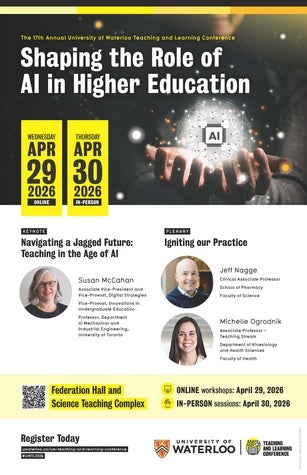
Keynote — Navigating a jagged future: teaching in the age of AI
Susan McCahan (Associate Vice-President & Vice-Provost, Digital Strategies, and the Vice-Provost, Innovations in Undergraduate Education at the University of Toronto)

The existence of, and easy access to, generative AI systems is fundamentally impacting our professional work as educators in all its dimensions, including assessment, curriculum, learning goals, and instruction. It is also changing the approaches students take to learning. In this talk, Professor McCahan starts by briefly reviewing how these systems work and their capabilities. This is intended to create a shared literacy about this technology so we, as a community, can have informed conversations about the implications for our work.
Beyond the basics, we explore how AI presents both opportunities and a “wicked challenge” for higher education; a challenge with no simple solution that shifts even as we attempt to address it. A primary tension we face is the importance of friction in the learning process. While AI is designed to make tasks easy, deep learning often requires the “productive struggle” that automation removes. Students and faculty are grappling with this deeply felt tension. This is particularly relevant to the future of educational technology and the ways we must rethink assessment. As AI changes the nature of work and other aspects of society, instructors are reconsidering the competencies that students need and adjusting their learning goals and instruction accordingly. While the fundamentals of higher education, such as critical thinking, will remain as relevant as ever, the way we teach these skills is being transformed.
Susan McCahan is the Associate Vice-President & Vice-Provost, Digital Strategies, and the Vice-Provost, Innovations in Undergraduate Education at the University of Toronto. She is responsible for strategic leadership on the University's IT and data systems working in close coordination with the CIO, CISO and Executive Director of Institutional Research and Data Governance. In her VPIUE role she is responsible for developing and implementing initiatives to re-imagine and enhance academic experiences at the University. This includes leadership on key pedagogical initiatives such as experiential learning.
She joined the Department of Mechanical & Industrial Engineering at Toronto in 1992. She is a Fellow of the American Association for the Advancement of Science in recognition of contributions to engineering education has been the recipient of several major teaching awards including the 3M National Teaching Fellowship and the Medal of Distinction in Engineering Education from Engineers Canada. She has developed and taught courses on energy systems, heat transfer, and design and she is the lead author of an introductory textbook on engineering design. Her current research focuses Engineering Education Research and she is the former President of the Canadian Engineering Education Association. Professor McCahan’s work focuses on the engineering learning environment as a designed system. In particular, she is currently working in the areas of assessment, educational technology, and curriculum.
Igniting our Practice

Dr. Michelle Ogrodnik (she/her) is an Assistant Professor, Teaching Stream in the Department of Kinesiology and Health Sciences, in the Faculty of Health. From understanding the impact of exercise on our minds to examining what it means to be “healthy,” her goal is to facilitate opportunities for students to learn how health is much more than individual pathophysiology.
Michelle teaches the Faculty of Health’s undergraduate communication requirement, their largest course, and serves as their Teaching Fellow. Michelle’s approach to teaching centres on creating a fun, supportive learning environment, whether that be in small seminars or classes of more than 700 students. Most recently, she received the Faculty of Health Teaching Award (2025).
In her talk, Michelle introduced the concept of if-then coping planning, a widely used behaviour change technique. As part of her lesson, she highlighted parallels between this thinking process and how GenAI tools operate, while emphasizing the role of human agency.

Dr. Jeff Nagge is a Clinical Associate Professor at the School of Pharmacy and the Director of the School’s Ambulatory Care Pharmacy residency program. In 2024, he received the Award for Innovation in Education from the Association of Faculties of Pharmacy of Canada, and in 2023, the Silver Medal from QS Reimagine Education Awards for his groundbreaking work in AI-enabled clinical education.
Jeff’s teaching philosophy centres on using technology to enhance, not replace, meaningful student-instructor interactions, and his current work with AI is shaped / informed by two decades of reflection on experiential learning. As the founder of Canada’s first pharmacist-led referral-based hypertension clinic (2006), he brings clinical expertise into the classroom by creating immersive learning experiences that prepare students for real-world practice. His MOAT (Management of Oral Anticoagulation Therapy) course pioneered the use of generative AI to replace traditional in-person clinical rotations, demonstrating that AI can scale high-quality experiential learning without compromising educational rigour.
Currently, Jeff is developing AI-enabled virtual clinical simulations for culturally safe Indigenous healthcare in partnership with Indigenous content experts and designing a course in advanced hypertension management that leverages AI to provide students with immediate, personalized feedback at scale. His work consistently emphasizes instructor agency: in all his AI-enabled courses, faculty define the learning objectives, assessment criteria, and knowledge base—AI simply facilitates delivery.
In his Igniting Our Practice session, participants witnessed a live demonstration of AI-enabled assessment that directly addressed faculty concerns about generative AI in education. A volunteer submitted a lay summary of a research article on sodium restriction and hypertension management, received immediate AI-generated feedback based on Jeff’s grading rubric, and then participated in an oral defense with an AI chatbot that probed their understanding and reasoning. This demonstration showcases how thoughtful assessment design can deter AI misuse while simultaneously enabling high-touch pedagogical practices (like oral examinations) that are traditionally difficult to scale. Participants explored how this approach reclaims instructor agency in the age of AI and considered applications across their own disciplines.
Contact
Visit our official conference website to learn about current and future conferences.
For questions about the conference, please contact Annik Bilodeau at the Centre for Teaching Excellence.