Nanotechnology Engineering degree
Design innovative systems measured in billionths of a metre.
Join us to be a technology rebel, break convention, and create disruptive novel ideas for a bold new scientific frontier!
Nanotechnology Engineering is the foundation of future technology. It saves lives, mitigates climate change, enables AI and quantum computing, powers the global economy, and enhances our quality of life.
At the University of Waterloo, Nanotechnology Engineering brings together Chemical Engineering, Electrical and Computer Engineering, and Chemistry to create a uniquely powerful, interdisciplinary program - ranked #1 in Canada for Nanotechnology by the U.S. News & World Report Best Global Universities.
Rooted in materials science, chemistry, quantum physics, biology, and medicine, nanotechnology fuels advances in everything from life-saving pharmaceuticals and biomedical tools to cutting-edge electronics, automotive innovation, and global communications. It enables game-changing technologies like COVID mRNA vaccines, precision drug delivery, high-performance integrated circuits, and sustainable energy solutions.
Our program is the first accredited nanotechnology program in Canada and features a dedicated program clean room with multimillion-dollar, cutting-edge equipment. You’ll gain hands-on experience working with nanoscale materials, devices, and fabrication processes that push the boundaries of modern technology.
You’ll gain extensive experience in your lab courses and through a range of paid co-op opportunities. When you graduate, you'll be well positioned to benefit from the billions of dollars of planned investment in the global nanotechnology sector that enables advanced computing, innovative health care systems, and tackling climate change through renewable energy production and storage.
What courses will you take in Nanotechnology Engineering?
First-year courses
You’ll take courses in chemistry, physics, calculus, linear algebra, and engineering design—building a foundation in molecular science, materials, and nanoscale engineering principles.
September to December
This is a sample schedule. Courses and course offerings may change depending on availability.
After first-year
Your upper-year courses will cover quantum mechanics, nanomaterials, nanoelectronics, nanofabrication techniques, and biomedical nanotechnology, with labs and projects focused on applications in energy, electronics, health, and advanced materials.
View all the courses required for your degree.
Sample upper-year courses
NE 336 – Micro and Nanosystem Computer-aided Design
NE 345 – Photonic Materials and Devices
NE 408 – Nanosystems Design Project
NE 471 – Nano-Electronics
NE 471 – Nanomedicine and Nanobiotechnology
*Courses with fewer than 20 students may be cancelled and are subject to change.
Customize your degree in Nanotechnology Engineering
Explore specializations within your program to enhance your degree.
- Nanobiosystems – Combine biology and nanotech to develop tiny devices and systems for healthcare and medicine.
- Nanoelectronics – Design ultra-small electronic components and circuits that power the next generation of technology.
- Nanofabrication – Learn advanced techniques to build and manufacture materials and devices at the nanoscale.
- Nanomaterials – Study and create new materials with unique properties to transform industries from energy to medicine.
Or choose one of the options available to all engineering students.
Faculty:
Faculty of Engineering
Degree:
Bachelor of Applied Science in Nanotechnology Engineering
Available as a co-op program?
Co-op only
Available as a regular program?
No
Available as a minor?
No
Apply your learning in state-of-the-art facilities. Waterloo is home to the $160-million Mike and Ophelia Lazardis Quantum-Nano Centre, a facility packed with the very latest nano-fabrication tools in ultra-sterile cleanrooms.
Study at a top-ranked university. Waterloo is ranked #1 in Canada for Nanoscience and Nanotechnology (U.S. News & World Report Best Global Universities, 2024–25).
Co-op = relevant paid work experience
In the world's leading co-op program, you'll explore potential careers, learn to interview for jobs, graduate with up to two years of valuable experience — and make money!
Sample co-op job titles
- Battery materials intern
- Research & development engineering
- Drug delivery & formulations co-op
- Nanofabrication assistant
- Optomechanical engineering
Co-op work-study sequence
Starting in first year, you'll normally alternate between school and work every four months, integrating your classroom learning with real-world experience. You can return to the same employer for a couple of work terms to gain greater knowledge and responsibility or work for different employers to get a broad range of experience.
| Year | September to December (Fall) | January to April (Winter) | May to August (Spring) |
|---|---|---|---|
| First | Study | Study | Co-op |
| Second | Study | Co-op | Study |
| Third | Co-op | Co-op | Study |
| Fourth | Study | Co-op | Co-op |
| Fifth | Study | Study | - |
Your first work term will be at the end of first year (May to August 2027).
Tiny tech, big possibilities: From building laser-powered glucose sensors to improving AI safety in Norway, Nanotechnology Engineering student Shawn used co-op to explore cutting-edge research, travel the world, and shape his future career, one project at a time.
What can I do with a degree in Nanotechnology Engineering?
As a graduate, you might pursue further specialized studies, a career in industry or government, or your own start-up company. With your unique collection of skills and attributes, you'll be employable in many sectors, including environment and sustainability, mining and energy, semiconductor and electronics, and agriculture and food, to name just a few.
Recent graduates
- Optoelectronic display engineer – VueReal Inc.
- Materials test engineer – Tesla Inc.
- Business technology analyst – Deloitte Consulting
- NPI engineering specialist – Teledyne DALSA
- Research and development engineer – AquaSensing
- Pharmacovigilance analyst – ProPharma Group
- Scanning probe microscopy experimentalist – Canadian Bank Note Company
Possible professional designation
Learn about the future of careers in engineering.
View more videos, including a tour of our labs
What is Nanotechnology Engineering?
Discover Canada's first accredited undergraduate Nanotechnology Engineering program.
Webinar: What is Nanotech Engineering?
Professor Ting Tsui, director of the Nanotechnology Engineering program Waterloo, explains what nanotechnology engineering is.
What does the Nanotechnology Engineering lab look like?
View a tour of the Nanotechnology Engineering teaching facilities and lab spaces. Visit state-of-the-art labs and take a look inside the only dedicated cleanroom for undergraduate students.
How are nanotechnology engineering labs used?
How nanotechnology engineering was used to create the COVID mRNA vaccine.
What is the difference between Nanotechnology Engineering and Materials and Nanosciences?
In Materials and Nanosciences, you’ll learn about designing composite materials, ceramics, semiconductor materials, fuel cells, energy storage devices, solar cells, and more. You'll mix chemistry, math, and physics in material sciences courses and graduate with the skills needed to work in fields such as biomedicine and materials research and development. In your upper years, you’ll choose whether to take more chemistry or physics depending on your interests.
Nanotechnology Engineering tackles everything from vaccines and integrated circuits to clean energy and climate solutions. You’ll combine chemistry, biology, electronics, and quantum physics to create nano and microscopic materials and devices. You’ll also master cutting-edge nanofabrication and characterization equipment in a dedicated clean room. After graduation, you may work as an analyst, engineer, or researcher in related fields.
Both programs explore the science of materials and can lead to careers in research, development, and innovation. Materials and Nanosciences is a science-based program that emphasizes understanding how materials behave and how they can be improved. Nanotechnology Engineering builds on that scientific foundation and applies it to the design and development of nanoscale technologies.
Student life in Engineering
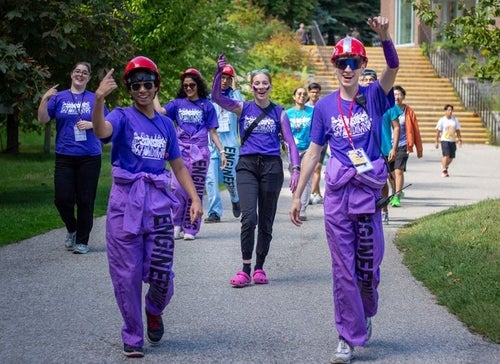
Waterloo Engineering goes far beyond lectures, with a vibrant community that works hard and plays even harder. Sing in an a cappella group, join a varsity or intramural team, compete in design challenges or hackathons, volunteer, or lead a student society! Whatever your interests, you’ll be in good company.
- 96% employment rate within 6 months of graduating, compared to the Ontario average of 89% for Engineering students.
- 90% graduation rate, higher than the Ontario average of 82%.
- 95% retention rate from first to second year.
Student design teams
Have fun and develop hands-on experience through one or more of our 35+ student-led design teams!
Design teams include rocketry, concrete canoe, small airplanes, robotics, solar car, submarine racing, autonomous vehicle, Engineers Without Borders, and more.
Engineering Society (EngSoc)
EngSoc is run by students and provides social and academic events and services to make your experience as a Waterloo Engineering student the best it can be.
Benefit from mentoring for first-year students or meet other students through an annual conference, semi-formal, career fair, charity events, community outreach, and much more!
Women in Engineering
Women in Engineering (WiE) supports women and non-binary engineering students and alumni, while encouraging the next generation to pursue a future career in engineering
Any student is also welcome to join Women in Science, Technology, Engineering, and Mathematics (WiSTEM), a student-run club that promotes equality in STEM through skills workshops, discussions, and guest speakers.
Campus-wide activities
Our campus is packed with opportunities to get involved – no matter how unique your interests.
Between our 200+ student-run clubs, sports and recreation opportunities, student government, and events, student life at Waterloo has something for everyone.
Admission requirements
Ontario students: six Grade 12 U and/or M courses including
- Advanced Functions (minimum final grade of 70% is required)
- Calculus and Vectors (minimum final grade of 70% is required)
- Chemistry (minimum final grade of 70% is required)
- Physics (minimum final grade of 70% is required)
- English (ENG4U) (minimum final grade of 70% is required)
Admission averages: Individual selection from the mid- to high 80s
How to apply?
Apply directly to this program on your application.
There are supplementary information forms, including the Admission Information Form, which are required for admission. We'll email you detailed instructions once we receive your application. An online video interview is required for Faculty of Engineering scholarships and is strongly recommended for admission.
Not studying in Ontario? Search our admission requirements.
Get information about programs, applying, and more!
Subscribe to our monthly newsletter
Get valuable updates and tips sent straight to your inbox!
Learn more
Questions about courses, programs, requirements, or careers?
Please contact the Faculty of Engineering which can answer any questions you have.
You can also learn more about Nanotechnology Engineering by viewing our brochure in English, French or Chinese.