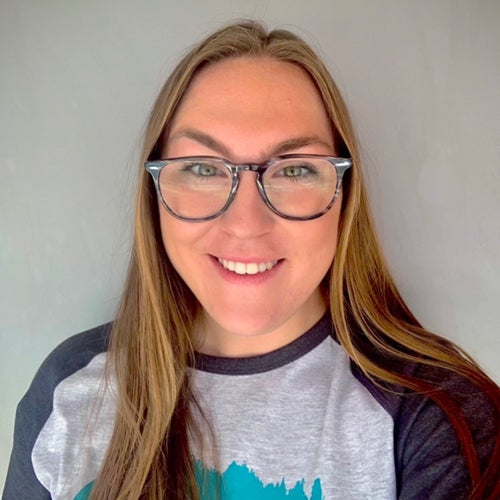
Curling, connection and community
For Paige Martin (BA ’24), recreation is a tool to fight loneliness and build inclusion.
Growing up, Paige Martin watched her mom find comfort and strength through simple, meaningful activities. Even though her mom lived with chronic pain, recreation was always part of her life. She crocheted. She loved to read. She followed curling on television. And she made space for hobbies even on difficult days.
“I saw how important recreation was for her in coping with life changes and challenges,” Martin says. “It really inspired me to want to bring that into the lives of other people.”
That early influence led Martin to study Therapeutic Recreation as an undergraduate student at the University of Waterloo. She believed leisure activities could offer more than entertainment. They could provide purpose, connection and even healing.
But through her experience in municipal recreation programs, hospital settings and non-profit organizations, Martin began noticing something important: not everyone has the same access to leisure.
Rethinking leisure
Martin saw this reality up close while volunteering with a local non-profit that supports people experiencing homelessness.
“A man came in from outside and said, ‘I can hear the kids having recess at the school down the street. Why don’t we have recess anymore? I think we should go outside and have fun for 10 or 15 minutes,’” she recalls.
For some people, time outside isn’t play. It’s searching for shelter. It’s trying to stay safe. It really made me rethink what leisure means and about who gets to participate.
Flexible MA program opens doors
After completing her undergraduate degree, Martin initially planned to enter the workforce. But conversations with professors and professionals encouraged her to reconsider.
When she learned about Waterloo’s online coursework-based Master of Arts program in Recreation and Leisure Studies (RLS), she saw a way to expand her options.
“The coursework program really inspired me to continue with school,” she says. “It broadens what I can do beyond therapeutic recreation and opens doors to non-profit work, municipal recreation and other areas.”
Although she never saw herself as a researcher, Martin appreciated that students can choose to gain research experience through REC 695: Selected Topics in RLS.
That option led to an unexpected opportunity.
During her undergraduate studies, Martin took a course on leisure and community with Dr. Heather Mair, a professor in RLS and chair of the department. Mair shared her research on curling and community development, which reminded Martin of her mom’s love for the sport.
After class, Martin spoke with Mair about her mom and their shared connection to curling. Over time, Mair invited Martin to join her research project with local curling clubs.
“I couldn’t really say no,” Martin says with a smile. “I know my mom would be really happy to hear that I was doing that.”
Strengthening sport’s social component
Through the Growing Community Sport project, Martin participates in club leagues and events and conducts interviews and surveys. Her work examines how welcoming the club feels, who joins, who stays — and what might be preventing others from participating.
One key finding relates to curling’s traditional social culture. Historically, post-game socializing often centred on alcohol, which can be a barrier for many people due to personal, cultural or health reasons. Martin encouraged the club to focus instead on connection by encouraging participants to stay after the game to talk about their experience over a beverage of their choice.
The impact of this suggestion has been significant. After one open house using this new approach, 47 people signed up for the program. Twenty-seven of those new registrants had participated in the open house and seven more were introduced to the program by those participants.
“It’s really cool to see their excitement,” Martin says. “This shows how powerful the social side of sport can be.”
We’re in an epidemic of loneliness. Sport and recreation can be about much more than physical activity. They’re a way to build connection and community.

Opening the door to opportunity
Martin’s own experience in the MA program reflects that sense of belonging. She values the relationships she has built with classmates and faculty.
“They’ve pushed me outside of my comfort zone,” she says. “They’ve encouraged me to learn, unlearn, and change my perspective.”
Martin also shares her Waterloo journey with her husband, Devon. The couple have been together since high school, and both completed undergraduate degrees in RLS. Although Devon was scheduled to graduate a term earlier, he delayed his convocation so they could cross the stage together in fall 2025.
“It was really special to do it together,” Martin says. “Our professors were cheering us on, and our families got to witness that moment.”
Looking ahead, Martin is focused on staying open to new opportunities.
“I didn’t know graduate studies would lead me to all these opportunities,” she says. “Saying yes to pursuing a master’s degree was the hardest part. After that, it got easier.”
For Martin, recreation remains what it was in her childhood: a source of comfort, connection and possibility. Now, she’s working to make sure more people get to experience that same sense of belonging.