News

Filter by:

Limit to news where the title matches:
Limit to items where the date of the news item:
Date range
Limit to news items tagged with one or more of:
Limit to news items where the audience is one or more of:

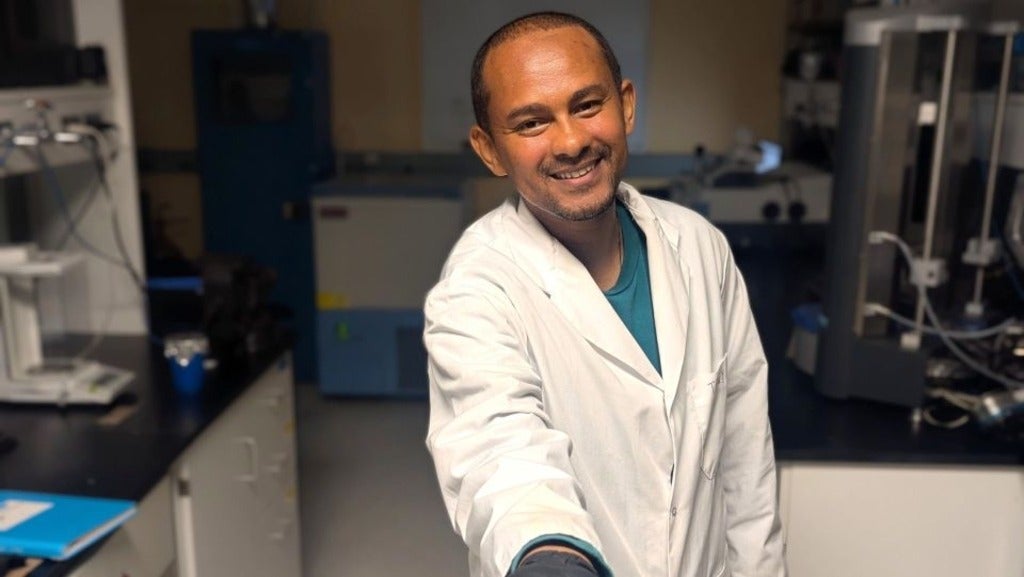
A University of Waterloo professor has received $100,000 from the Scotiabank Climate Action Research Fund to advance bacteria-powered technology that turns mixed waste streams into low-carbon products. 

Dr. Christian Euler from the Department of Chemical Engineering is investigating how landfill gas by-products and other waste materials can be transformed into valuable bioplastics at industrial scale.

Graduate students swept the top three spots in this year’s Waterloo Engineering contest to recognize striking photographs taken during academic research.

The first-place prize of $1,000 went to chemical engineering student Estatira Amirieh for a forest-like image that emerged from a laboratory bench, not nature. Its delicate structures were created through electrospinning, a process in which a liquid polymer solution is pulled by electric fields into ultra-thin threads that solidify as they travel through the air.

A student design team shared new insights on microgravity soldering at the International Astronautical Congress (IAC), presenting one of the first student-led investigations into improving electronic repair and manufacturing in space.

Building on a Waterloo-developed experiment that flew in Canada’s national microgravity research competition, the Waterloo Space Soldering Team (WSST) reported new findings on how rotational acceleration can strengthen solder joints formed in reduced gravity.

A Waterloo Engineering research team earned major international recognition for advancing multimodal approaches to continuous sign language understanding.

Electrical and Computer Engineering master’s student Md Rezwanul Haque and alumnus S. M. Taslim Uddin Raju (MASc ’25, Electrical and Computer Engineering) earned recognition at the IEEE/CVF International Conference on Computer Vision 2025 for a paper supervised by Dr. Fakhri Karray. 

A startup company founded by two Waterloo Engineering graduates has secured US $1.5 million in funding to help speed the development and adoption of its self-cleaning technology to make solar panels more efficient.

Swish Solar is based in Kitchener and has acquired customers in multiple countries in North America and the Middle East since it was launched last year by Miswar Syed and Amirhossein Boreiri (both MASc ’24, electrical and computer engineering).

A research team led by Waterloo Engineering professors received $2 million in new federal funding to safeguard Canada’s critical cybersecurity infrastructure by identifying and countering threats that could emerge through the supply chain.

Led by Dr. Sebastian Fischmeister, an electrical and computer engineering professor, and Dr. Michael Mayer, a professor in mechanical and mechatronics engineering, the Materials-based Cybersecurity in Electronics (MATSEC) project brings together a collaborative team of Waterloo Engineering researchers.
 

Five professors from Waterloo Engineering were named among the most influential researchers worldwide for their citation impact, according to the 2025 Highly Cited Researchers list from Clarivate.

The recognition highlights global research leaders whose work continues to advance knowledge and drive innovation across disciplines.

The University of Waterloo’s Faculty of Engineering proudly unveiled its new welding lab in the Department of Mechanical and Mechatronics Engineering (MME).  

The state-of-the-art facility expands the Faculty’s capacity to deliver industry-relevant, experiential learning. The department’s leadership established the lab with internal investment and funds from the CWB Welding Foundation, a national charity established in 2013 by the Canadian Welding Bureau (CWB) and a longstanding supporter of Waterloo Engineering. 

University of Waterloo students from all six faculties put their problem-solving skills to the test in a hackathon delivered in partnership by the UN-Habitat's Quality of Life Initiative and the University’s Pearl Sullivan Engineering Ideas Clinic.  

The event, designed to engage university students as strategic partners in community transformation, challenged the 70 participants to solve pressing local problems that affect urban wellbeing in the City of Waterloo. 

Waterloo Engineering researchers have upped the evolving game of automated hockey analysis with new advances to follow the puck and track player movement with more accuracy than ever before.

In two recent studies, the researchers developed artificial intelligence (AI) software to overcome challenges posed by motion blurring and obstructed views in broadcast video of the fast-paced sport.