Section 85 of the regulations for industrial establishments under the Occupational Health and Safety Act state:
85. Where a worker is exposed to the hazard of falling and the surface to which he or she might fall is more than three metres below the position where he or she is situated,
- The worker shall wear a serviceable safety belt or harness and lifeline adequately secured to a fixed support and so arranged that the worker cannot fall freely for a vertical distance of more than 1.5 metres; and
- The fall arresting system described in clause (1) shall,
- Have sufficient capacity to absorb twice the energy and twice the load that under the circumstances of its use may be transmitted to it, and
- Be equipped with a shock absorber or other devices to limit the maximum arresting force to a 8.0 kilonewtons to the wearer. R.R.O. 1990, Reg 851, s.85.
Equipment standards
- CSA Z259.11-M92 shock absorbers for personal fall arrest systems
- CSA-Z259.10-M90 full body harnesses
When to wear fall arrest
When working above 3 meters ( 10 ft.)
-
Roof
-
Aerial truck
-
Erecting scaffolding
Inspection of fall arrest system
Inspecting the components of your fall arrest equipment at the start of each shift is necessary to ensure that the system will provide the necessary protection. The list below covers the inspection points.
Full body harness
Buckle
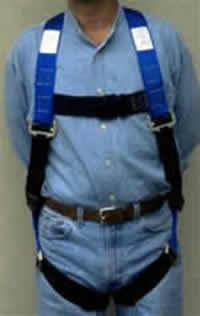
Check that buckle tongue overlaps buckle frame and moves freely. Buckle tongue must not be bent out of shape or worn down.
Inspect roller. It should turn freely on buckle frame. Check for distortion and sharp edges
D- Ring
Inspect for cracks, breaks, and sharp or rough edges.
Ensure that fasteners are not cracked, burned, or cutting into the belt or harness. A damaged fastener can fail under stress.
Webbing
Look for cuts, fraying, or other damage.
During welding or cutting, check for burns from welding splatter and cutting sparks.
Inspect tongue area of belt or harness. Buckling and unbuckling can cause normal wear and tear. Ensure that grommets are not loose, broken, or misshapen.
Check for worn, cut, or frayed fibres where buckle attaches to belt or harness.
Types
- Group A - Fall arresting
- Group D - Controlled descent
- Group E - Confined entry and exit (raising and lowering)
- Group L - Ladder climbing
- Group P - Work positioning
Shock Absorbing Lanyard
Check webbing material for wear, tear, and fraying.
If absorber is made with tear-away stitching designed to gradually absorb fall-arrest load, check to make sure that stitching is intact.
Snaphook
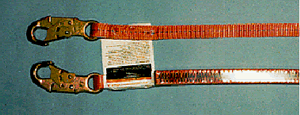
Check that keeper (latch) seats into bill without binding. It should not be bent or wobbly.
Ensure that spring has enough tension to close keeper securely. Examine for bent, cracked, or broken fasteners.
Check that the locking device is working properly.
Lifeline
Vertical lifelines should be at least 16mm-diameter polypropylene or other

Inspect lifelines from end to end before installing them.
Check for wear, abrasion, cuts, and burns. On polypropylene lifelines, check for deterioration from the sun's ultraviolet light.
Rope grab

Check for corrosion, distortion, and secure mounting. Make sure that cams show no signs of having been subjected to a fall-arrest load.
Lifeline anchorage
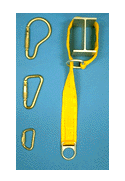
Check that lifelines are securely attached to anchors before using the system.
Make sure that, wherever possible, only one lifeline is attached to each anchor.