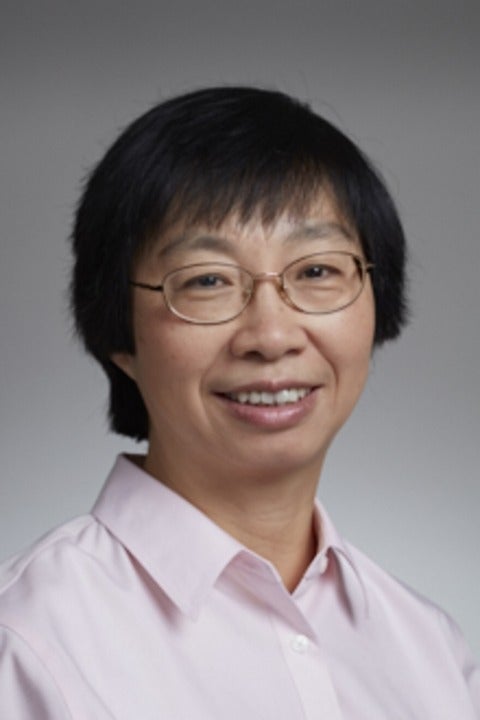
Frank Gu's research contributions honoured by RSC
Frank Gu, a Waterloo chemical engineering professor, is part of the 2017 cohort of the Royal Society of Canada's (RSC) prestigious College of New Scholars, Artists and Scientists.
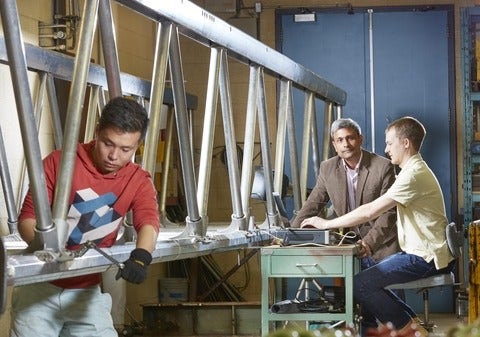
Researchers at Waterloo Engineering have developed computer software to detect when drivers are dangerously distracted by texting or other physical activities while they are behind the wheel.
Combining cameras and artificial intelligence, the system could be used to improve safety by alerting drivers to pay attention or trigger even more decisive action as advanced self-driving features are added to vehicles.

More than 63 researchers at Waterloo Engineering are receiving funding from the Natural Sciences and Engineering Research Council of Canada (NSERC) to help them continue making discoveries that improve the quality of life of Canadians.
Over $8.6 million for Waterloo Engineering research was announced by NSERC today at the University of Victoria.
A medical startup founded by three Waterloo Engineering researchers has been named one of the 20 most innovative technology companies for 2017 by the Canadian Innovation Exchange (CIX).
Elucid Labs, which uses artificial intelligence (AI) technology in a small imaging device for the early detection of skin cancer, grew out of research by Farnoud Kazemzadeh for his PhD at Waterloo.
Drinking water can be tested for E. coli bacteria in three hours or less with simple, inexpensive paper strips developed by researchers at Waterloo Engineering.
Sushanta Mitra, a mechanical and mechatronics engineering professor, is working with colleagues at startup Glacierclean Technologies Inc. to refine the invention and hopes to have a product costing just 50 cents a test on the market within nine months.
A Capstone Design invention created to produce clean drinking water in developing countries and a patch that delivers allergy medication to children co-developed by an engineering student are among the top winners in this year’s Canadian James Dyson Awards competition.
The two Waterloo projects are among the four runners-up of the competition’s national round, in which a team from the University of Toronto took first place.
Weihua Zhuang of Waterloo's electrical and computer engineering department is a new fellow of the prestigious Royal Society of Canada's (RSC) Academy of Science.
A groundwater festival for children, an environmental group and an AIDS-ravaged country in Africa are all benefiting from a University of Waterloo student team with a mission to do good.
A chapter of Blueprint, which began at the University of California, Berkeley in 2012, was co-founded by Waterloo Engineering student Luisa San Martin a year ago to create technology such as websites and mobile applications for non-profit organizations.
Two incoming Waterloo Engineering students are among four campus-wide winners of prestigious Schulich Leader Scholarships for high school graduates pursuing studies in science, technology, engineering and mathematics.
Mickey Dang of Mississauga in systems design engineering and Emma Lozhkin of Toronto in computer engineering will each receive $100,000 towards their educations. Across the country, there were more than 1,300 nominees for a total of 50 scholarships.
Machine-learning software developed by Waterloo Engineering researchers could soon enable earlier detection of melanoma, the deadliest form of skin cancer.
The new artificial intelligence tool, a project that involved collaboration with the Sunnybrook Research Institute in Toronto, adds objective data to the visual assessments of skin lesions now done by dermatologists.