Bringing Peace and Justice Issues to the Podium
“According to the National Centre for Truth and Reconciliation, ‘thousands of students suffered physical and sexual abuse at residential schools. All suffered from loneliness and a longing to be home with their families.’ Mennonites were directly complicit in and responsible for the running of a number of these schools.” Sophia Kauffman shared these words with a predominantly American audience at Peace Talks in September.
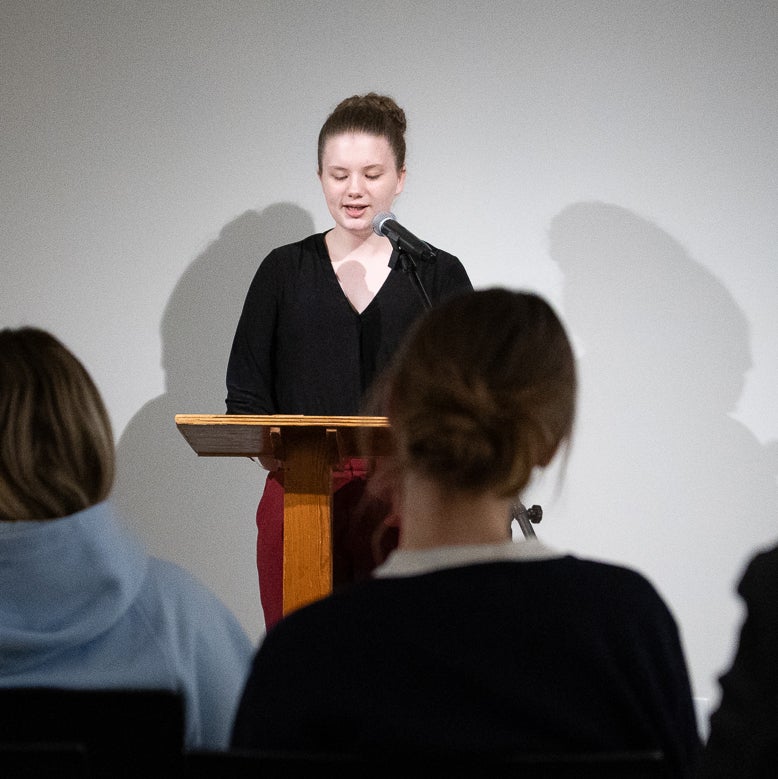
As a second-year Peace and Conflict Studies and Political Science student at Conrad Grebel University College and the University of Waterloo, she has been learning more about Canadian Indigenous people and cultures, and wrestling with her own ingrained assumptions. “I titled this speech ‘Sitting with Our Shame’ because I believe that this is exactly what we as a church need to do. The first step is to find the shame,” she said in her speech. “Once we find that place, we then have to do the even harder thing. We have to sit there, sit with the shame and guilt of what we’ve done. Listen to the stories of those we have hurt. Realize that our church has so, so far to go in our work towards reconciliation. And then, even harder, we have to act.”
In the spring, Sophia won second place in Grebel’s C. Henry Smith Peace Oratorical Contest, with this speech “Sitting with Our Shame: Facing the History of Mennonite Residential Schools.” Organized by Mennonite Central Committee, the contest invites students at Anabaptist colleges and universities to explore how their Christian convictions about peace apply to contemporary issues and to present their arguments to an audience.
Traditionally, each school has held its own in-person contest, and the winners submitted videos for an international final round of judging. This year, with support from the Lilly Endowment, Goshen College in Indiana launched Peace Talks, inviting students from participating C. Henry Smith Peace Oratorical institutions to a weekend of networking, coaching, conversation, and a final public speaking competition.
Sophia was chosen as Grebel’s representative because of the strength of her speech in the spring. “I was excited about the opportunity to meet students from other universities and colleges,” said Sophia. “I really enjoyed meeting the other competitors.”
“I think that the speeches given by the other contestants increased my awareness on a number of important issues, which I look forward to integrating into my courses,” noted Sophia, as she reflected on the experience.
"We are delighted that Sophia was able to take her peace speech to the next level and participate in the competition at Goshen,” said Professor Nathan Funk, Chair of Peace and Conflict Studies at Grebel. “There are many worthwhile pursuits in which a university student can participate, including competitions that challenge a person to produce one's best work,” he explained. “The Peace Talks competition at Goshen presents a unique opportunity — not just to think deeply about one's underlying values and commitments, but also to give skilful, persuasive expression to them in relation to a contemporary peace and justice issue.”
"It's easy to hold opinions and research a social justice issue. The challenge of Peace Talks, though, is to think things through carefully — to explore one's concerns in the light of deeper values, and to connect with an audience in a way that is memorable or inspiring,” Nathan added, asking, “What do our deeper convictions mean for us today, and how can we hold ourselves accountable to them?”
Group photo by Peter Ringenberg/Goshen College
Contestants, from left: Preston Vicenzi, Sophia Kauffman, Caoimhe Farrell, Katherine Brown, Mateo Gonzalez.