Christianity and Queerness
How do you create a safe, welcoming space that includes unsafe opinions? How can I have productive conversations on this issue? What does the original Hebrew in Genesis say about gender? These questions, and so many more, prompted thoughtful discussion at Conrad Grebel University College in mid-March.
The Theological Studies Department, along with Grebel’s Chapel Committee, hosted a panel discussion this March on Christian faith and 2SLGBTQ+ identity: “Christianity and Queerness.” Panelists included Religious Studies and Theological Studies Professor Derek Suderman (BA 1996, MTS 2000), Religious Studies student Jay McDonald-Lee, Mennonite Pastor Peter Haresnape (MTS 2025), and Leah Harder (BA 2009), a leader with In This Together, an LGBTQ+ Anabaptist network. The event marked PIE Day (Public, Intentional, and Explicit) also known as National Affirming Day, which was co-founded by Affirm United and Affirming Connections to celebrate the full inclusion of 2SLGBTQIA+ people in faith communities and beyond.
“I think conversations about Christianity and queerness have always been important,” explained Jay. “Right now, many churches are in the middle of or have had hard conversations and transitions; people who have not had to think about or question their stance surrounding queerness before are being asked to. That change can be hard and relieving and complicated.”
“One of the ongoing challenges with discussions of sexuality and the church is that people have often grown up, lived, and worshipped among like-minded folks and may not have encountered a different perspective before,” observed Derek. He noted that a sign of this event’s success was the wide range of questions asked. “I strongly affirm the ‘conservative’ insistence that we need to ‘take the Bible seriously,' as well as the more ‘liberal’ or progressive insistence that different historical and cultural contexts need to be taken into account,” he added. “This kind of event that honors both tendencies and brings people together rather than splitting them apart doesn’t happen enough, as far as I’m concerned.”
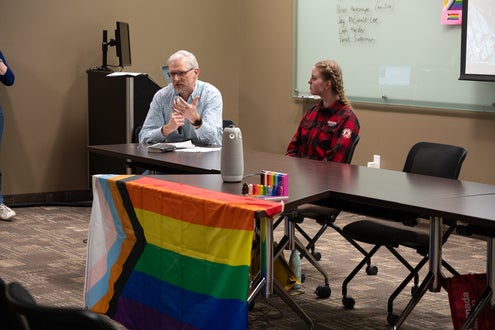
“This event proved that people of all different beliefs and walks of life can come together in one room to discuss a very polarizing topic,” said student Abby Krueger who was in the audience. “As a Christian and an ally, I was amazed that we could all find common ground without judgment,” added Abby. “The panelists did a phenomenal job in answering questions from theological, personal, and communal views. I hope people left with a new way to engage in this topic and some courage to seek more answers.” Director of Student Services Jessie Reesor Rempel moderated the discussion and invited participants to submit anonymous questions, allowing for more open conversation.
“As we seek to live out anti-racism, belonging, inclusion, diversity, and equity at Grebel, it is so important to have spaces like this panel where people can ask honest and challenging questions,” remarked Jessie. “We have many students who identify as 2SLGBTQ+ or as allies, and others for whom the idea that Christianity and queerness can co-exist is new and sometimes uncomfortable. Shared meals are not usually the space to dig into our differing theologies of sexuality, so we need to open other spaces to do this important work.”
“Students have shown me how much pain they've felt in religious spaces when it comes to sexual identity and gender. They have felt rejected and cancelled,” explained Carol Penner, Chaplain and Theological Studies Director. “Events like this help us to foster spaces where queer people can be themselves and feel accepted. It stems from our faith in a God who created us good, and it's also a core value of Grebel as part of our ABIDE commitments.” Grebel’s ABIDE commitment includes embedding principles of equity and inclusion in everything, in order to foster spaces where everyone belongs and feels valued, empowered, represented, and safe.
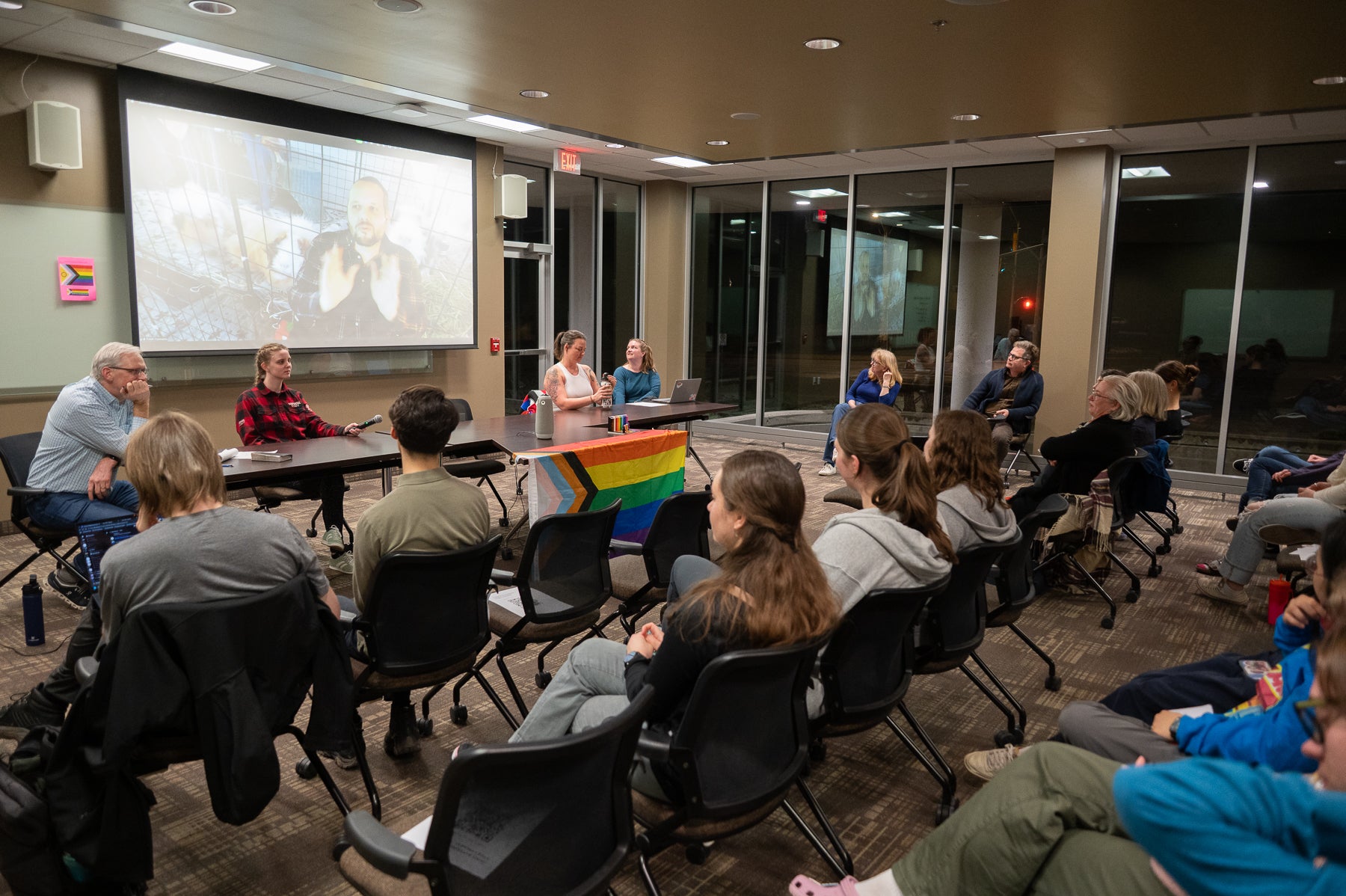
“Grebel is a very unique place in that we uphold strong Anabaptist values while being an affirming and inclusive space,” described Abby. “These conversations matter because university is a place for people to learn who they are. Sexuality and queerness are a part of that journey for many students at Grebel. It is important to be able to address these issues and understand where people are coming from with grace and love.”
“When some churches are publicly, intentionally and explicitly rejecting queer people through their preaching, actions, and websites, it isn't supportive to be silently and privately affirming,” attested Carol. “We need to show our support in concrete ways.”
“It felt really powerful to be in a space with other people who are both queer and Christian when so often it can feel as if I am the only person occupying that intersection in most of the spaces I enter,” added Jay. “Some of the thanks I received afterwards are words I will keep close to my heart for a long time.”
“At Grebel, we want to be a welcoming place for 2SLGBTQ+ students and while we have come a long way, we recognize that there is more to do,” summarized Jessie. “Being clear about our welcoming stance through events like this panel is an important next step.”
“I hope people walked away from the discussion with something on their mind. I hope something I said was able to resonate with and challenge those who came,” reflected Jay. “My hope is always that my queerness will be celebrated and respected in all of the spaces I enter. I hope this conversation and my words made that more possible.”