The Making of a Mennonite Literary Movement
The Mennonite Archives of Ontario at Conrad Grebel University College has acquired an extraordinary collection of materials about many of the most influential figures in Mennonite literature and art, including Canadians Rudy Wiebe, David Bergen, Di Brandt, Patrick Friesen, and Americans Woldemar Neufeld, Dallas Wiebe, Julia Kasdorf, and Jeff Gundy. Amassed by Dr. Hildi Froese Tiessen over four decades and now donated to the Archives, these manuscripts, correspondence, interviews, photographs, voice recordings, and related materials reveal the origins and growth of Mennonite writing and artistic expression in the twentieth century.
One of the foremost scholars of Mennonite literature, Hildi has held a central role in the development of the Mennonite literary movement. As Professor Emerita of English and Peace and Conflict Studies at Grebel, Hildi championed established and emerging Mennonite writers through author readings, conferences, edited publications, and her own scholarship, including Liars and Rascals (1989), a landmark anthology of short fiction by Mennonite authors, Acts of Concealment (1992), an early collection about Mennonite/s writing in Canada, 11 Encounters with Mennonite Fiction (2017), and On Mennonite/s Writing (2023), a selection of essays spanning over fifty years of research and writing in the field.
Hildi’s interest in Mennonite literature began early in her academic career. “During my growing-up years in Winnipeg I became conscious of the fact that a Mennonite minority community like my own could claim an exciting place in the Canadian cultural landscape,” she recalled. She described a particularly eye-opening moment when “the Mennonite Mirror, a magazine celebrating diverse elements of Mennonite culture, appeared alongside early chapbooks by poets who had the temerity to question (or not) the dogmas and power dynamics of their Mennonite communities.” As a graduate student at the University of Alberta, long before Mennonite literature became “a thing,” Hildi wrote a paper on Rudy Wiebe for a Canadian Literature course. “There was much to draw me to Mennonite writers from the beginning, not least the fact that a particular way of being that was so familiar to me should be considered worthy of exploration in literature.”
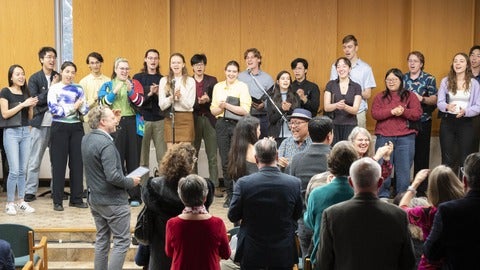
Mennonite/s Writing began to take shape as a literary phenomenon in 1990, when Hildi and the New Quarterly hosted the first of ten international conferences on this topic. Subsequent conferences continue to explore Mennonite contributions to literature and the arts. “Mennonites, although a highly literate people, have, for the most part, eschewed the arts – both literature and visual art – as worldly, frivolous, and dishonest,” Hildi said. “But some writers and artists who identified as Mennonite began, during the twentieth century, to demand the right to express themselves through the arts. Many have since become successful artists/writers, recognized nationally and internationally.”
“I hosted approximately a hundred readings and lectures from the early-1980s until as recently as this year,” Hildi added. “Writers would tend to read from their work, and discuss it, both in my classes and for much larger audiences on campus, at conferences, and beyond.” Materials collected from these conferences, readings, and lectures – including full recordings – are among the more than 80 boxes of material Hildi has donated to the Mennonite Archives of Ontario.
The product of decades of collecting, preserving, and carving space for other people’s work, Hildi’s carefully curated donation includes periodicals and anthologies, annotated essays, grant and conference materials, notebooks, articles, clippings, and other original and unique archival records. Her extensive inventory notes include descriptions of the contents of each box, offering backstories, thoughtful reflections, candid opinions, evidence of painstaking planning, fascinating comparisons, and constructive criticism. Hildi noted that "Among the emails preserved here are little gems, like the 2016 casual note from Rudy Wiebe where he attaches a snapshot of himself with Miriam Toews in Germany in 2008." Another note includes a post-conference commentary from Di Brandt on a debate within Mennonite communities about why writers who left the church often seemed to receive more attention than those who stayed. Another treasure is Hildi's SSHRC-funded interview project where she recorded lengthy conversations with 28 Mennonite writers about their families, communities, and experiences growing up Mennonite.
“Over a forty-year period, Hildi documented Mennonite activities in literature and the arts, particularly Mennonite writers and writing in Canada,” summarized Laureen Harder-Gissing, Archivist-Librarian at Grebel. “This period dovetails with the emergence and flourishing of a Mennonite literary movement. Hildi played a significant role during this time in developing Mennonite literature into a field of study.”
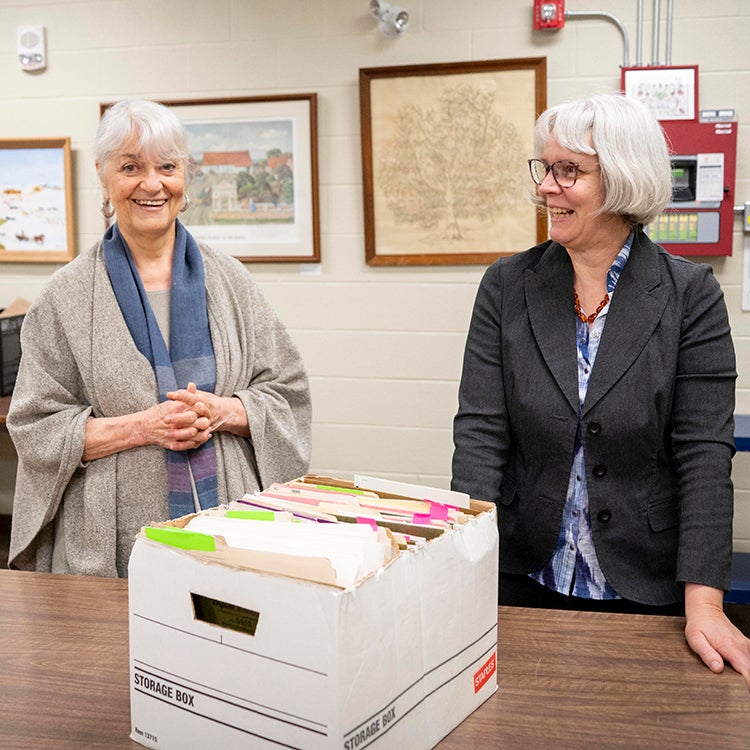
For decades, Hildi collected stories, conversations, debates, and creative work that documented a literary movement in the making. Now, she is giving that history to future researchers. “I didn’t consciously assemble an archive, but I did deliberately hold on to the immense amount of material that came my way,” Hildi reflected. “In the early years, many writers were wary of being trapped in a Mennonite literary ghetto. Now many foreground their roots in the Mennonite community because the literary world in Canada and beyond has taken a committed interest in the work of Mennonite writers. And the writers recognize that they don’t have to leave the community in order to pursue their craft. Mennonite writing has entered a new phase.”
With Mennonite literature firmly established in Canada, and new Canadian literary voices like Casey Plett, Miriam Toews, and Carrie Snyder winning accolades, Hildi’s collection offers future generations a glimpse into how that literary movement began. “Researchers of Mennonite literature, culture, and history will find much to explore here,” Laureen suggested. Due to its size and scope, it will take years for this collection to be made accessible, but “the Mennonite Archives of Ontario is grateful for this valuable addition to our collections and is looking forward to preserving it and eventually making it available for research.”
“Most collections would tend to focus on one writer at a time,” Hildi noted. “This one provides a series of views of a remarkable literary phenomenon where writers and critics are published alongside each other and, in many cases, interact with each other. The collection documents seminal events and offers a range of historical perspectives on the burgeoning of Mennonite writing and art in North America. It offers a portrait – or series of portraits – of a creative community at work.”